Culture
Major languages include Melanesian pidgin (lingua franca in much of the country), English (official but spoken by only 1%-2% of the population), 120 indigenous languages.
CIA 2026
Loading TerraBrawl
Data as of May 28, 2026
Solomon Islands tops Oceania for renewable energy. How does it compare to its neighbors?
Solomon Islands tops Oceania for renewable energy. Neighbors look to it as a regional benchmark. How does it compare to its neighbors?
Area
29K km²
Pop.
738.8K
Stats
102
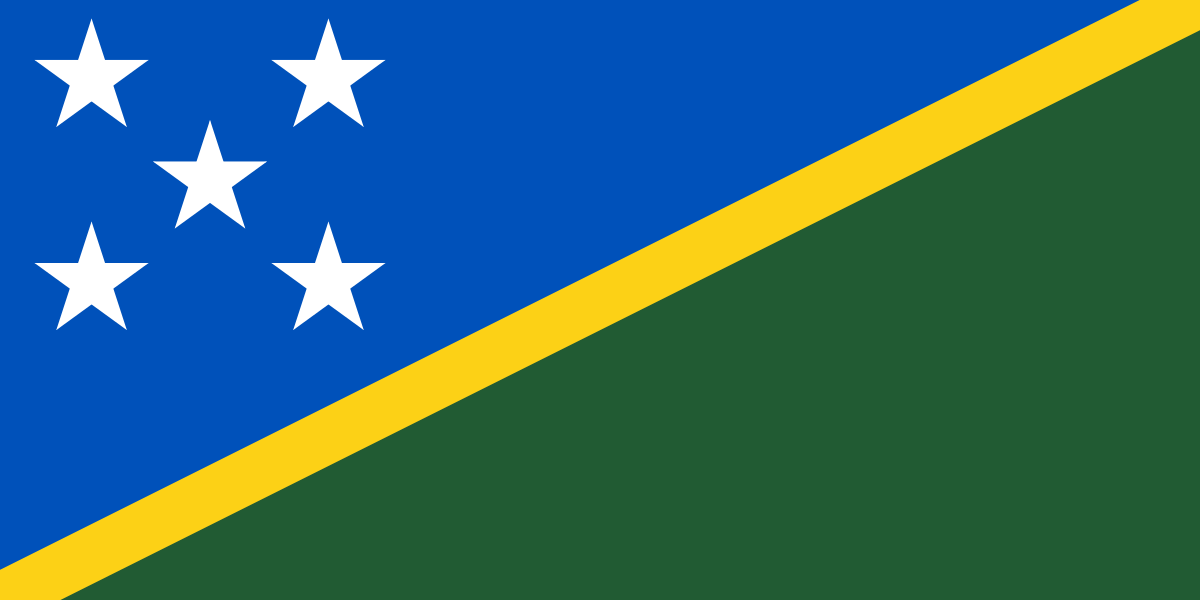
Solomon Islands is a country in Oceania with a population of 738.8K and an area of 28,896 km². Life expectancy is 70.5 years.
Short factual summary generated from the same country data used in game rounds.
Core numbers
Fast scan first, deep dive later.
Land Area
28.0K km²Total land area in square kilometers, excluding lakes, rivers, and territorial waters.
Life Expectancy
70.5 yearsHow many years a newborn can expect to live, based on current mortality rates.
Internet Users (%)
43%The percentage of people who have used the internet in the last 3 months.
Human Development Index
0.58Composite 0-1 index of life expectancy, education, and income, from Our World in Data using the latest available country values in TerraBrawl.
Country briefing
A quick real-world briefing before you dive deeper into rankings, surprises, and matchups.
Culture
Major languages include Melanesian pidgin (lingua franca in much of the country), English (official but spoken by only 1%-2% of the population), 120 indigenous languages.
Economy
Key industries include fish (tuna), mining, timber.
Context
Settlers from Papua arrived on the Solomon Islands around 30,000 years ago.
Cities
Browse this country's cities before City Detective asks you to guess.
Top stats
The strongest source-backed stats before the deeper data table.
Forest Coverage (%)
90.06%The percentage of land covered by forests - natural or planted trees at least 5 meters tall (excludes orchards and urban parks).
Education Spending (% GDP)
8.3% of GDPGovernment education spending as a share of GDP, from World Bank Open Data.
Smoking Rate
36.9%The percentage of people aged 15 and older who use tobacco products.
Coastline Length
5.3K kmTotal coastline length from CIA World Factbook.
Broadband Access (%)
202 per 100 peopleFixed broadband subscriptions per 100 people, from World Bank Open Data.
Reality checks
The stats that tend to surprise players in real rounds.
Only ranks #131 in tourist arrivals
How many international tourists visit the country each year.
Keeps youth unemployment rate unusually low
Share of the labor force ages 15-24 that is unemployed from the World Bank latest available country value.
Only ranks #206 in irrigated land
Irrigated land area from CIA World Factbook.
Has one of the highest suicide rate figures
Suicide mortality rate per 100,000 people, from World Bank Open Data.
Keeps unemployment rate unusually low
The percentage of the workforce that is unemployed but actively looking for work.
Compared with the region
Country vs continent vs world averages
GDP per person, adjusted for purchasing power parity (PPP) so costs of living are comparable across countries.
How many years a newborn can expect to live, based on current mortality rates.
Composite 0-1 index of life expectancy, education, and income, from Our World in Data using the latest available country values in TerraBrawl.
The percentage of people who have used the internet in the last 3 months.
Think you can guess which countries rank higher?
Play this countryFactbook notes
Country briefing
Settlers from Papua arrived on the Solomon Islands around 30,000 years ago.
Settlers from Papua arrived on the Solomon Islands around 30,000 years ago. About 6,000 years ago, Austronesian settlers came to the islands, and the two groups mixed extensively. Despite significant inter-island trade, no attempts were made to unite the islands into a single political entity. In 1568, a Spanish explorer became the first European to spot the islands. After a failed Spanish attempt at creating a permanent European settlement in the late 1500s, the Solomon Islands remained free of European contact until a British explorer arrived in 1767. European explorers and US and British whaling ships regularly visited the islands into the 1800s.
Germany declared a protectorate over the northern Solomon Islands in 1885, and the UK established a protectorate over the southern islands in 1893. In 1899, Germany transferred its islands to the UK in exchange for the UK relinquishing all claims in Samoa. In 1942, Japan invaded the islands, and the Guadalcanal Campaign (August 1942-February 1943) proved a turning point in the Pacific theater of WWII. The fighting destroyed large parts of the Solomon Islands, and a nationalist movement emerged near the end of the war. By 1960, the British allowed some local autonomy. The islands were granted self-government in 1976 and independence two years later under Prime Minister Sir Peter KENILOREA.
In 1999, longstanding tensions between ethnic Guale in Honiara and ethnic Malaitans in Honiara’s suburbs erupted in civil war, leading thousands of Malaitans to take refuge in Honiara and prompting Guale to flee the city. In 2000, newly elected Prime Minister Manasseh SOGAVARE focused on peace agreements and distributing resources equally among groups, but his actions bankrupted the government in 2001 and led to his ouster. In 2003, the Solomon Islands requested international assistance to reestablish law and order; the Australian-led Regional Assistance Mission to the Solomon Islands, which ended in 2017, improved the security situation. In 2006, however, riots broke out in Honiara, and the city’s Chinatown was burned amid allegations that the prime minister took money from China. SOGAVARE was reelected prime minister for a fourth time in 2019. When a small group of protestors, mostly from the island of Malaita, approached parliament to lodge a petition calling for SOGAVARE’s removal and more development in Malaita in 2021, police fired tear gas into the crowd which sparked rioting and looting in Honiara.
Data vault
Every tracked stat, grouped for fast scanning.
Keep exploring
Open the head-to-head pages people naturally search after reading this profile.
Jump straight to the rankings where this country has its strongest edge.
Turn Solomon Islands's strongest number into a challenge card.
Total land area in square kilometers, excluding lakes, rivers, and territorial waters.
Solomon Islands has a population of 738.8K, ranking #165 globally by population.
Solomon Islands is located in Oceania. It has an area of 28,896 km².
Life expectancy in Solomon Islands is 70.5 years, ranking #147 globally.
Solomon Islands's GDP per capita (PPP) is $2,674.89, ranking #187 globally.
Solomon Islands ranks particularly high in Land Area (#141), Life Expectancy (#147), Population (#165).
Solomon Islands has an HDI of 0.584, ranking #156 globally. The HDI combines life expectancy, education, and income indicators.
Solomon Islands has a population density of 28.6 people per km², ranking #173 globally.