Geography
Natural resources include fish, timber, phosphates, bauxite, and more.
CIA 2026
Loading TerraBrawl
Data as of May 28, 2026
With a global ranking of #8, Guinea-Bissau leads in renewable energy. Test your knowledge of this global leader.
With a global ranking of #8, Guinea-Bissau leads in renewable energy. Few places match this level of performance. Test your knowledge of this global leader.
Area
36K km²
Pop.
2.13M
Stats
108
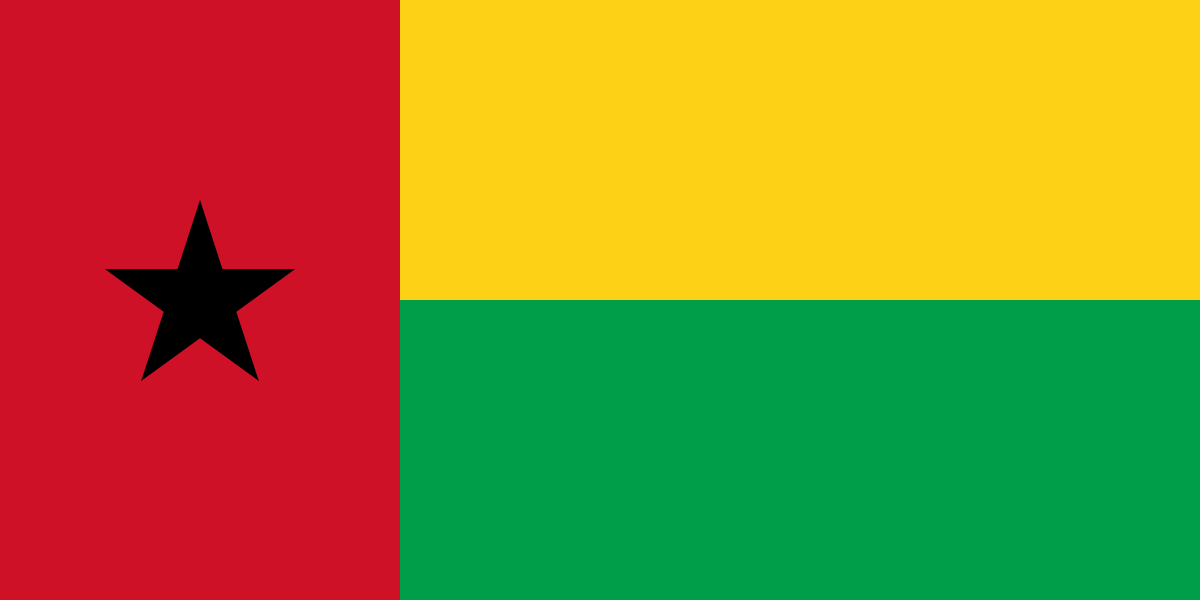
Guinea-Bissau is a country in Africa with a population of 2.13M and an area of 36,125 km². Life expectancy is 64.1 years.
Short factual summary generated from the same country data used in game rounds.
Core numbers
Fast scan first, deep dive later.
Population Density
76.58 /km²How many people live in each square kilometer of land.
Land Area
28.1K km²Total land area in square kilometers, excluding lakes, rivers, and territorial waters.
Internet Users (%)
33%The percentage of people who have used the internet in the last 3 months.
Life Expectancy
64.1 yearsHow many years a newborn can expect to live, based on current mortality rates.
Country briefing
A quick real-world briefing before you dive deeper into rankings, surprises, and matchups.
Geography
Natural resources include fish, timber, phosphates, bauxite, and more.
Culture
Major languages include Portuguese-based Creole, Portuguese (official; largely used as a second or third language), Pular (a Fula language), Mandingo.
Identity
Formal name: Republic of Guinea-Bissau.
Cities
Browse this country's cities before City Detective asks you to guess.
Top stats
The strongest source-backed stats before the deeper data table.
Renewable Energy (%)
87.4%The percentage of energy consumption that comes from renewable sources like solar, wind, and hydro.
Broadband Access (%)
202 per 100 peopleFixed broadband subscriptions per 100 people, from World Bank Open Data.
Birth Rate
35.82 per 1kThe number of babies born per 1,000 people each year.
Child Mortality
69.3 per 1k birthsDeaths before age 5 per 1,000 live births, from World Bank Open Data.
Reality checks
The stats that tend to surprise players in real rounds.
Keeps youth unemployment rate unusually low
Share of the labor force ages 15-24 that is unemployed from the World Bank latest available country value.
Only ranks #200 in electric generating capacity
Installed electricity generating capacity in kilowatts from the frozen public-domain CIA World Factbook snapshot.
Ranks #14 globally in fertility rate
The average number of children a woman would have over her lifetime based on current birth rates.
Only ranks #201 in electricity access (%)
The percentage of the population with access to electricity.
Keeps co2 per capita unusually low
Annual carbon dioxide emissions in tonnes per person, from Our World in Data using the latest available country values in TerraBrawl.
Compared with the region
Country vs continent vs world averages
GDP per person, adjusted for purchasing power parity (PPP) so costs of living are comparable across countries.
How many years a newborn can expect to live, based on current mortality rates.
Composite 0-1 index of life expectancy, education, and income, from Our World in Data using the latest available country values in TerraBrawl.
The percentage of people who have used the internet in the last 3 months.
Think you can guess which countries rank higher?
Play this countryFactbook notes
Country briefing
For much of its history, Guinea-Bissau was under the control of the Mali Empire and the Kaabu Kingdom.
For much of its history, Guinea-Bissau was under the control of the Mali Empire and the Kaabu Kingdom. In the 16th century, Portugal began establishing trading posts along Guinea-Bissau’s shoreline. Initially, the Portuguese were restricted to the coastline and islands. However, the slave and gold trades were lucrative to local African leaders, and the Portuguese were slowly able to expand their power and influence inland. Starting in the 18th century, the Mali Empire and Kingdom of Kaabu slowly disintegrated into smaller local entities. By the 19th century, Portugal had fully incorporated Guinea-Bissau into its empire.
Since gaining independence in 1974, Guinea-Bissau has experienced considerable political and military upheaval. In 1980, a military coup established General Joao Bernardo 'Nino' VIEIRA as president. VIEIRA's regime suppressed political opposition and purged political rivals. Several coup attempts through the 1980s and early 1990s failed to unseat him, but a military mutiny and civil war in 1999 led to VIEIRA's ouster. In 2000, a transitional government turned over power to opposition leader Kumba YALA. In 2003, a bloodless military coup overthrew YALA and installed businessman Henrique ROSA as interim president. In 2005, VIEIRA was reelected, pledging to pursue economic development and national reconciliation; he was assassinated in 2009. Malam Bacai SANHA was then elected president, but he passed away in 2012 from a long-term illness. A military coup blocked the second round of the election to replace him, but after mediation from the Economic Community of Western African States, a civilian transitional government assumed power. In 2014, Jose Mario VAZ was elected president in a free and fair election, and in 2019, he became the first president in Guinea-Bissau’s history to complete a full term. Umaro Sissoco EMBALO was elected president in 2019, but he did not take office until 2020 because of a prolonged challenge to the election results.
Data vault
Every tracked stat, grouped for fast scanning.
Keep exploring
Open the head-to-head pages people naturally search after reading this profile.
Jump straight to the rankings where this country has its strongest edge.
Turn Guinea-Bissau's strongest number into a challenge card.
How many people live in each square kilometer of land.
Guinea-Bissau has a population of 2.13M, ranking #149 globally by population.
Guinea-Bissau is located in Africa. It has an area of 36,125 km².
Life expectancy in Guinea-Bissau is 64.1 years, ranking #191 globally.
Guinea-Bissau's GDP per capita (PPP) is $3,119.37, ranking #183 globally.
Guinea-Bissau ranks particularly high in Population Density (#127), Population (#149), Land Area (#139).
Guinea-Bissau has an HDI of 0.514, ranking #174 globally. The HDI combines life expectancy, education, and income indicators.
Guinea-Bissau has a population density of 76.6 people per km², ranking #127 globally.