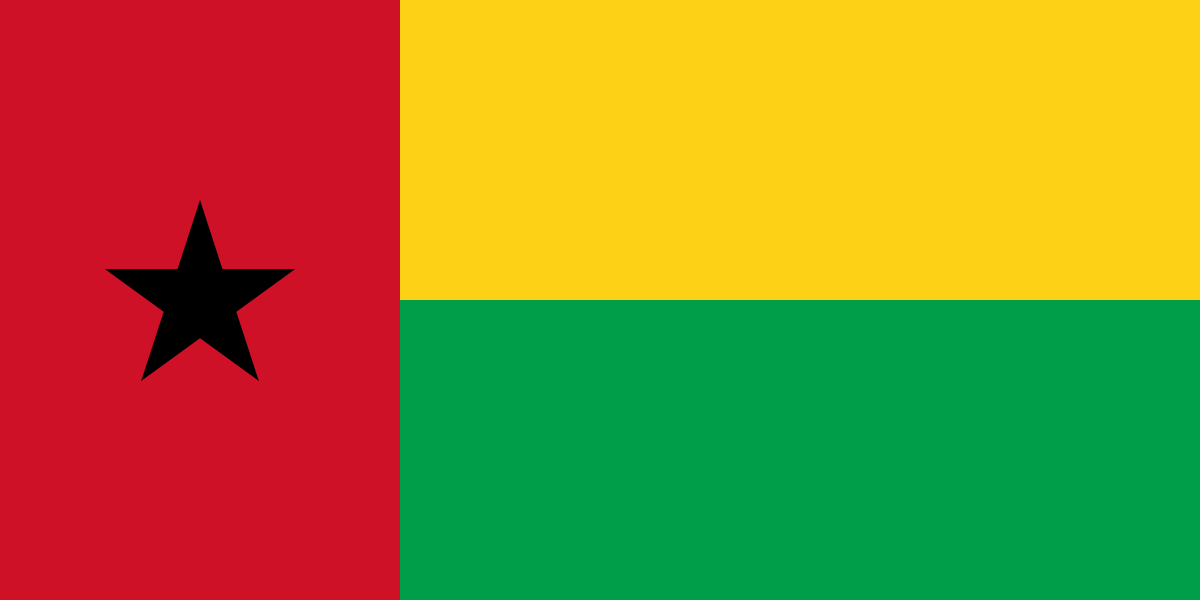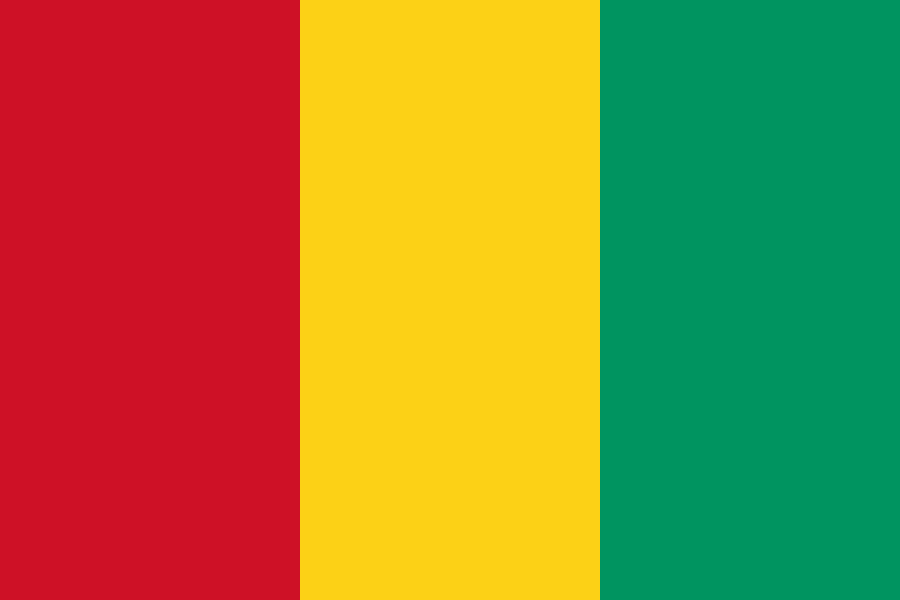
Identity
Name origin: the country is named after the Guinea region of West Africa that lies along the Gulf of Guinea, but the name itself derives from the Tuareg word aginaw, mea…
CIA 2026
Loading TerraBrawl
Data as of May 28, 2026
Guinea ranks high and low in ways you wouldn't predict. Can you guess what else is surprising?
Guinea ranks high and low in ways you wouldn't predict. #13 in fertility rate but near the bottom in life expectancy. Can you guess what else is surprising?
Area
246K km²
Pop.
14.37M
Stats
108
Guinea is a country in Africa with a population of 14.37M and an area of 245,857 km². Life expectancy is 60.7 years.
Short factual summary generated from the same country data used in game rounds.
Core numbers
Fast scan first, deep dive later.
Land Area
245.7K km²Total land area in square kilometers, excluding lakes, rivers, and territorial waters.
Population Density
58.63 /km²How many people live in each square kilometer of land.
GDP Per Capita
$4,028.48GDP per person adjusted for purchasing power in constant 2017 international dollars, from Our World in Data using the latest available country values in TerraBrawl.
GDP Per Capita (PPP)
$4,565.3GDP per person, adjusted for purchasing power parity (PPP) so costs of living are comparable across countries.
CO2 Per Capita
0.27 t/person/yrAnnual carbon dioxide emissions in tonnes per person, from Our World in Data using the latest available country values in TerraBrawl.
Country briefing
A quick real-world briefing before you dive deeper into rankings, surprises, and matchups.
Identity
Name origin: the country is named after the Guinea region of West Africa that lies along the Gulf of Guinea, but the name itself derives from the Tuareg word aginaw, mea…
Geography
Size snapshot: slightly smaller than Oregon.
Culture
Major languages include French (official), Pular, Maninka, Susu, and more.
Cities
Browse this country's cities before City Detective asks you to guess.
Conakry
Guinea
Kankan
Kankan Region, Guinea
Nzérékoré
Nzerekore Region, Guinea
Labé
Labe Region, Guinea
Kindia
Guinea
Boké
Boke Region, Guinea
Siguiri
Kankan Region, Guinea
Macenta
Nzerekore Region, Guinea
Top stats
The strongest source-backed stats before the deeper data table.
Infant Mortality
61.5 per 1k birthsInfant deaths before age 1 per 1,000 live births, from World Bank Open Data.
Child Mortality
95 per 1k birthsDeaths before age 5 per 1,000 live births, from World Bank Open Data.
Teen Birth Rate
118.58 per 1kThe number of births per 1,000 women aged 15-19.
Broadband Access (%)
202 per 100 peopleFixed broadband subscriptions per 100 people, from World Bank Open Data.
Protected Land (%)
37.6%The percentage of land area designated as protected natural reserves or parks.
Reality checks
The stats that tend to surprise players in real rounds.
Only ranks #229 in life expectancy
Average number of years a newborn would be expected to live if current mortality patterns stayed the same, from Our World in Data.
Ranks #13 globally in fertility rate
The average number of children a woman would have over her lifetime based on current birth rates.
Only ranks #177 in merchant fleet size
Number of merchant marine ships from the frozen public-domain CIA World Factbook snapshot.
Ranks #14 globally in birth rate
The number of babies born per 1,000 people each year.
Only ranks #175 in education spending (% gdp)
Government education spending as a share of GDP, from World Bank Open Data.
Compared with the region
Country vs continent vs world averages
GDP per person, adjusted for purchasing power parity (PPP) so costs of living are comparable across countries.
How many years a newborn can expect to live, based on current mortality rates.
Composite 0-1 index of life expectancy, education, and income, from Our World in Data using the latest available country values in TerraBrawl.
The percentage of people who have used the internet in the last 3 months.
Think you can guess which countries rank higher?
Play this countryFactbook notes
Country briefing
Guinea's deep Muslim heritage arrived via the neighboring Almoravid Empire in the 11th century.
Guinea's deep Muslim heritage arrived via the neighboring Almoravid Empire in the 11th century. Following Almoravid decline, Guinea existed on the fringe of several African kingdoms, all competing for regional dominance. In the 13th century, the Mali Empire took control of Guinea and encouraged its already growing Muslim faith. After the fall of the West African empires, various smaller kingdoms controlled Guinea. In the 18th century, Fulani Muslims established an Islamic state in central Guinea that provided one of the earliest examples of a written constitution and alternating leadership. European traders first arrived in the 16th century, and the French secured colonial rule in the 19th century.
In 1958, Guinea achieved independence from France. Sekou TOURE became Guinea’s first post-independence president; he established a dictatorial regime and ruled until his death in 1984, after which General Lansana CONTE staged a coup and seized the government. He too established an authoritarian regime and manipulated presidential elections until his death in 2008, when Captain Moussa Dadis CAMARA led a military coup, seized power, and suspended the constitution. In 2009, CAMARA was wounded in an assassination attempt and was exiled to Burkina Faso. In 2010 and 2013 respectively, the country held its first free and fair presidential and legislative elections. Alpha CONDE won the 2010 and 2015 presidential elections, and his first cabinet was the first all-civilian government in Guinean history. CONDE won a third term in 2020 after a constitutional change to term limits. In 2021, Col Mamady DOUMBOUYA led another successful military coup, establishing the National Committee for Reconciliation and Development (CNRD), suspending the constitution, and dissolving the government and the legislature. DOUMBOUYA was sworn in as transition president and appointed Mohamed BEAVOGUI as transition prime minister. The National Transition Council (CNT), which acts as the legislative body for the transition, was formed in 2022 and consists of appointed members representing a broad swath of Guinean society.
Data vault
Every tracked stat, grouped for fast scanning.
Keep exploring
Open the head-to-head pages people naturally search after reading this profile.
Jump straight to the rankings where this country has its strongest edge.
Turn Guinea's strongest number into a challenge card.
The total number of people living in the country.
Guinea has a population of 14.37M, ranking #76 globally by population.
Guinea is located in Africa. It has an area of 245,857 km².
Life expectancy in Guinea is 60.7 years, ranking #208 globally.
Guinea's GDP per capita (PPP) is $4,565.3, ranking #165 globally.
Guinea ranks particularly high in Population (#76), Land Area (#78), Population Density (#145).
Guinea has an HDI of 0.500, ranking #179 globally. The HDI combines life expectancy, education, and income indicators.
Guinea has a population density of 58.6 people per km², ranking #145 globally.