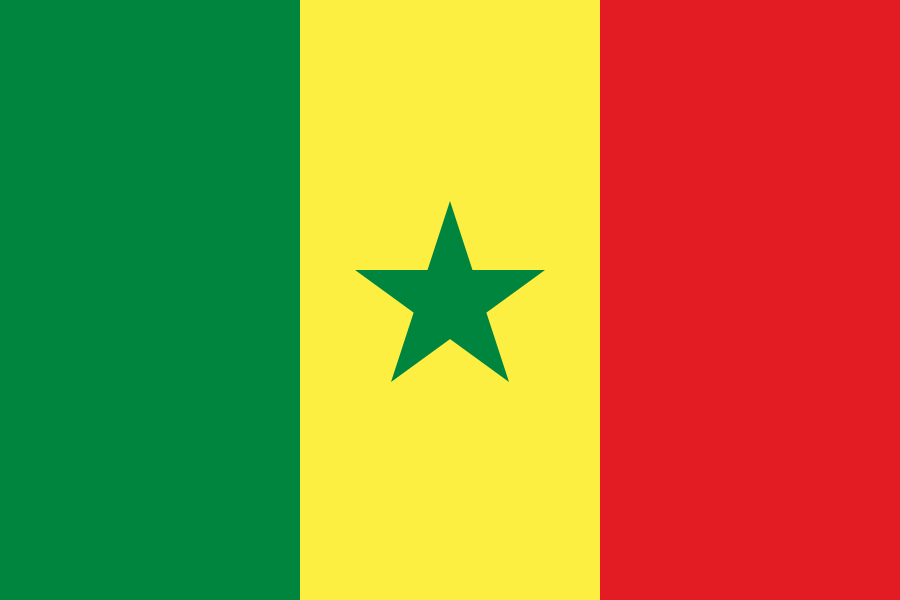
Culture
Major languages include French (official), Wolof, Pulaar, Jola, and more.
CIA 2026
Loading TerraBrawl
Data as of May 28, 2026
The numbers tell two very different stories about Senegal. Think you can explain the gap?
The numbers tell two very different stories about Senegal. Strong at #22 for women in parliament, it stumbles on life expectancy. Think you can explain the gap?
Area
197K km²
Pop.
18.85M
Stats
124
Senegal is a country in Africa with a population of 18.85M and an area of 196,722 km². Life expectancy is 68.7 years.
Short factual summary generated from the same country data used in game rounds.
Core numbers
Fast scan first, deep dive later.
Land Area
192.5K km²Total land area in square kilometers, excluding lakes, rivers, and territorial waters.
Population Density
93.89 /km²How many people live in each square kilometer of land.
Internet Users (%)
61%The percentage of people who have used the internet in the last 3 months.
Life Expectancy
68.7 yearsHow many years a newborn can expect to live, based on current mortality rates.
Country briefing
A quick real-world briefing before you dive deeper into rankings, surprises, and matchups.
Culture
Major languages include French (official), Wolof, Pulaar, Jola, and more.
Identity
Formal name: Republic of Senegal.
Curated stat
Senegal's Cape Verde Peninsula is the westernmost point of mainland Africa.
Cities
Browse this country's cities before City Detective asks you to guess.
Dakar
Senegal
Kaolack
Senegal
Saint-Louis
Senegal
Ziguinchor
Senegal
Thiès
Thies, Senegal
Kolda
Senegal
Louga
Senegal
Tambacounda
Senegal
Top stats
The strongest source-backed stats before the deeper data table.
Air Pollution (PM2.5)
63.74 µg/m³The average level of fine particle air pollution (PM2.5) that people are exposed to.
Fertility Rate
4.0 children/womanThe average number of children a woman would have over her lifetime based on current birth rates.
Women in Parliament (%)
41.21%The percentage of parliament seats held by women.
Education Spending (% GDP)
6.2% of GDPGovernment education spending as a share of GDP, from World Bank Open Data.
Reality checks
The stats that tend to surprise players in real rounds.
Only ranks #238 in highest elevation
Highest point elevation from CIA World Factbook.
Only ranks #157 in smoking rate
The percentage of people aged 15 and older who use tobacco products.
Keeps youth unemployment rate unusually low
Share of the labor force ages 15-24 that is unemployed from the World Bank latest available country value.
Keeps inflation rate unusually low
How much prices increased over the year, based on the cost of everyday goods and services.
Only ranks #197 in broadband access (%)
Fixed broadband subscriptions per 100 people, from World Bank Open Data.
Compared with the region
Country vs continent vs world averages
GDP per person, adjusted for purchasing power parity (PPP) so costs of living are comparable across countries.
How many years a newborn can expect to live, based on current mortality rates.
Composite 0-1 index of life expectancy, education, and income, from Our World in Data using the latest available country values in TerraBrawl.
The percentage of people who have used the internet in the last 3 months.
Think you can guess which countries rank higher?
Play this countryFactbook notes
Country briefing
Senegal is one of the few countries in the world with evidence of continuous human life from the Paleolithic period to present.
Senegal is one of the few countries in the world with evidence of continuous human life from the Paleolithic period to present. Between the 14th and 16th centuries, the Jolof Empire ruled most of Senegal. Starting in the 15th century, Portugal, the Netherlands, France, and Great Britain traded along the Senegalese coast. Senegal’s location on the western tip of Africa made it a favorable base for the European slave trade. European powers used the Senegalese island of Goree as a base to purchase slaves from the warring chiefdoms on the mainland, and at the height of the slave trade in Senegal, over one-third of the Senegalese population was enslaved. In 1815, France abolished slavery and began expanding inland. During the second half of the 19th century, France took possession of Senegal as a French colony. In 1959, the French colonies of Senegal and French Sudan were merged and granted independence in 1960 as the Mali Federation. The union broke up after only a few months. In 1982, Senegal joined with The Gambia to form the nominal confederation of Senegambia. The envisaged integration of the two countries was never implemented, and the union dissolved in 1989.
Since the 1980s, the Movement of Democratic Forces in the Casamance -- a separatist movement based in southern Senegal -- has led a low-level insurgency. Several attempts at reaching a comprehensive peace agreement have failed. Since 2012, despite sporadic incidents of violence, an unofficial cease-fire has remained largely in effect. Senegal is one of the most stable democracies in Africa and has a long history of participating in international peacekeeping and regional mediation. The Socialist Party of Senegal ruled for 40 years until Abdoulaye WADE was elected president in 2000 and re-elected in 2007. WADE amended Senegal's constitution over a dozen times to increase executive power and weaken the opposition. In 2012, WADE’s decision to run for a third presidential term sparked public backlash that led to his loss to current President Macky SALL. A 2016 constitutional referendum limited future presidents to two consecutive five-year terms. President Bassirou Diomaye FAYE took office in April 2024.
Data vault
Every tracked stat, grouped for fast scanning.
Keep exploring
Open the head-to-head pages people naturally search after reading this profile.
Jump straight to the rankings where this country has its strongest edge.
Turn Senegal's strongest number into a challenge card.
The total number of people living in the country.
Senegal has a population of 18.85M, ranking #68 globally by population.
Senegal is located in Africa. It has an area of 196,722 km².
Life expectancy in Senegal is 68.7 years, ranking #158 globally.
Senegal's GDP per capita (PPP) is $5,070.65, ranking #162 globally.
Senegal ranks particularly high in Population (#68), Land Area (#86), Population Density (#110).
Senegal has an HDI of 0.530, ranking #169 globally. The HDI combines life expectancy, education, and income indicators.
Senegal has a population density of 93.9 people per km², ranking #110 globally.