Geography
Climate: arid to semiarid.
CIA 2026
Loading TerraBrawl
Data as of May 28, 2026
Globally, Algeria places #10 in land area. Ready to explore more about Algeria?
Globally, Algeria places #10 in land area. This ranking reflects a standout track record. Ready to explore more about Algeria?
Area
2.4M km²
Pop.
47.74M
Stats
118
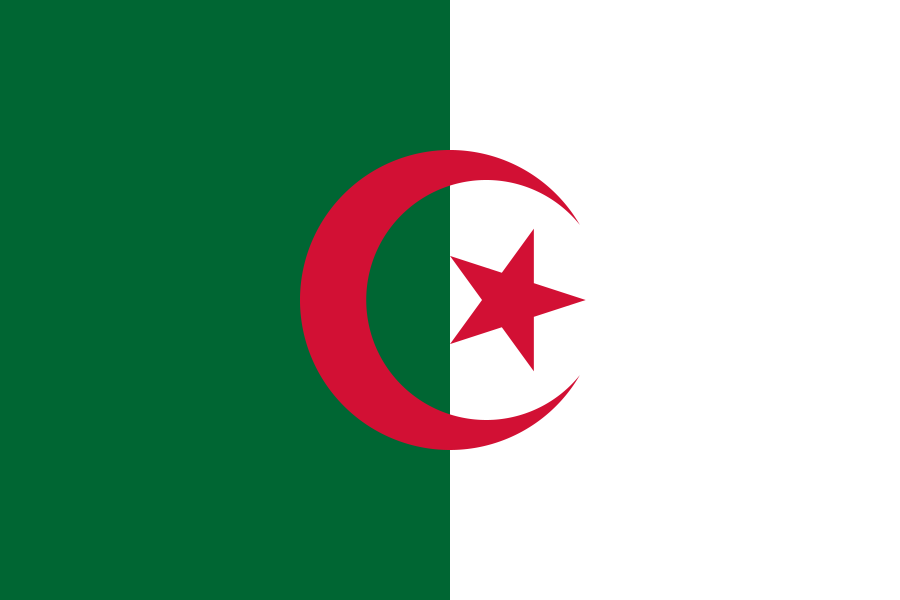
Algeria is a country in Africa with a population of 47.74M and an area of 2,381,741 km². Life expectancy is 76.3 years.
Short factual summary generated from the same country data used in game rounds.
Core numbers
Fast scan first, deep dive later.
Land Area
2.38M km²Total land area in square kilometers, excluding lakes, rivers, and territorial waters.
CO2 Per Capita
4.2 t/person/yrAnnual carbon dioxide emissions in tonnes per person, from Our World in Data using the latest available country values in TerraBrawl.
Life Expectancy
76.3 yearsHow many years a newborn can expect to live, based on current mortality rates.
University Enrollment Rate
54.43%Total university and college enrollment as a percentage of the typical college-age population.
Country briefing
A quick real-world briefing before you dive deeper into rankings, surprises, and matchups.
Geography
Climate: arid to semiarid.
Culture
Major languages include Arabic (official), French (lingua franca), Tamazight (official) (dialects include Kabyle (Taqbaylit), Shawiya (Tacawit), and more.
Identity
Formal name: People's Democratic Republic of Algeria.
Cities
Browse this country's cities before City Detective asks you to guess.
Oran
Algeria
Algiers
Algeria
Constantine
Algeria
Ghardaïa
Ghardaia, Algeria
Annaba
Algeria
Tamanghasset
Tamanrasset, Algeria
Batna
Algeria
Biskra
Algeria
Top stats
The strongest source-backed stats before the deeper data table.
Military Spending
8.0% of GDPMilitary expenditure as a share of GDP, from World Bank Open Data.
Land Border Length
6.7K kmTotal length of land borders with neighboring countries from the frozen public-domain CIA World Factbook snapshot.
Youth Unemployment Rate
29.44% of youth labor forceShare of the labor force ages 15-24 that is unemployed from the World Bank latest available country value.
Total CO2 Emissions
186.36 Mt CO2eTotal carbon dioxide emissions excluding LULUCF from the World Bank latest available country value.
Education Spending (% GDP)
5.6% of GDPGovernment education spending as a share of GDP, from World Bank Open Data.
Reality checks
The stats that tend to surprise players in real rounds.
Only ranks #202 in renewable energy (%)
The percentage of energy consumption that comes from renewable sources like solar, wind, and hydro.
Only ranks #175 in women in parliament (%)
The percentage of parliament seats held by women.
Only ranks #224 in lowest elevation
Lowest point elevation from CIA World Factbook.
Only ranks #207 in death rate
The number of deaths per 1,000 people each year.
Keeps suicide rate unusually low
Suicide mortality rate per 100,000 people, from World Bank Open Data.
Compared with the region
Country vs continent vs world averages
GDP per person, adjusted for purchasing power parity (PPP) so costs of living are comparable across countries.
How many years a newborn can expect to live, based on current mortality rates.
Composite 0-1 index of life expectancy, education, and income, from Our World in Data using the latest available country values in TerraBrawl.
The percentage of people who have used the internet in the last 3 months.
Think you can guess which countries rank higher?
Play this countryFactbook notes
Country briefing
Algeria has known many empires and dynasties, including the ancient Numidians (3rd century B.C.), Phoenicians, Carthaginians, Romans, Vandals, Byzantines, over a dozen different Arab and Amazigh dynasties, Spaniards, and Ottoman Turks.
Algeria has known many empires and dynasties, including the ancient Numidians (3rd century B.C.), Phoenicians, Carthaginians, Romans, Vandals, Byzantines, over a dozen different Arab and Amazigh dynasties, Spaniards, and Ottoman Turks. Under the Turks, the Barbary pirates operated from North Africa and preyed on shipping, from about 1500 until the French captured Algiers in 1830. The French southward conquest of Algeria proceeded throughout the 19th century and was marked by many atrocities. A bloody eight-year struggle culminated in Algerian independence in 1962.
Algeria's long-dominant political party, the National Liberation Front (FLN), was established in 1954 as part of the struggle for independence and has since played a large role in politics, though it is falling out of favor with the youth and current President Abdelmadjid TEBBOUNE. The Government of Algeria in 1988 instituted a multi-party system in response to public unrest, but the surprising first-round success of the Islamic Salvation Front (FIS) in the 1991 legislative election led the Algerian military to intervene and postpone the second round of elections to prevent what the secular elite feared would be an extremist-led government from assuming power. An army crackdown on the FIS escalated into an FIS insurgency and intense violence from 1992-98 that resulted in over 100,000 deaths, many of which were attributed to extremist groups massacring villagers. The government gained the upper hand by the late 1990s, and FIS’s armed wing, the Islamic Salvation Army, disbanded in 2000. FIS membership is now illegal.
In 1999, Abdelaziz BOUTEFLIKA won the presidency with the backing of the military, in an election that was boycotted by several candidates protesting alleged fraud. He won subsequent elections in 2004, 2009, and 2014. Widespread protests against his decision to seek a fifth term broke out in early 2019. BOUTEFLIKA resigned in April 2019, and in December 2019, Algerians elected former Prime Minister Abdelmadjid TEBBOUNE as the country’s new president. A longtime FLN member, TEBBOUNE ran for president as an independent. In 2020, Algeria held a constitutional referendum on governmental reforms, which TEBBOUNE enacted in 2021. Subsequent reforms to the national electoral law introduced open-list voting to curb corruption. The new law also eliminated gender quotas in Parliament, and the 2021 legislative elections saw female representation plummet. The referendum, parliamentary elections, and local elections saw record-low voter turnout.
Data vault
Every tracked stat, grouped for fast scanning.
Keep exploring
Open the head-to-head pages people naturally search after reading this profile.
Jump straight to the rankings where this country has its strongest edge.
Turn Algeria's strongest number into a challenge card.
Total land area in square kilometers, excluding lakes, rivers, and territorial waters.
Algeria has a population of 47.74M, ranking #33 globally by population.
Algeria is located in Africa. It has an area of 2,381,741 km².
Life expectancy in Algeria is 76.3 years, ranking #91 globally.
Algeria's GDP per capita (PPP) is $17,620.74, ranking #110 globally.
Algeria ranks particularly high in Land Area (#10), Population (#33), CO2 Per Capita (#81).
Algeria has an HDI of 0.763, ranking #96 globally. The HDI combines life expectancy, education, and income indicators.
Algeria has a population density of 19.4 people per km², ranking #186 globally.