Geography
Location: Western Africa, bordering the North Atlantic Ocean, between Senegal and Western Sahara.
CIA 2026
Loading TerraBrawl
Data as of May 28, 2026
Expect the unexpected when it comes to Mauritania. Discover more about this complex place.
Expect the unexpected when it comes to Mauritania. It ranks #12 in fertility rate, yet surprisingly lags in population density. Discover more about this complex place.
Area
1.0M km²
Pop.
5.20M
Stats
117
Mauritania is a country in Africa with a population of 5.20M and an area of 1,030,700 km². Life expectancy is 68.5 years.
Short factual summary generated from the same country data used in game rounds.
Core numbers
Fast scan first, deep dive later.
Land Area
1.03M km²Total land area in square kilometers, excluding lakes, rivers, and territorial waters.
Life Expectancy
68.5 yearsHow many years a newborn can expect to live, based on current mortality rates.
GDP Per Capita
$6,396.99GDP per person adjusted for purchasing power in constant 2017 international dollars, from Our World in Data using the latest available country values in TerraBrawl.
CO2 Per Capita
1.0 t/person/yrAnnual carbon dioxide emissions in tonnes per person, from Our World in Data using the latest available country values in TerraBrawl.
GDP Per Capita (PPP)
$7,368.75GDP per person, adjusted for purchasing power parity (PPP) so costs of living are comparable across countries.
Country briefing
A quick real-world briefing before you dive deeper into rankings, surprises, and matchups.
Geography
Location: Western Africa, bordering the North Atlantic Ocean, between Senegal and Western Sahara.
Culture
Major languages include Arabic (official and national), Pular, Soninke, Wolof (all national languages), and more.
Identity
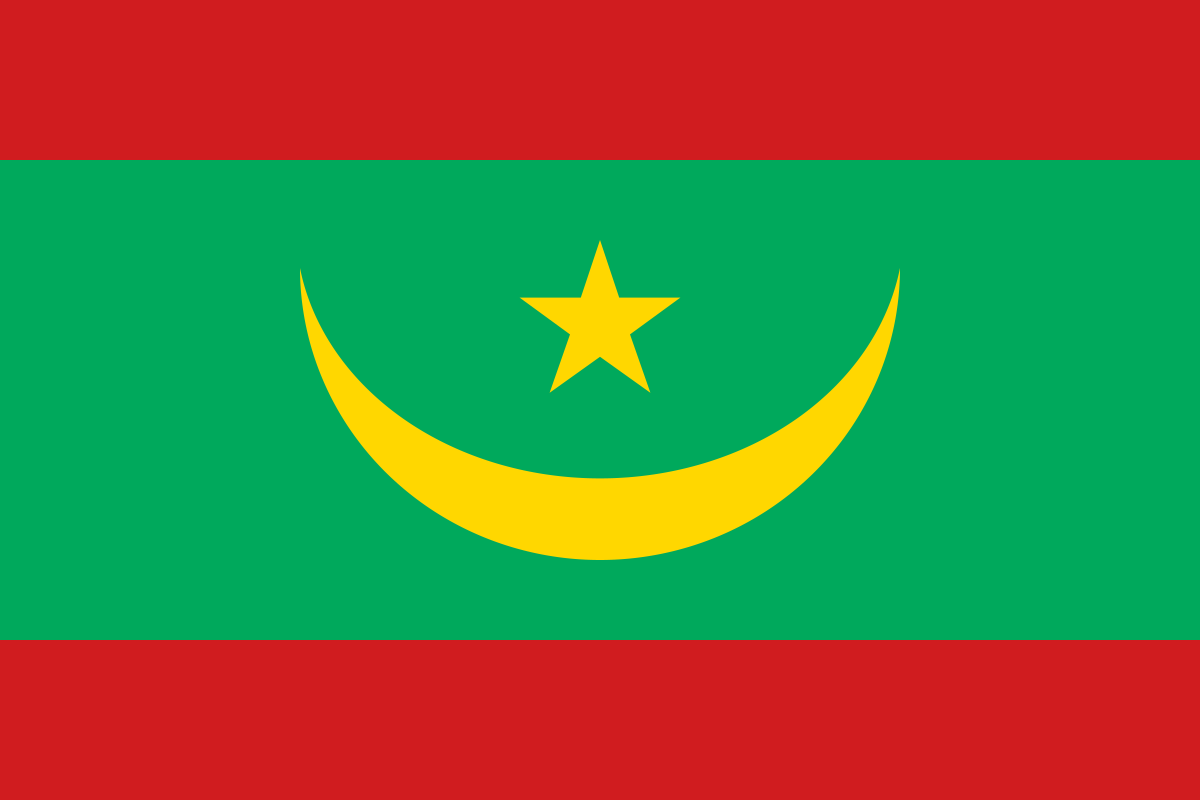
Formal name: Islamic Republic of Mauritania.
Cities
Browse this country's cities before City Detective asks you to guess.
Top stats
The strongest source-backed stats before the deeper data table.
Air Pollution (PM2.5)
70.82 µg/m³The average level of fine particle air pollution (PM2.5) that people are exposed to.
Dependency Ratio
84.98% of working-age pop.Dependents as a share of the working-age population, from World Bank Open Data.
Fertility Rate
4.8 children/womanThe average number of children a woman would have over her lifetime based on current birth rates.
FDI Inflows (% GDP)
13.2% of GDPForeign direct investment net inflows as a share of GDP, from World Bank Open Data.
Land Border Length
5.0K kmTotal length of land borders with neighboring countries from the frozen public-domain CIA World Factbook snapshot.
Reality checks
The stats that tend to surprise players in real rounds.
Only ranks #187 in beer consumption
Liters of beer consumed per person per year, from Our World in Data using the latest available country values in TerraBrawl.
Only ranks #213 in broadband access (%)
Fixed broadband subscriptions per 100 people, from World Bank Open Data.
Only ranks #208 in protected land (%)
The percentage of land area designated as protected natural reserves or parks.
Only ranks #147 in university enrollment rate
Total university and college enrollment as a percentage of the typical college-age population.
Only ranks #205 in population density
How many people live in each square kilometer of land.
Compared with the region
Country vs continent vs world averages
GDP per person, adjusted for purchasing power parity (PPP) so costs of living are comparable across countries.
How many years a newborn can expect to live, based on current mortality rates.
Composite 0-1 index of life expectancy, education, and income, from Our World in Data using the latest available country values in TerraBrawl.
The percentage of people who have used the internet in the last 3 months.
Think you can guess which countries rank higher?
Play this countryFactbook notes
Country briefing
The Amazigh and Bafour people were among the earliest settlers in what is now Mauritania and among the first in recorded history to convert from a nomadic to agricultural lifestyle.
The Amazigh and Bafour people were among the earliest settlers in what is now Mauritania and among the first in recorded history to convert from a nomadic to agricultural lifestyle. These groups account for roughly one third of Mauritania’s ethnic makeup. The remainder of Mauritania’s ethnic groups derive from Sub-Saharan ethnic groups originating mainly from the Senegal River Valley, including descendants of former enslaved peoples. These three groups are organized according to a strict caste system with deep ethnic divides that impact access to resources and power dynamics.
A former French colony, Mauritania achieved independence from France in 1960. Mauritania initially began as a single-party, authoritarian regime and experienced 49 years of dictatorships, flawed elections, failed attempts at democracy, and military coups. Ould Abdel AZIZ led the last coup in 2008, was elected president in 2009, and was reelected in 2014. Mohamed Ould Cheikh GHAZOUANI was elected president in 2019, and his inauguration marked the first peaceful transition of power from one democratically elected president to another, solidifying the country's status as an emerging democracy. International observers recognized the elections as relatively free and fair. GHAZOUANI is seeking re-election in June 2024 for a second, and final, five-year term.
The country is working to address vestigial practices of slavery and its hereditary impacts. Mauritania officially abolished slavery in 1981, but the practice was not criminalized until 2007. Between 2005 and 2011, Al-Qaeda in the Islamic Maghreb (AQIM) launched a series of attacks killing western tourists and aid workers, attacking diplomatic and government facilities, and ambushing Mauritanian soldiers and gendarmes. Although Mauritania has not seen an attack since 2011, AQIM and similar groups remain active in the Sahel region.
Data vault
Every tracked stat, grouped for fast scanning.
Keep exploring
Open the head-to-head pages people naturally search after reading this profile.
Jump straight to the rankings where this country has its strongest edge.
Turn Mauritania's strongest number into a challenge card.
Total land area in square kilometers, excluding lakes, rivers, and territorial waters.
Mauritania has a population of 5.20M, ranking #125 globally by population.
Mauritania is located in Africa. It has an area of 1,030,700 km².
Life expectancy in Mauritania is 68.5 years, ranking #161 globally.
Mauritania's GDP per capita (PPP) is $7,368.75, ranking #151 globally.
Mauritania ranks particularly high in Land Area (#28), Population (#125), Life Expectancy (#161).
Mauritania has an HDI of 0.563, ranking #163 globally. The HDI combines life expectancy, education, and income indicators.
Mauritania has a population density of 4.9 people per km², ranking #205 globally.