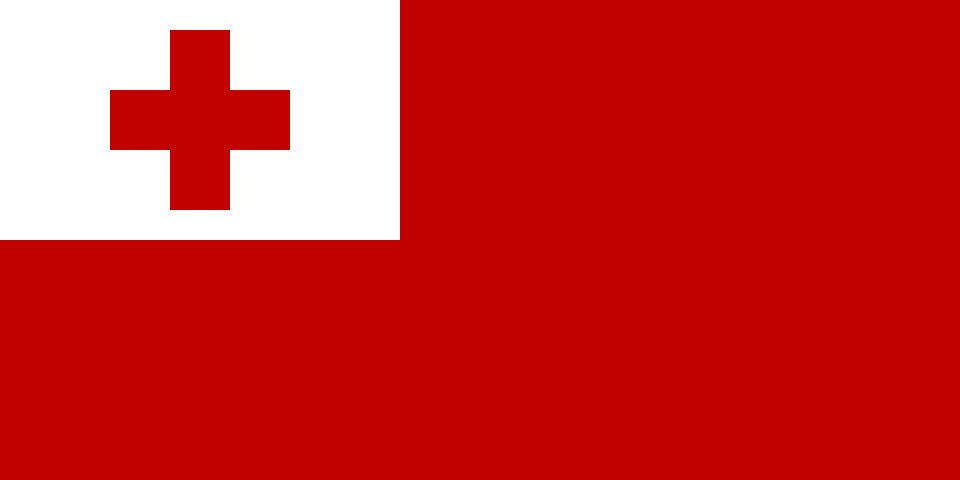
Identity
Name origin: the name is of local origin and is said to mean "island.
CIA 2026
Loading TerraBrawl
Data as of May 28, 2026
Tonga excels and struggles in equal measure. See what other surprises Tonga holds.
Tonga excels and struggles in equal measure. A top performer in obesity rate (#2), it falls behind in urban population. See what other surprises Tonga holds.
Area
747 km²
Pop.
104.5K
Stats
101
Tonga is a country in Oceania with a population of 104.5K and an area of 747 km². Life expectancy is 72.9 years.
Short factual summary generated from the same country data used in game rounds.
Core numbers
Fast scan first, deep dive later.
Population Density
145.27 /km²How many people live in each square kilometer of land.
Human Development Index
0.77Composite 0-1 index of life expectancy, education, and income, from Our World in Data using the latest available country values in TerraBrawl.
Life Expectancy
72.9 yearsHow many years a newborn can expect to live, based on current mortality rates.
University Enrollment Rate
42.86%Total university and college enrollment as a percentage of the typical college-age population.
CO2 Per Capita
1.5 t/person/yrAnnual carbon dioxide emissions in tonnes per person, from Our World in Data using the latest available country values in TerraBrawl.
Country briefing
A quick real-world briefing before you dive deeper into rankings, surprises, and matchups.
Identity
Name origin: the name is of local origin and is said to mean "island.
Geography
Size snapshot: four times the size of Washington, D.C.
Culture
Major languages include Tongan only 85%, Tongan and other language 13.9%, Tongan not used at home 1.1% (2021 est.).
Top stats
The strongest source-backed stats before the deeper data table.
Obesity Rate
70.54%Share of adults with obesity, from Our World in Data using the latest available country values in TerraBrawl.
High-Tech Exports (%)
28.46%High-tech products (like computers, pharmaceuticals, and aerospace) as a percentage of total manufactured exports.
Smoking Rate
31.3%The percentage of people aged 15 and older who use tobacco products.
Dependency Ratio
72.77% of working-age pop.Dependents as a share of the working-age population, from World Bank Open Data.
Education Spending (% GDP)
5.3% of GDPGovernment education spending as a share of GDP, from World Bank Open Data.
Reality checks
The stats that tend to surprise players in real rounds.
Only ranks #213 in irrigated land
Irrigated land area from CIA World Factbook.
Only ranks #203 in gdp (nominal)
The country's total economic output in current US dollars.
Only ranks #131 in foreign patents
How many patent applications are filed by non-residents each year.
Only ranks #220 in urban population (%)
The percentage of people living in cities and urban areas.
Only ranks #231 in land border length
Total length of land borders with neighboring countries from the frozen public-domain CIA World Factbook snapshot.
Compared with the region
Country vs continent vs world averages
GDP per person, adjusted for purchasing power parity (PPP) so costs of living are comparable across countries.
How many years a newborn can expect to live, based on current mortality rates.
Composite 0-1 index of life expectancy, education, and income, from Our World in Data using the latest available country values in TerraBrawl.
The percentage of people who have used the internet in the last 3 months.
Think you can guess which countries rank higher?
Play this countryFactbook notes
Country briefing
The first humans arrived in Tonga around 1000 B.C.
The first humans arrived in Tonga around 1000 B.C. The islands’ politics were highly centralized under the Tu’i Tonga, or Tongan king, by A.D. 950, and by 1200, the Tu’i Tonga had expanded his influence throughout Polynesia and into Melanesia and Micronesia. The Tongan Empire began to decline in the 1300s, with civil wars, a military defeat to Samoa, and internal political strife. By the mid-1500s, some Tu’i Tongans were ethnic Samoan, and day-to-day administration of Tonga was transferred to a new position occupied by ethnic Tongans.
Dutch navigators explored the islands in the 1600s, followed by the British in the 1770s, who named them the Friendly Islands. Between 1799 and 1852 Tonga went through a period of war and disorder. In the 1830s, a low-ranking chief from Ha’apai began to consolidate control over the islands and was crowned King George TUPOU I in 1845, establishing the only still-extant Polynesian monarchy. During TUPOU's reign (1845–93), Tonga became a unified and independent country with a modern constitution (1875), legal code, and administrative structure. In separate treaties, Germany (1876), Great Britain (1879), and the US (1888) recognized Tonga’s independence. His son and successor, King George TUPOU II, agreed to enter a protectorate agreement with the UK in 1900 after rival Tongan chiefs tried to overthrow him. As a protectorate, Tonga never completely lost its indigenous governance, but it did become more isolated and the social hierarchy became more stratified between a group of nobles and a large class of commoners. Today, about one third of parliamentary seats are reserved for nobles.
Tonga regained full control of domestic and foreign affairs and became a fully independent nation within the Commonwealth in 1970. A pro-democracy movement gained steam in the early 2000s, led by ‘Akilisi POHIVA, and in 2006, riots broke out in Nuku’alofa to protest the lack of progress on reform. To appease the activists, in 2008, King George TUPOU V announced he was relinquishing most of his powers leading up to parliamentary elections in 2010 and henceforth most of the monarch’s governmental decisions, except those relating to the judiciary, were to be made in consultation with the prime minister. The 2010 Legislative Assembly was called Tonga’s first democratically elected Parliament. King George TUPOU V died in 2012 and was succeeded by his brother Crown Prince Tupouto‘a Lavaka who ruled as George TUPOU VI. In 2015, ‘Akalisi POHIVA became Tonga’s first non-noble prime minister.
Data vault
Every tracked stat, grouped for fast scanning.
Keep exploring
Open the head-to-head pages people naturally search after reading this profile.
Jump straight to the rankings where this country has its strongest edge.
Turn Tonga's strongest number into a challenge card.
How many people live in each square kilometer of land.
Tonga has a population of 104.5K, ranking #189 globally by population.
Tonga is located in Oceania. It has an area of 747 km².
Life expectancy in Tonga is 72.9 years, ranking #122 globally.
Tonga's GDP per capita (PPP) is $7,802.67, ranking #148 globally.
Tonga ranks particularly high in Population Density (#80), Human Development Index (#92), Life Expectancy (#122).
Tonga has an HDI of 0.769, ranking #92 globally. The HDI combines life expectancy, education, and income indicators.
Tonga has a population density of 145.3 people per km², ranking #80 globally.