Identity
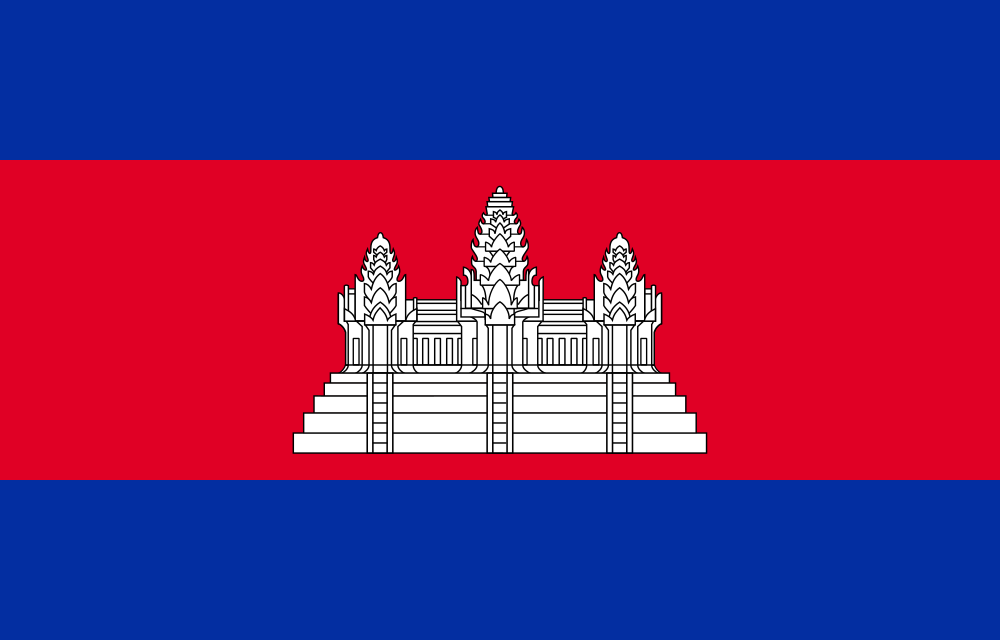
Formal name: Kingdom of Cambodia.
CIA 2026
Loading TerraBrawl
Data as of May 28, 2026
Protected Land is where Cambodia truly shines. How well do you know Cambodia's strengths?
Protected Land is where Cambodia truly shines. At 39.8% (#15 globally), conservation is taken seriously. How well do you know Cambodia's strengths?
Area
181K km²
Pop.
17.23M
Stats
123
Cambodia is a country in Asia with a population of 17.23M and an area of 181,035 km². Life expectancy is 70.7 years.
Short factual summary generated from the same country data used in game rounds.
Core numbers
Fast scan first, deep dive later.
Land Area
176.5K km²Total land area in square kilometers, excluding lakes, rivers, and territorial waters.
Population Density
98.71 /km²How many people live in each square kilometer of land.
Life Expectancy
70.7 yearsHow many years a newborn can expect to live, based on current mortality rates.
Internet Users (%)
61%The percentage of people who have used the internet in the last 3 months.
Country briefing
A quick real-world briefing before you dive deeper into rankings, surprises, and matchups.
Identity
Formal name: Kingdom of Cambodia.
Curated stat
Cambodia's Tonle Sap can reverse river flow in monsoon season, turning a lake into a flood-pulse engine.
Geography
Size snapshot: 1.5 times the size of Pennsylvania.
Cities
Browse this country's cities before City Detective asks you to guess.
Top stats
The strongest source-backed stats before the deeper data table.
Protected Land (%)
39.8%The percentage of land area designated as protected natural reserves or parks.
FDI Inflows (% GDP)
9.5% of GDPForeign direct investment net inflows as a share of GDP, from World Bank Open Data.
Armed Forces Personnel
191.0KTotal armed forces personnel from the World Bank latest available country value.
Beer Consumption
2.8 L/person/yrLiters of beer consumed per person per year, from Our World in Data using the latest available country values in TerraBrawl.
Reality checks
The stats that tend to surprise players in real rounds.
Keeps unemployment rate unusually low
The percentage of the workforce that is unemployed but actively looking for work.
Only ranks #194 in obesity rate
Share of adults with obesity, from Our World in Data using the latest available country values in TerraBrawl.
Only ranks #166 in education spending (% gdp)
Government education spending as a share of GDP, from World Bank Open Data.
Only ranks #139 in hospital beds (per 1,000)
The number of hospital beds available per 1,000 people.
Compared with the region
Country vs continent vs world averages
GDP per person, adjusted for purchasing power parity (PPP) so costs of living are comparable across countries.
How many years a newborn can expect to live, based on current mortality rates.
Composite 0-1 index of life expectancy, education, and income, from Our World in Data using the latest available country values in TerraBrawl.
The percentage of people who have used the internet in the last 3 months.
Think you can guess which countries rank higher?
Play this countryFactbook notes
Country briefing
Most Cambodians consider themselves to be Khmers, descendants of the Angkor Empire that extended over much of Southeast Asia and reached its zenith between the 10th and 13th centuries.
Most Cambodians consider themselves to be Khmers, descendants of the Angkor Empire that extended over much of Southeast Asia and reached its zenith between the 10th and 13th centuries. Attacks by the Thai and Cham (from present-day Vietnam) weakened the empire, ushering in a long period of decline. The king placed the country under French protection in 1863, and it became part of French Indochina in 1887. Following Japanese occupation in World War II, Cambodia gained full independence from France in 1953. In 1975, after a seven-year struggle, communist Khmer Rouge forces captured Phnom Penh and evacuated all cities and towns. At least 1.5 million Cambodians died from execution, forced hardships, or starvation during the Khmer Rouge regime under POL POT. A 1978 Vietnamese invasion drove the Khmer Rouge into the countryside, began a 10-year Vietnamese occupation, and touched off 13 years of internecine warfare in which a coalition of Khmer Rouge, Cambodian nationalists, and royalist insurgents, with assistance from China, fought the Vietnamese-backed People’s Republic of Kampuchea (PRK).
The 1991 Paris Agreements ended the country’s civil war and mandated democratic elections, which took place in 1993 and ushered in a period of multi-party democracy with a constitutional monarchy. King Norodom SIHANOUK was reinstated as head of state, and the Cambodian People's Party (CPP) and the royalist FUNCINPEC party formed a coalition government. Nevertheless, the power-sharing arrangement proved fractious and fragile, and in 1997, a coup led by CPP leader and former PRK prime minister HUN SEN dissolved the coalition and sidelined FUNCINPEC. Despite further attempts at coalition governance, the CPP has since remained in power through elections criticized for lacking fairness, political and judicial corruption, media control, and influence over labor unions, all of which have been enforced with violence and intimidation. HUN SEN remained as prime minister until 2023, when he transferred power to his son, HUN MANET. HUN SEN has subsequently maintained considerable influence as the leader of the CPP and the Senate. The CPP has also placed limits on civil society, press freedom, and freedom of expression. Despite some economic growth and considerable investment from China over the past decade, Cambodia remains one of East Asia's poorest countries.
The remaining elements of the Khmer Rouge surrendered in 1999. A UN-backed special tribunal established in Cambodia in 1997 tried some of the surviving Khmer Rouge leaders for crimes against humanity and genocide. The tribunal concluded in 2022 with three convictions.
Data vault
Every tracked stat, grouped for fast scanning.
Keep exploring
Open the head-to-head pages people naturally search after reading this profile.
Jump straight to the rankings where this country has its strongest edge.
Turn Cambodia's strongest number into a challenge card.
The total number of people living in the country.
Cambodia has a population of 17.23M, ranking #74 globally by population.
Cambodia is located in Asia. It has an area of 181,035 km².
Life expectancy in Cambodia is 70.7 years, ranking #146 globally.
Cambodia's GDP per capita (PPP) is $7,966.87, ranking #146 globally.
Cambodia ranks particularly high in Population (#74), Land Area (#89), Population Density (#104).
Cambodia has an HDI of 0.606, ranking #151 globally. The HDI combines life expectancy, education, and income indicators.
Cambodia has a population density of 98.7 people per km², ranking #104 globally.