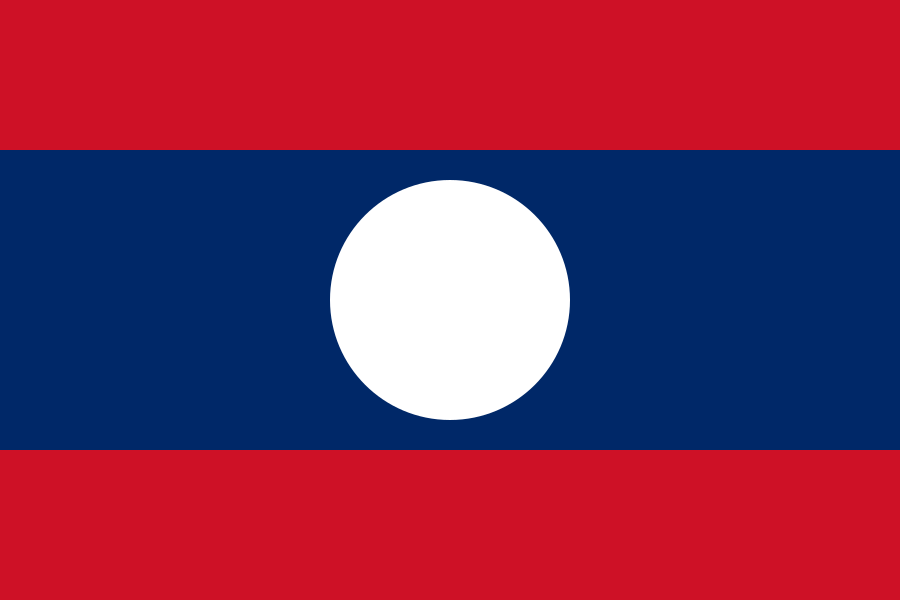
Culture
National symbols include elephant.
CIA 2026
Loading TerraBrawl
Data as of May 28, 2026
Laos excels and struggles in equal measure. See what other surprises Laos holds.
Laos excels and struggles in equal measure. Strong at #16 for forest coverage, it stumbles on health spending. See what other surprises Laos holds.
Area
237K km²
Pop.
7.95M
Stats
120
Laos is a country in Asia with a population of 7.95M and an area of 236,800 km². Life expectancy is 69.0 years.
Short factual summary generated from the same country data used in game rounds.
Core numbers
Fast scan first, deep dive later.
Land Area
230.8K km²Total land area in square kilometers, excluding lakes, rivers, and territorial waters.
CO2 Per Capita
3.1 t/person/yrAnnual carbon dioxide emissions in tonnes per person, from Our World in Data using the latest available country values in TerraBrawl.
Internet Users (%)
64%The percentage of people who have used the internet in the last 3 months.
GDP Per Capita
$8,610.9GDP per person adjusted for purchasing power in constant 2017 international dollars, from Our World in Data using the latest available country values in TerraBrawl.
GDP Per Capita (PPP)
$9,775.83GDP per person, adjusted for purchasing power parity (PPP) so costs of living are comparable across countries.
Country briefing
A quick real-world briefing before you dive deeper into rankings, surprises, and matchups.
Culture
National symbols include elephant.
Identity
Formal name: Lao People's Democratic Republic.
Geography
Size snapshot: about twice the size of Pennsylvania.
Cities
Browse this country's cities before City Detective asks you to guess.
Top stats
The strongest source-backed stats before the deeper data table.
Forest Coverage (%)
71.46%The percentage of land covered by forests - natural or planted trees at least 5 meters tall (excludes orchards and urban parks).
Alcohol Consumption
10.82 L/adult/yrLiters of pure alcohol the average adult aged 15+ consumes per year, from Our World in Data using the latest available country values in TerraBrawl.
Inflation Rate
23.1%How much prices increased over the year, based on the cost of everyday goods and services.
Lowest Elevation
70 mLowest point elevation from CIA World Factbook.
Teen Birth Rate
81.65 per 1kThe number of births per 1,000 women aged 15-19.
Reality checks
The stats that tend to surprise players in real rounds.
Only ranks #191 in health spending (% gdp)
Current health expenditure as a share of GDP, from World Bank Open Data.
Only ranks #184 in merchant fleet size
Number of merchant marine ships from the frozen public-domain CIA World Factbook snapshot.
Only ranks #156 in military spending
Military expenditure as a share of GDP, from World Bank Open Data.
Keeps youth unemployment rate unusually low
Share of the labor force ages 15-24 that is unemployed from the World Bank latest available country value.
Keeps unemployment rate unusually low
The percentage of the workforce that is unemployed but actively looking for work.
Compared with the region
Country vs continent vs world averages
GDP per person, adjusted for purchasing power parity (PPP) so costs of living are comparable across countries.
How many years a newborn can expect to live, based on current mortality rates.
Composite 0-1 index of life expectancy, education, and income, from Our World in Data using the latest available country values in TerraBrawl.
The percentage of people who have used the internet in the last 3 months.
Think you can guess which countries rank higher?
Play this countryFactbook notes
Country briefing
Modern-day Laos has its roots in the ancient Lao kingdom of Lan Xang, established in the 14th century under King FA NGUM.
Modern-day Laos has its roots in the ancient Lao kingdom of Lan Xang, established in the 14th century under King FA NGUM. For 300 years, Lan Xang had influence reaching into present-day Cambodia and Thailand, as well as over all of what is now Laos. After centuries of gradual decline, Laos came under the domination of Siam (Thailand) from the late 18th century until the late 19th century, when it became part of French Indochina. The Franco-Siamese Treaty of 1907 defined the current Lao border with Thailand. Following more than 15 years of civil war, the communist Pathet Lao took control of the government in 1975, ending a six-century-old monarchy and instituting a one party--the Lao People's Revolutionary Party--communist state. A gradual, limited return to private enterprise and the liberalization of foreign investment laws began in the late 1980s. Laos became a member of ASEAN in 1997 and the WTO in 2013.
In the 2010s, the country benefited from direct foreign investment, particularly in the natural resource and industry sectors. Construction of a number of large hydropower dams and expanding mining activities have also boosted the economy. Laos has retained its official commitment to communism and maintains close ties with its two communist neighbors, Vietnam and China, both of which continue to exert substantial political and economic influence on the country. China, for example, provided 70% of the funding for a $5.9 billion, 400-km railway line between the Chinese border and the capital Vientiane, which opened for operations in 2021. Laos financed the remaining 30% with loans from China. At the same time, Laos has expanded its economic reliance on the West and other Asian countries, such as Japan, Malaysia, Singapore, Taiwan, and Thailand. Nevertheless, despite steady economic growth for more than a decade, it remains one of Asia's poorest countries.
Data vault
Every tracked stat, grouped for fast scanning.
Keep exploring
Open the head-to-head pages people naturally search after reading this profile.
Jump straight to the rankings where this country has its strongest edge.
Turn Laos's strongest number into a challenge card.
Total land area in square kilometers, excluding lakes, rivers, and territorial waters.
Laos has a population of 7.95M, ranking #103 globally by population.
Laos is located in Asia. It has an area of 236,800 km².
Life expectancy in Laos is 69.0 years, ranking #157 globally.
Laos's GDP per capita (PPP) is $9,775.83, ranking #138 globally.
Laos ranks particularly high in Land Area (#80), Population (#103), CO2 Per Capita (#108).
Laos has an HDI of 0.617, ranking #147 globally. The HDI combines life expectancy, education, and income indicators.
Laos has a population density of 33.2 people per km², ranking #166 globally.