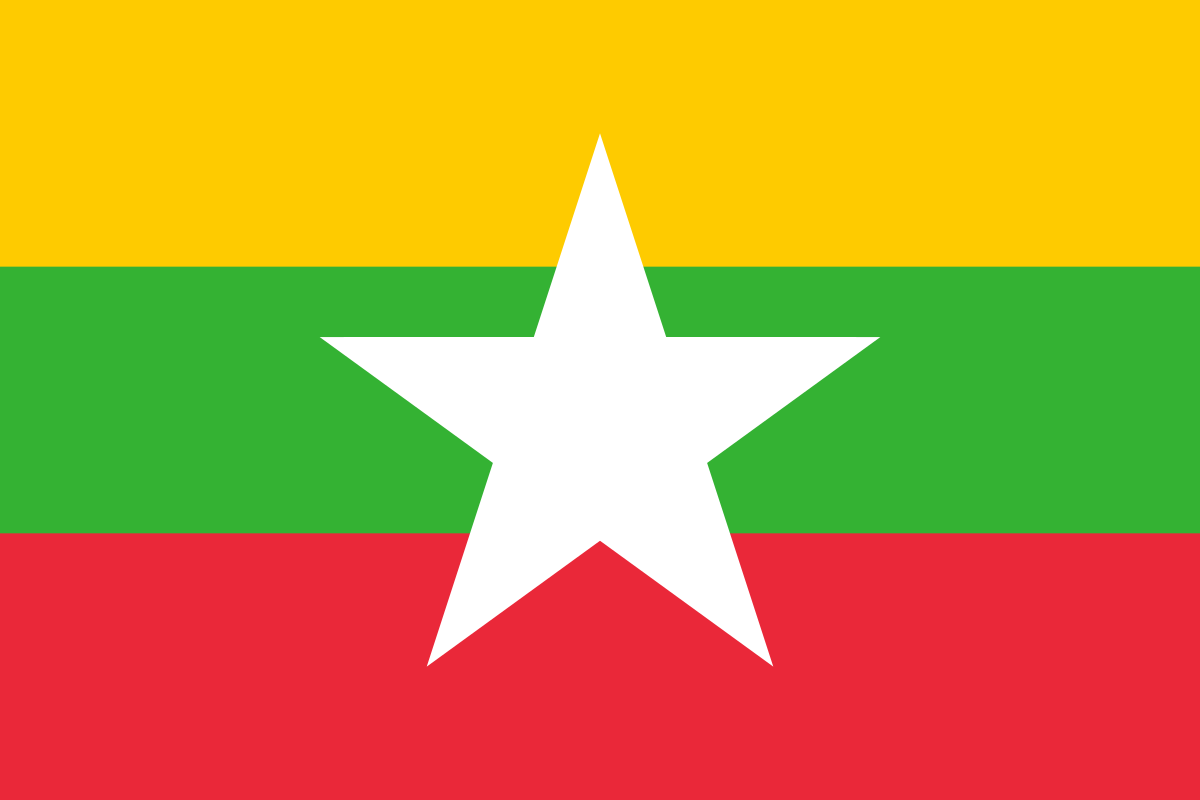
Geography
Natural resources include petroleum, timber, tin, antimony, and more.
CIA 2026
Loading TerraBrawl
Data as of May 28, 2026
No place in Asia outperforms Myanmar in renewable energy. Test your knowledge of Asia's top performer.
No place in Asia outperforms Myanmar in renewable energy. This regional dominance shapes its continental identity. Test your knowledge of Asia's top performer.
Area
677K km²
Pop.
57.93M
Stats
119
Myanmar is a country in Asia with a population of 57.93M and an area of 676,578 km². Life expectancy is 66.9 years.
Short factual summary generated from the same country data used in game rounds.
Core numbers
Fast scan first, deep dive later.
Land Area
652.7K km²Total land area in square kilometers, excluding lakes, rivers, and territorial waters.
Population Density
82.94 /km²How many people live in each square kilometer of land.
Internet Users (%)
59%The percentage of people who have used the internet in the last 3 months.
Human Development Index
0.61Composite 0-1 index of life expectancy, education, and income, from Our World in Data using the latest available country values in TerraBrawl.
GDP Per Capita
$5,276.29GDP per person adjusted for purchasing power in constant 2017 international dollars, from Our World in Data using the latest available country values in TerraBrawl.
Country briefing
A quick real-world briefing before you dive deeper into rankings, surprises, and matchups.
Geography
Natural resources include petroleum, timber, tin, antimony, and more.
Culture
Major languages include Burmese (official).
Identity
Formal name: Union of Burma.
Cities
Browse this country's cities before City Detective asks you to guess.
Nay Pyi Taw
Myanmar
Yangon
Myanmar
Mandalay
Mandalay Region, Myanmar
Sittwe
Rakhine, Myanmar
Bago
Bago Region, Myanmar
Monywa
Sagaing Region, Myanmar
Magway
Myanmar
Mawlamyine
Mon, Myanmar
Top stats
The strongest source-backed stats before the deeper data table.
Smoking Rate
44.4%The percentage of people aged 15 and older who use tobacco products.
Military Spending
6.8% of GDPMilitary expenditure as a share of GDP, from World Bank Open Data.
Highest Elevation
5.9K mHighest point elevation from CIA World Factbook.
Forest Area
276.7K km²Total forest area in square kilometers, including natural and planted trees at least 5 meters tall.
Inflation Rate
8.8%How much prices increased over the year, based on the cost of everyday goods and services.
Reality checks
The stats that tend to surprise players in real rounds.
Only ranks #100 in r&d spending (% gdp)
Research and development spending as a share of GDP, from World Bank Open Data.
Only ranks #194 in gdp growth rate
The annual percentage change in the country's GDP.
Ranks #14 globally in armed forces personnel
Total armed forces personnel from the World Bank latest available country value.
Ranks #20 globally in land border length
Total length of land borders with neighboring countries from the frozen public-domain CIA World Factbook snapshot.
Only ranks #179 in obesity rate
Share of adults with obesity, from Our World in Data using the latest available country values in TerraBrawl.
Compared with the region
Country vs continent vs world averages
GDP per person, adjusted for purchasing power parity (PPP) so costs of living are comparable across countries.
How many years a newborn can expect to live, based on current mortality rates.
Composite 0-1 index of life expectancy, education, and income, from Our World in Data using the latest available country values in TerraBrawl.
The percentage of people who have used the internet in the last 3 months.
Think you can guess which countries rank higher?
Play this countryFactbook notes
Country briefing
Burma is home to ethnic Burmans and scores of other ethnic and religious minority groups that have resisted external efforts to consolidate control of the country throughout its history.
Burma is home to ethnic Burmans and scores of other ethnic and religious minority groups that have resisted external efforts to consolidate control of the country throughout its history. Britain conquered Burma over a period extending from the 1820s to the 1880s and administered it as a province of India until 1937, when Burma became a self-governing colony. Burma gained full independence in 1948. In 1962, General NE WIN seized power and ruled the country until 1988 when a new military regime took control.
In 1990, the military regime permitted an election but then rejected the results after the main opposition National League for Democracy (NLD) and its leader AUNG SAN SUU KYI (ASSK) won in a landslide. The military regime placed ASSK under house arrest until 2010. In 2007, rising fuel prices in Burma led pro-democracy activists and Buddhist monks to launch a "Saffron Revolution" consisting of large protests against the regime, which violently suppressed the movement. The regime prevented new elections until it had drafted a constitution designed to preserve the military's political control; it passed the new constitution in its 2008 referendum. The regime conducted an election in 2010, but the NLD boycotted the vote, and the military’s political proxy, the Union Solidarity and Development Party, easily won; international observers denounced the election as flawed.
Burma nonetheless began a halting process of political and economic reforms. ASSK's return to government in 2012 eventually led to the NLD's sweeping victory in the 2015 election. With ASSK as the de facto head of state, Burma’s first credibly elected civilian government drew international criticism for blocking investigations into Burma’s military operations -- which the US Department of State determined constituted genocide -- against its ethnic Rohingya population. When the 2020 elections resulted in further NLD gains, the military denounced the vote as fraudulent. In 2021, the military's senior leader General MIN AUNG HLAING launched a coup that returned Burma to authoritarian rule, with military crackdowns that undid reforms and resulted in the detention of ASSK and thousands of pro-democracy actors.
Pro-democracy organizations have formed in the wake of the coup, including the National Unity Government (NUG). Members of the NUG include representatives from the NLD, ethnic minority groups, and civil society. In 2021, the NUG announced the formation of armed militias called the People's Defense Forces (PDF) and an insurgency against the military junta. As of 2024, PDF units across the country continued to fight the regime with varying levels of support from and cooperation with the NUG and other anti-regime organizations, including armed ethnic groups that have been fighting the central government for decades.
Data vault
Every tracked stat, grouped for fast scanning.
Keep exploring
Open the head-to-head pages people naturally search after reading this profile.
Jump straight to the rankings where this country has its strongest edge.
Turn Myanmar's strongest number into a challenge card.
The total number of people living in the country.
Myanmar has a population of 57.93M, ranking #26 globally by population.
Myanmar is located in Asia. It has an area of 676,578 km².
Life expectancy in Myanmar is 66.9 years, ranking #175 globally.
Myanmar's GDP per capita (PPP) is $5,997.47, ranking #157 globally.
Myanmar ranks particularly high in Population (#26), Land Area (#39), Population Density (#118).
Myanmar has an HDI of 0.609, ranking #150 globally. The HDI combines life expectancy, education, and income indicators.
Myanmar has a population density of 82.9 people per km², ranking #118 globally.