Geography
Climate: arid to semiarid.
CIA 2026
Loading TerraBrawl
Data as of May 28, 2026
The numbers tell two very different stories about Afghanistan. Think you can explain the gap?
The numbers tell two very different stories about Afghanistan. #1 in health spending but near the bottom in internet access. Think you can explain the gap?
Area
652K km²
Pop.
49.47M
Stats
116
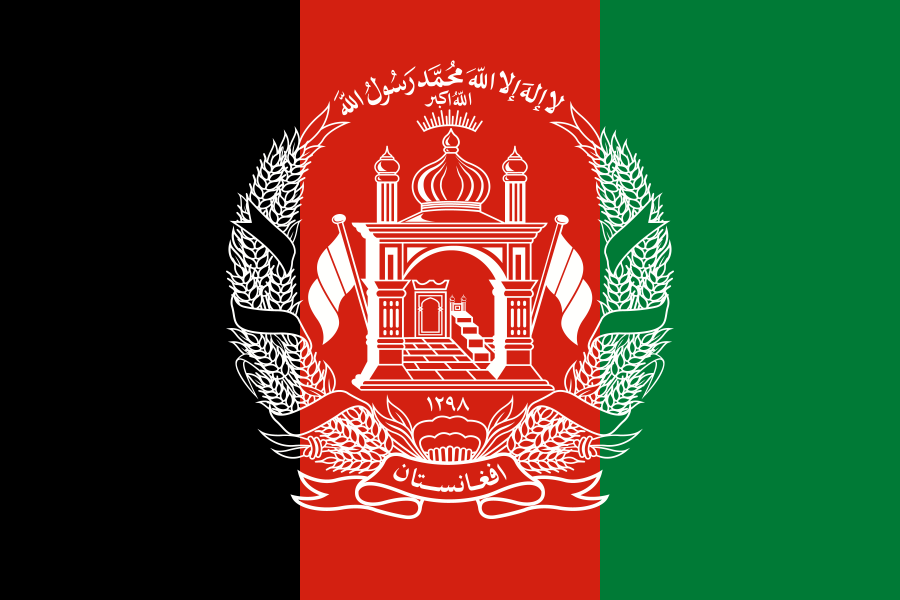
Afghanistan is a country in Asia with a population of 49.47M and an area of 652,230 km². Life expectancy is 66.0 years.
Short factual summary generated from the same country data used in game rounds.
Core numbers
Fast scan first, deep dive later.
Land Area
652.2K km²Total land area in square kilometers, excluding lakes, rivers, and territorial waters.
Population Density
63.56 /km²How many people live in each square kilometer of land.
Life Expectancy
66.0 yearsHow many years a newborn can expect to live, based on current mortality rates.
University Enrollment Rate
10.85%Total university and college enrollment as a percentage of the typical college-age population.
Country briefing
A quick real-world briefing before you dive deeper into rankings, surprises, and matchups.
Geography
Climate: arid to semiarid.
Culture
Major languages include Afghan Persian or Dari (official, lingua franca) 77%, Pashto (official) 48%, Uzbeki 11%, and more.
Identity
Formal name: Islamic Republic of Afghanistan (prior to 15 August 2021); current country name disputed.
Cities
Browse this country's cities before City Detective asks you to guess.
Kabul
Afghanistan
Kandahār
Kandahar, Afghanistan
Herāt
Herat, Afghanistan
Mazār-e Sharīf
Balkh, Afghanistan
Baghlān
Baghlan, Afghanistan
Jalālābād
Nangarhar, Afghanistan
Kunduz
Afghanistan
Balkh
Afghanistan
Top stats
The strongest source-backed stats before the deeper data table.
Broadband Access (%)
202 per 100 peopleFixed broadband subscriptions per 100 people, from World Bank Open Data.
Health Spending (% GDP)
23.09% of GDPCurrent health expenditure as a share of GDP, from World Bank Open Data.
Highest Elevation
7.5K mHighest point elevation from CIA World Factbook.
Birth Rate
35.99 per 1kThe number of babies born per 1,000 people each year.
Irrigated Land
24.9K km²Irrigated land area from CIA World Factbook.
Reality checks
The stats that tend to surprise players in real rounds.
Keeps inflation rate unusually low
How much prices increased over the year, based on the cost of everyday goods and services.
Only ranks #184 in beer consumption
Liters of beer consumed per person per year, from Our World in Data using the latest available country values in TerraBrawl.
Ranks #11 globally in fertility rate
The average number of children a woman would have over her lifetime based on current birth rates.
Only ranks #208 in elderly population (%)
Share of the population ages 65 and older, from World Bank Open Data.
Only ranks #225 in median age
The age that splits the population in half: half are younger, half are older. UN WPP estimate as of 1 July 2023.
Compared with the region
Country vs continent vs world averages
GDP per person, adjusted for purchasing power parity (PPP) so costs of living are comparable across countries.
How many years a newborn can expect to live, based on current mortality rates.
Composite 0-1 index of life expectancy, education, and income, from Our World in Data using the latest available country values in TerraBrawl.
The percentage of people who have used the internet in the last 3 months.
Think you can guess which countries rank higher?
Play this countryFactbook notes
Country briefing
Ahmad Shah DURRANI unified the Pashtun tribes and founded Afghanistan in 1747.
Ahmad Shah DURRANI unified the Pashtun tribes and founded Afghanistan in 1747. The country served as a buffer between the British and Russian Empires until it won independence from notional British control in 1919. A brief experiment in increased democracy ended in a 1973 coup and a 1978 communist countercoup. The Soviet Union invaded in 1979 to support the tottering Afghan communist regime, touching off a long and destructive war. Internationally supported anti-communist mujahidin rebels forced the USSR to withdraw in 1989. A series of subsequent civil wars saw Kabul finally fall in 1996 to the Taliban, a hardline Pakistani-sponsored movement. Following the 11 September 2001 terrorist attacks, a US and Allied military action toppled the Taliban for sheltering Usama BIN LADIN.
A UN-sponsored Bonn Conference in 2001 established a process for political reconstruction that included the adoption of a new constitution, a presidential election in 2004, and National Assembly elections in 2005. In 2004, Hamid KARZAI became the first democratically elected president of Afghanistan, and he was reelected in 2009. Ashraf Ghani AHMADZAI succeeded him as president in 2014 following a disputed election. The Taliban conducted an insurgency for two decades against the Afghan Government and forces from the United States and other countries. In February 2020, the US and the Taliban signed an agreement that led to the withdrawal of international forces in exchange for commitments on counterterrorism and other assurances. The Taliban took over Afghanistan on 15 August 2021.
The Taliban established an all-male interim leadership structure dominated by Pashtun clerics under the leadership of Haivatrullah AKHUNDZADA. The Taliban issued numerous edicts that constrained women's mobility, ability to study and work, and access to education beyond primary school. To date, no country has recognized the Taliban as the government of Afghanistan.
Data vault
Every tracked stat, grouped for fast scanning.
Keep exploring
Open the head-to-head pages people naturally search after reading this profile.
Jump straight to the rankings where this country has its strongest edge.
Turn Afghanistan's strongest number into a challenge card.
The total number of people living in the country.
Afghanistan has a population of 49.47M, ranking #32 globally by population.
Afghanistan is located in Asia. It has an area of 652,230 km².
Life expectancy in Afghanistan is 66.0 years, ranking #182 globally.
Afghanistan's GDP per capita (PPP) is $2,201.72, ranking #188 globally.
Afghanistan ranks particularly high in Population (#32), Land Area (#40), Population Density (#140).
Afghanistan has an HDI of 0.496, ranking #181 globally. The HDI combines life expectancy, education, and income indicators.
Afghanistan has a population density of 63.6 people per km², ranking #140 globally.