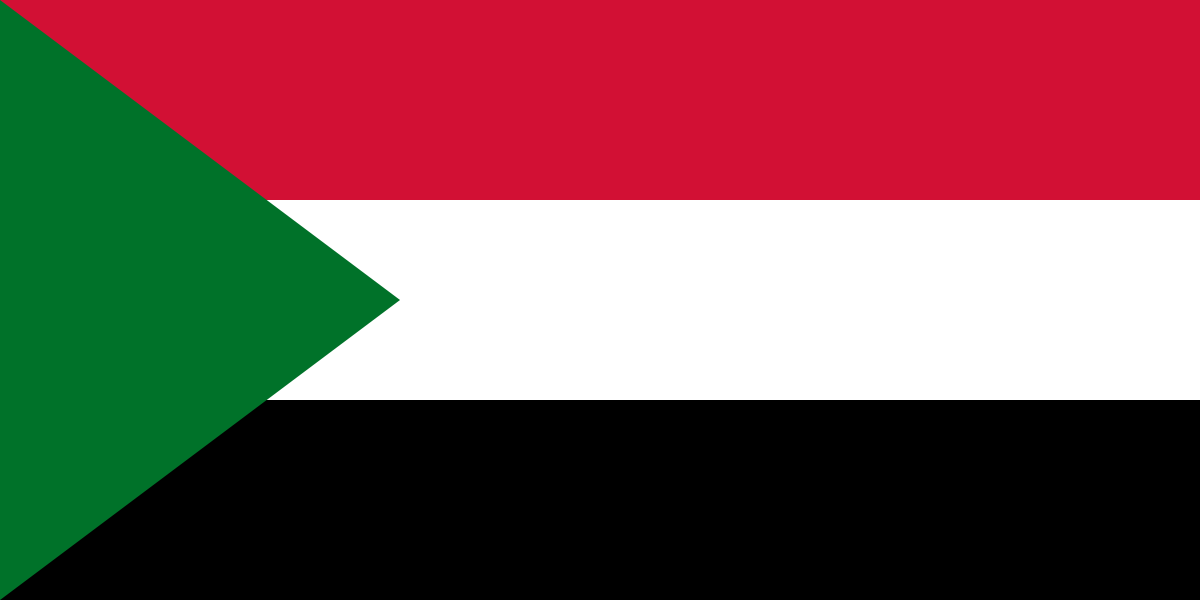
Geography
Location: north-eastern Africa, bordering the Red Sea, between Egypt and Eritrea.
CIA 2026
Loading TerraBrawl
Data as of May 28, 2026
No place in Africa outperforms Sudan in land area. Test your knowledge of Africa's top performer.
No place in Africa outperforms Sudan in land area. This regional dominance shapes its continental identity. Test your knowledge of Africa's top performer.
Area
1.9M km²
Pop.
50.47M
Stats
114
Sudan is a country in Africa with a population of 50.47M and an area of 1,886,068 km². Life expectancy is 66.3 years.
Short factual summary generated from the same country data used in game rounds.
Core numbers
Fast scan first, deep dive later.
Land Area
1.87M km²Total land area in square kilometers, excluding lakes, rivers, and territorial waters.
Population Density
26.79 /km²How many people live in each square kilometer of land.
Life Expectancy
66.3 yearsHow many years a newborn can expect to live, based on current mortality rates.
CO2 Per Capita
0.35 t/person/yrAnnual carbon dioxide emissions in tonnes per person, from Our World in Data using the latest available country values in TerraBrawl.
Country briefing
A quick real-world briefing before you dive deeper into rankings, surprises, and matchups.
Geography
Location: north-eastern Africa, bordering the Red Sea, between Egypt and Eritrea.
Culture
Major languages include Arabic (official), English (official), Nubian, Ta Bedawie, and more.
Identity
Formal name: Republic of the Sudan.
Cities
Browse this country's cities before City Detective asks you to guess.
Khartoum
Sudan
Nyala
Southern Darfur, Sudan
Port Sudan
Red Sea, Sudan
Kassala
Sudan
El Obeid
North Kordofan, Sudan
Dongola
Northern State, Sudan
Al-Junaynah
Western Darfur, Sudan
Omdurman
Khartoum, Sudan
Top stats
The strongest source-backed stats before the deeper data table.
Inflation Rate
138.8%How much prices increased over the year, based on the cost of everyday goods and services.
Birth Rate
32.95 per 1kThe number of babies born per 1,000 people each year.
Land Border Length
6.8K kmTotal length of land borders with neighboring countries from the frozen public-domain CIA World Factbook snapshot.
Air Pollution (PM2.5)
45.83 µg/m³The average level of fine particle air pollution (PM2.5) that people are exposed to.
Broadband Access (%)
202 per 100 peopleFixed broadband subscriptions per 100 people, from World Bank Open Data.
Reality checks
The stats that tend to surprise players in real rounds.
Only ranks #207 in gdp growth rate
The annual percentage change in the country's GDP.
Only ranks #185 in alcohol consumption
Liters of pure alcohol the average adult aged 15+ consumes per year, from Our World in Data using the latest available country values in TerraBrawl.
Only ranks #199 in protected land (%)
The percentage of land area designated as protected natural reserves or parks.
Ranks #18 globally in fertility rate
The average number of children a woman would have over her lifetime based on current birth rates.
Only ranks #176 in human development index
Composite 0-1 index of life expectancy, education, and income, from Our World in Data using the latest available country values in TerraBrawl.
Compared with the region
Country vs continent vs world averages
GDP per person, adjusted for purchasing power parity (PPP) so costs of living are comparable across countries.
How many years a newborn can expect to live, based on current mortality rates.
Composite 0-1 index of life expectancy, education, and income, from Our World in Data using the latest available country values in TerraBrawl.
The percentage of people who have used the internet in the last 3 months.
Think you can guess which countries rank higher?
Play this countryFactbook notes
Country briefing
Long referred to as Nubia, modern-day Sudan was the site of the Kingdom of Kerma (ca.
Long referred to as Nubia, modern-day Sudan was the site of the Kingdom of Kerma (ca. 2500-1500 B.C.) until it was absorbed into the New Kingdom of Egypt. By the 11th century B.C., the Kingdom of Kush gained independence from Egypt; it lasted in various forms until the middle of the 4th century A.D. After the fall of Kush, the Nubians formed three Christian kingdoms of Nobatia, Makuria, and Alodia, with the latter two enduring until around 1500. Between the 14th and 15th centuries, Arab nomads settled much of Sudan, leading to extensive Islamization between the 16th and 19th centuries. Following Egyptian occupation early in the 19th century, an agreement in 1899 set up a joint British-Egyptian government in Sudan, but it was effectively a British colony.
Military regimes favoring Islamic-oriented governments have dominated national politics since Sudan gained independence from Anglo-Egyptian co-rule in 1956. During most of the second half of the 20th century, Sudan was embroiled in two prolonged civil wars rooted in northern domination of the largely non-Muslim, non-Arab southern portion of the country. The first civil war ended in 1972, but another broke out in 1983. Peace talks gained momentum in 2002-04, and the final North/South Comprehensive Peace Agreement in 2005 granted the southern rebels autonomy for six years, followed by a referendum on independence for Southern Sudan. South Sudan became independent in 2011, but Sudan and South Sudan have yet to fully implement security and economic agreements to normalize relations between the two countries. Sudan has also faced conflict in Darfur, Southern Kordofan, and Blue Nile starting in 2003.
In 2019, after months of nationwide protests, the 30-year reign of President Omar Hassan Ahmad al-BASHIR ended when the military forced him out. Economist and former international civil servant Abdalla HAMDOUK al-Kinani was selected to serve as the prime minister of a transitional government as the country prepared for elections in 2022. In late 2021, however, the Sudanese military ousted HAMDOUK and his government and replaced civilian members of the Sovereign Council (Sudan’s collective Head of State) with individuals selected by the military. HAMDOUK was briefly reinstated but resigned in January 2022. General Abd-al-Fatah al-BURHAN Abd-al-Rahman, the Chair of Sudan’s Sovereign Council and Commander-in-Chief of the Sudanese Armed Forces, currently serves as de facto head of state and government. He presides over a Sovereign Council consisting of military leaders, former armed opposition group representatives, and military-appointed civilians. A cabinet of acting ministers handles day-to-day administration.
Data vault
Every tracked stat, grouped for fast scanning.
Keep exploring
Open the head-to-head pages people naturally search after reading this profile.
Jump straight to the rankings where this country has its strongest edge.
Turn Sudan's strongest number into a challenge card.
Total land area in square kilometers, excluding lakes, rivers, and territorial waters.
Sudan has a population of 50.47M, ranking #30 globally by population.
Sudan is located in Africa. It has an area of 1,886,068 km².
Life expectancy in Sudan is 66.3 years, ranking #179 globally.
Sudan's GDP per capita (PPP) is $2,115.82, ranking #189 globally.
Sudan ranks particularly high in Land Area (#15), Population (#30), Population Density (#175).
Sudan has an HDI of 0.511, ranking #176 globally. The HDI combines life expectancy, education, and income indicators.
Sudan has a population density of 26.8 people per km², ranking #175 globally.