Identity
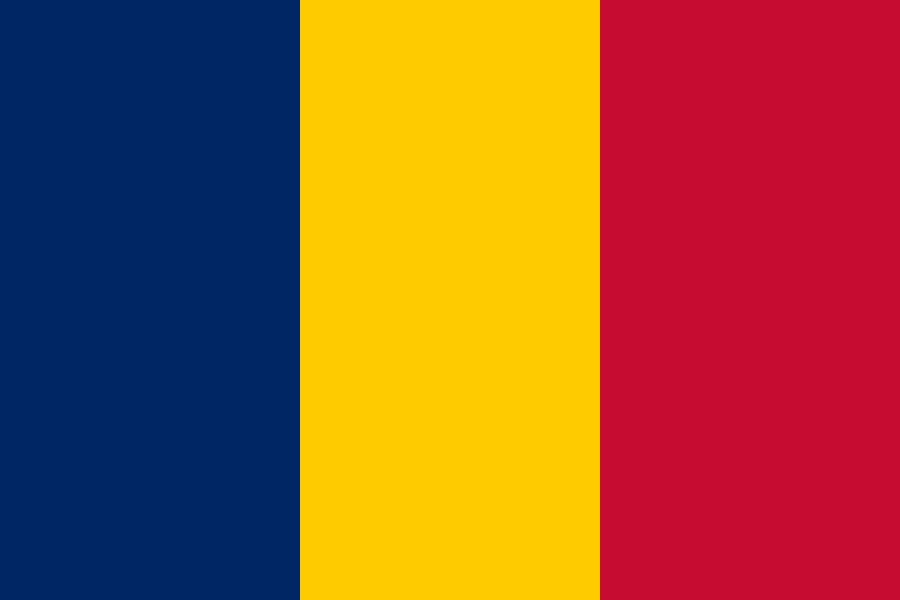
Formal name: Republic of Chad.
CIA 2026
Loading TerraBrawl
Data as of May 28, 2026
Chad is a place of striking contrasts. Explore the contradictions that define this nation.
Chad is a place of striking contrasts. #7 in fertility rate but near the bottom in life expectancy. Explore the contradictions that define this nation.
Area
1.3M km²
Pop.
19.67M
Stats
114
Chad is a country in Africa with a population of 19.67M and an area of 1,284,000 km². Life expectancy is 55.1 years.
Short factual summary generated from the same country data used in game rounds.
Core numbers
Fast scan first, deep dive later.
Land Area
1.26M km²Total land area in square kilometers, excluding lakes, rivers, and territorial waters.
Population Density
15.34 /km²How many people live in each square kilometer of land.
GDP Per Capita
$2,605.77GDP per person adjusted for purchasing power in constant 2017 international dollars, from Our World in Data using the latest available country values in TerraBrawl.
GDP Per Capita (PPP)
$2,742.66GDP per person, adjusted for purchasing power parity (PPP) so costs of living are comparable across countries.
CO2 Per Capita
0.14 t/person/yrAnnual carbon dioxide emissions in tonnes per person, from Our World in Data using the latest available country values in TerraBrawl.
Country briefing
A quick real-world briefing before you dive deeper into rankings, surprises, and matchups.
Identity
Formal name: Republic of Chad.
Geography
Size snapshot: almost nine times the size of New York state.
Culture
Major languages include French (official), Arabic (official), Sara (in south), more than 120 languages and dialects.
Cities
Browse this country's cities before City Detective asks you to guess.
Top stats
The strongest source-backed stats before the deeper data table.
Child Mortality
101.1 per 1k birthsDeaths before age 5 per 1,000 live births, from World Bank Open Data.
Teen Birth Rate
134.74 per 1kThe number of births per 1,000 women aged 15-19.
Lowest Elevation
160 mLowest point elevation from CIA World Factbook.
Air Pollution (PM2.5)
49.14 µg/m³The average level of fine particle air pollution (PM2.5) that people are exposed to.
Reality checks
The stats that tend to surprise players in real rounds.
Only ranks #216 in broadband access (%)
Fixed broadband subscriptions per 100 people, from World Bank Open Data.
Only ranks #234 in median age
The age that splits the population in half: half are younger, half are older. UN WPP estimate as of 1 July 2023.
Only ranks #212 in electricity access (%)
The percentage of the population with access to electricity.
Only ranks #214 in life expectancy
How many years a newborn can expect to live, based on current mortality rates.
Only ranks #190 in human development index
Composite 0-1 index of life expectancy, education, and income, from Our World in Data using the latest available country values in TerraBrawl.
Compared with the region
Country vs continent vs world averages
GDP per person, adjusted for purchasing power parity (PPP) so costs of living are comparable across countries.
How many years a newborn can expect to live, based on current mortality rates.
Composite 0-1 index of life expectancy, education, and income, from Our World in Data using the latest available country values in TerraBrawl.
The percentage of people who have used the internet in the last 3 months.
Think you can guess which countries rank higher?
Play this countryFactbook notes
Country briefing
Chad emerged from a collection of powerful states that controlled the Sahelian belt starting around the 9th century.
Chad emerged from a collection of powerful states that controlled the Sahelian belt starting around the 9th century. These states focused on controlling trans-Saharan trade routes and profited mostly from the slave trade. The Kanem-Bornu Empire, centered around the Lake Chad Basin, existed between the 9th and 19th centuries, and at its peak, the empire controlled territory stretching from southern Chad to southern Libya and included portions of modern-day Algeria, Cameroon, Niger, Nigeria, and Sudan. The Sudanese warlord Rabih AZ-ZUBAYR used an army comprised largely of slaves to conquer the Kanem-Bornu Empire in the late 19th century. In southeastern Chad, the Bagirmi and Ouaddai (Wadai) kingdoms emerged in the 15th and 16th centuries and lasted until the arrival of the French in the 19th and 20th centuries. France began moving into the region in the late 1880s and defeated the Bagirmi kingdom in 1897, Rabih AZ-ZUBAYR in 1900, and the Ouddai kingdom in 1909. In the arid regions of northern Chad and southern Libya, an Islamic order called the Sanusiyya (Sanusi) relied heavily on the trans-Saharan slave trade and had upwards of 3 million followers by the 1880s. The French defeated the Sanusiyya in 1910 after years of intermittent war. By 1910, France had incorporated the northern arid region, the Lake Chad Basin, and southeastern Chad into French Equatorial Africa.
Chad achieved its independence in 1960 and then saw three decades of instability, oppressive rule, civil war, and a Libyan invasion. With the help of the French military and several African countries, Chadian leaders expelled Libyan forces during the 1987 "Toyota War," so named for the use of Toyota pickup trucks as fighting vehicles. In 1990, Chadian general Idriss DEBY led a rebellion against President Hissene HABRE. Under DEBY, Chad approved a constitution and held elections in 1996. Shortly after DEBY was killed during a rebel incursion in 2021, a group of military officials -- led by DEBY’s son, Mahamat Idriss DEBY -- took control of the government. The military officials dismissed the National Assembly, suspended the Constitution, and formed a Transitional Military Council (TMC), while pledging to hold democratic elections by October 2022. A national dialogue in August-October 2022 culminated in decisions to extend the transition for up to two years, dissolve the TMC, and appoint Mahamat DEBY as Transitional President; the transitional authorities held a constitutional referendum in December 2023 and claimed 86 percent of votes were in favor of the new constitution. The transitional authorities have announced plans to hold elections by October 2024.
Chad has faced widespread poverty, an economy severely weakened by volatile international oil prices, terrorist-led insurgencies in the Lake Chad Basin, and several waves of rebellions in northern and eastern Chad. In 2015, the government imposed a state of emergency in the Lake Chad Basin following multiple attacks by the terrorist group Boko Haram, now known as ISIS-West Africa. The same year, Boko Haram conducted bombings in N'Djamena. In 2019, the Chadian government also declared a state of emergency in the Sila and Ouaddai regions bordering Sudan and in the Tibesti region bordering Niger, where rival ethnic groups are still fighting. The army has suffered heavy losses to Islamic terror groups in the Lake Chad Basin.
Data vault
Every tracked stat, grouped for fast scanning.
Keep exploring
Open the head-to-head pages people naturally search after reading this profile.
Jump straight to the rankings where this country has its strongest edge.
Turn Chad's strongest number into a challenge card.
Total land area in square kilometers, excluding lakes, rivers, and territorial waters.
Chad has a population of 19.67M, ranking #66 globally by population.
Chad is located in Africa. It has an area of 1,284,000 km².
Life expectancy in Chad is 55.1 years, ranking #214 globally.
Chad's GDP per capita (PPP) is $2,742.66, ranking #186 globally.
Chad ranks particularly high in Land Area (#21), Population (#66), Population Density (#198).
Chad has an HDI of 0.416, ranking #190 globally. The HDI combines life expectancy, education, and income indicators.
Chad has a population density of 15.3 people per km², ranking #198 globally.