Culture
National symbols include Hispaniolan trogon (bird), hibiscus flower.
CIA 2026
Loading TerraBrawl
Data as of May 28, 2026
Haiti dominates North America when it comes to renewable energy. See how it stacks up across the continent.
Haiti dominates North America when it comes to renewable energy. That 76.7% figure tops every neighbor. See how it stacks up across the continent.
Area
28K km²
Pop.
11.90M
Stats
109
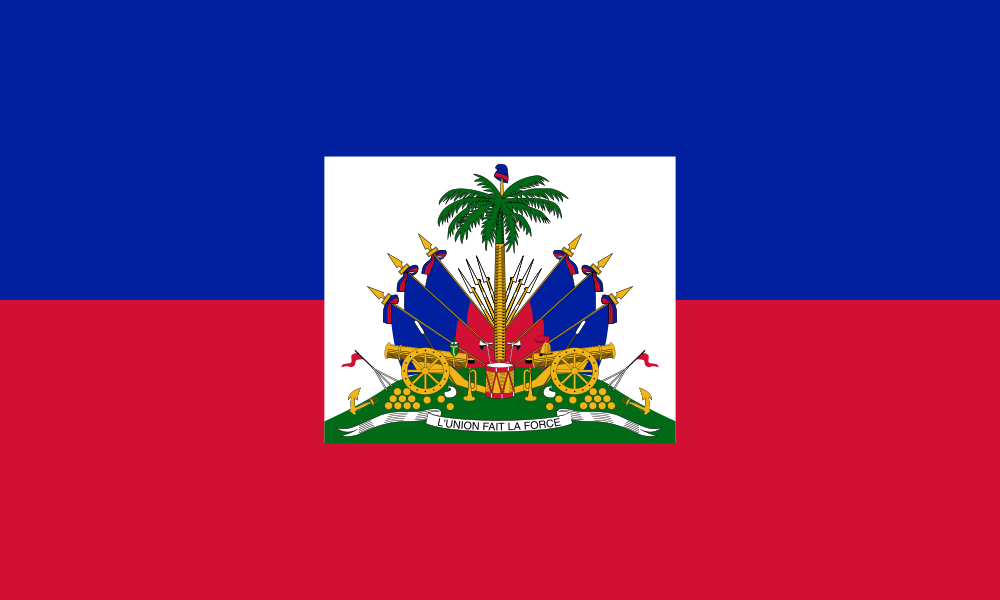
Haiti is a country in North America with a population of 11.90M and an area of 27,750 km². Life expectancy is 64.9 years.
Short factual summary generated from the same country data used in game rounds.
Core numbers
Fast scan first, deep dive later.
Population Density
422.26 /km²How many people live in each square kilometer of land.
Land Area
27.6K km²Total land area in square kilometers, excluding lakes, rivers, and territorial waters.
Internet Users (%)
39%The percentage of people who have used the internet in the last 3 months.
Human Development Index
0.55Composite 0-1 index of life expectancy, education, and income, from Our World in Data using the latest available country values in TerraBrawl.
Life Expectancy
64.9 yearsHow many years a newborn can expect to live, based on current mortality rates.
Country briefing
A quick real-world briefing before you dive deeper into rankings, surprises, and matchups.
Culture
National symbols include Hispaniolan trogon (bird), hibiscus flower.
Identity
Formal name: Republic of Haiti.
Geography
Size snapshot: slightly smaller than Maryland.
Cities
Browse this country's cities before City Detective asks you to guess.
Top stats
The strongest source-backed stats before the deeper data table.
Youth Unemployment Rate
37.52% of youth labor forceShare of the labor force ages 15-24 that is unemployed from the World Bank latest available country value.
Broadband Access (%)
202 per 100 peopleFixed broadband subscriptions per 100 people, from World Bank Open Data.
Inflation Rate
26.9%How much prices increased over the year, based on the cost of everyday goods and services.
Renewable Energy (%)
76.7%The percentage of energy consumption that comes from renewable sources like solar, wind, and hydro.
Child Mortality
55.1 per 1k birthsDeaths before age 5 per 1,000 live births, from World Bank Open Data.
Reality checks
The stats that tend to surprise players in real rounds.
Only ranks #158 in military spending
Military expenditure as a share of GDP, from World Bank Open Data.
Only ranks #204 in gdp growth rate
The annual percentage change in the country's GDP.
Only ranks #180 in education spending (% gdp)
Government education spending as a share of GDP, from World Bank Open Data.
Only ranks #164 in armed forces personnel
Total armed forces personnel from the World Bank latest available country value.
Only ranks #171 in merchant fleet size
Number of merchant marine ships from the frozen public-domain CIA World Factbook snapshot.
Compared with the region
Country vs continent vs world averages
GDP per person, adjusted for purchasing power parity (PPP) so costs of living are comparable across countries.
How many years a newborn can expect to live, based on current mortality rates.
Composite 0-1 index of life expectancy, education, and income, from Our World in Data using the latest available country values in TerraBrawl.
The percentage of people who have used the internet in the last 3 months.
Think you can guess which countries rank higher?
Play this countryFactbook notes
Country briefing
The native Taino -- who inhabited the island of Hispaniola when Christopher COLUMBUS first landed in 1492 -- were virtually wiped out by Spanish settlers within 25 years.
The native Taino -- who inhabited the island of Hispaniola when Christopher COLUMBUS first landed in 1492 -- were virtually wiped out by Spanish settlers within 25 years. In the early 17th century, the French established a presence on Hispaniola. In 1697, Spain ceded to the French the western third of the island, which later became Haiti. The French colony, based on forestry and sugar-related industries, became one of the wealthiest in the Caribbean but relied heavily on the forced labor of enslaved Africans and environmentally degrading practices. In the late 18th century, Toussaint L'OUVERTURE led a revolution of Haiti's nearly half a million slaves that ended France's rule on the island. After a prolonged struggle, and under the leadership of Jean-Jacques DESSALINES, Haiti became the first country in the world led by former slaves after declaring its independence in 1804, but it was forced to pay an indemnity of 100 million francs (equivalent to $22 billion USD in March 2023) to France for more than a century and was shunned by other countries for nearly 40 years. In 1862, the US officially recognized Haiti, but foreign economic influence and internal political instability induced the US to occupy Haiti from 1915 to 1934.
Francois "Papa Doc" DUVALIER and then his son Jean-Claude "Baby Doc" DUVALIER led repressive and corrupt regimes that ruled Haiti in 1957-1971 and 1971-1986, respectively. Jean-Bertrand ARISTIDE was Haiti's first democratically elected president in 1991 and was elected a second time in 2000, but coups interrupted his first term after only a few months and ended his second term in 2004. President Jovenel MOÏSE was assassinated in 2021, leading the country further into an extra-constitutional governance structure and contributing to the country’s growing fragility. The Government of Haiti then installed Ariel HENRY -- whom President MOÏSE had nominated shortly before his death -- as prime minister.
On 29 February 2024, a significant escalation of gang violence occurred on the 20th anniversary of ARISTIDE's second overthrow, after the announcement that HENRY would not hold elections until August 2025. HENRY’s return from an overseas trip was diverted to Puerto Rico when the airport closed due to gang violence. With control of much of the capital, Port-au-Prince, gang leaders called for the ouster of HENRY’S government. By mid-March, Haiti’s continued violence, HENRY’S inability to return to the country, and increasing pressure from the international community led HENRY to pledge to resign. On 25 April 2024, HENRY formally submitted his resignation as a nine-member Transitional Presidential Council assumed control, tasked with returning stability to the country and preparing elections. Since January 2023, Haiti has had no sitting elected officials.
The country has long been plagued by natural disasters. In 2010, a major 7.0 magnitude earthquake struck Haiti with an epicenter about 25 km (15 mi) west of the capital, Port-au-Prince. An estimated 300,000 people were killed, and some 1.5 million left homeless. The earthquake was assessed as the worst in this region in 200 years. A 7.2 magnitude earthquake hit Haiti’s southern peninsula in 2021, causing well over 2,000 deaths; an estimated 500,000 required emergency humanitarian aid. Haiti is the poorest country in the Western Hemisphere, as well as one of the most unequal in wealth distribution.
Data vault
Every tracked stat, grouped for fast scanning.
Keep exploring
Open the head-to-head pages people naturally search after reading this profile.
Jump straight to the rankings where this country has its strongest edge.
Turn Haiti's strongest number into a challenge card.
How many people live in each square kilometer of land.
Haiti has a population of 11.90M, ranking #83 globally by population.
Haiti is located in North America. It has an area of 27,750 km².
Life expectancy in Haiti is 64.9 years, ranking #188 globally.
Haiti's GDP per capita (PPP) is $3,193.67, ranking #182 globally.
Haiti ranks particularly high in Population Density (#27), Population (#83), Land Area (#142).
Haiti has an HDI of 0.554, ranking #166 globally. The HDI combines life expectancy, education, and income indicators.
Haiti has a population density of 422.3 people per km², ranking #27 globally.