Geography
Size snapshot: slightly less than twice the size of Texas.
CIA 2026
Loading TerraBrawl
Data as of May 28, 2026
Among all countries, Ethiopia stands 7th in renewable energy. Can you guess its other standout statistics?
Among all countries, Ethiopia stands 7th in renewable energy. This achievement puts it ahead of the vast majority of countries. Can you guess its other standout statistics?
Area
1.1M km²
Pop.
121.37M
Stats
125
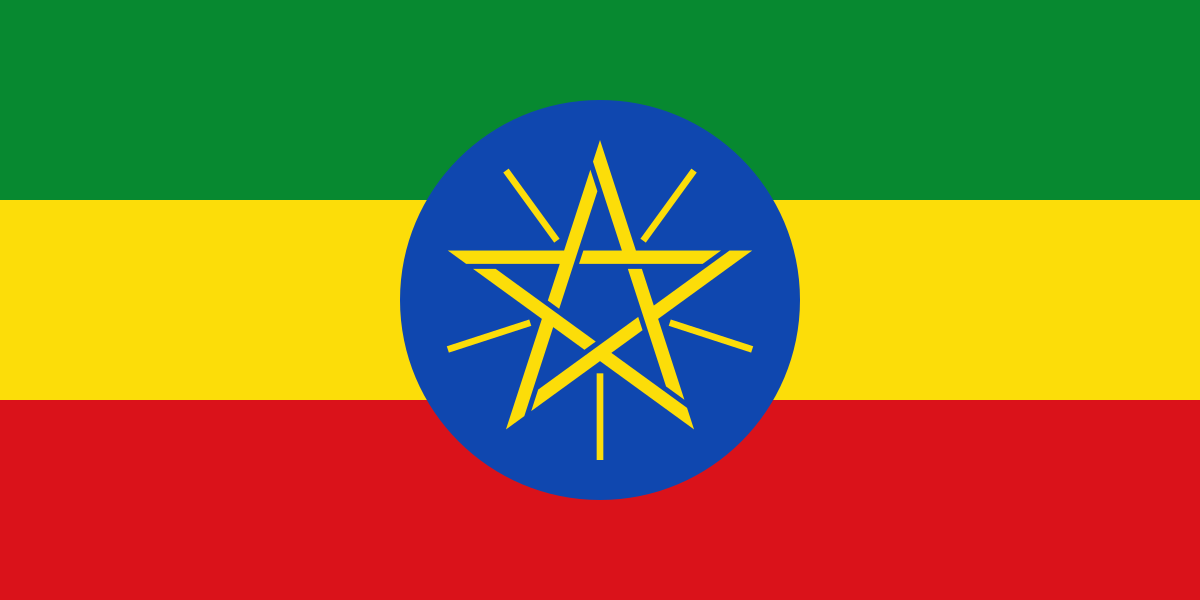
Ethiopia is a country in Africa with a population of 121.37M and an area of 1,104,300 km². Life expectancy is 67.3 years.
Short factual summary generated from the same country data used in game rounds.
Core numbers
Fast scan first, deep dive later.
Land Area
1.13M km²Total land area in square kilometers, excluding lakes, rivers, and territorial waters.
Population Density
114.04 /km²How many people live in each square kilometer of land.
Life Expectancy
67.3 yearsHow many years a newborn can expect to live, based on current mortality rates.
GDP Per Capita
$2,884.26GDP per person adjusted for purchasing power in constant 2017 international dollars, from Our World in Data using the latest available country values in TerraBrawl.
Country briefing
A quick real-world briefing before you dive deeper into rankings, surprises, and matchups.
Geography
Size snapshot: slightly less than twice the size of Texas.
Culture
Major languages include Oromo (official regional working language) 33.8%, Amharic (official national language) 29.3%, Somali (official regional working language) 6.2%, T…
Identity
Formal name: Federal Democratic Republic of Ethiopia.
Cities
Browse this country's cities before City Detective asks you to guess.
Addis Ababa
Ethiopia
Bahir Dar
Amhara, Ethiopia
Dire Dawa
Ethiopia
Mek'ele
Tigray, Ethiopia
Gonder
Amhara, Ethiopia
Harar
Harari, Ethiopia
Awasa
Sidama Region, Ethiopia
Jijiga
Somali, Ethiopia
Top stats
The strongest source-backed stats before the deeper data table.
Renewable Energy (%)
90.6%The percentage of energy consumption that comes from renewable sources like solar, wind, and hydro.
Broadband Access (%)
202 per 100 peopleFixed broadband subscriptions per 100 people, from World Bank Open Data.
Land Border Length
5.9K kmTotal length of land borders with neighboring countries from the frozen public-domain CIA World Factbook snapshot.
Women in Parliament (%)
41.31%The percentage of parliament seats held by women.
Reality checks
The stats that tend to surprise players in real rounds.
Only ranks #197 in obesity rate
Share of adults with obesity, from Our World in Data using the latest available country values in TerraBrawl.
Only ranks #225 in internet users (%)
The percentage of people who have used the internet in the last 3 months.
Keeps co2 per capita unusually low
Annual carbon dioxide emissions in tonnes per person, from Our World in Data using the latest available country values in TerraBrawl.
Only ranks #234 in lowest elevation
Lowest point elevation from CIA World Factbook.
Only ranks #182 in health spending (% gdp)
Current health expenditure as a share of GDP, from World Bank Open Data.
Compared with the region
Country vs continent vs world averages
GDP per person, adjusted for purchasing power parity (PPP) so costs of living are comparable across countries.
How many years a newborn can expect to live, based on current mortality rates.
Composite 0-1 index of life expectancy, education, and income, from Our World in Data using the latest available country values in TerraBrawl.
The percentage of people who have used the internet in the last 3 months.
Think you can guess which countries rank higher?
Play this countryFactbook notes
Country briefing
The area that is modern-day Ethiopia is rich in cultural and religious diversity with more than 80 ethnic groups.
The area that is modern-day Ethiopia is rich in cultural and religious diversity with more than 80 ethnic groups. The oldest hominid yet found comes from Ethiopia, and Ethiopia was the second country to officially adopt Christianity in the 4th century A.D. A series of monarchies ruled the area that is now Ethiopia from 980 B.C. to 1855, when the Amhara kingdoms of northern Ethiopia united in an empire under Tewodros II. Many Ethiopians still speak reverently about the Battle of Adwa in 1896, when they defeated Italian forces and won their freedom from colonial rule.
Emperor Haile SELASSIE became an internationally renowned figure in 1935, when he unsuccessfully appealed to the League of Nations to prevent Italy from occupying Ethiopia from 1936 to 1941. SELASSIE survived an attempted coup in 1960, annexed modern-day Eritrea in 1962, and played a leading role in establishing the Organization of African Unity in 1963. However, in 1974, a military junta called the Derg deposed him and established a socialist state. Torn by bloody coups, uprisings, drought, and massive displacement, the Derg regime was toppled in 1991 by a coalition of opposing forces, the Ethiopian People's Revolutionary Democratic Front (EPRDF). The EPRDF became an ethno-federalist political coalition that ruled Ethiopia from 1991 until its dissolution in 2019. Ethiopia adopted its constitution in 1994 and held its first multiparty elections in 1995.
A two-and-a-half-year border war with Eritrea in the late 1990s ended with a peace treaty in 2000. Ethiopia subsequently rejected the 2007 Eritrea-Ethiopia Boundary Commission demarcation. This resulted in more than a decade of a tense “no peace, no war” stalemate between the two countries. In 2012, longtime Prime Minister MELES Zenawi died in office and was replaced by his Deputy Prime Minister HAILEMARIAM Desalegn, marking the first peaceful transition of power in decades. Following a wave of popular dissent and anti-government protest that began in 2015, HAILEMARIAM resigned in 2018, and ABIY Ahmed Ali took office the same year as Ethiopia's first ethnic Oromo prime minister. In 2018, ABIY promoted a rapprochement between Ethiopia and Eritrea that was marked with a peace agreement and a reopening of their shared border. In 2019, Ethiopia's nearly 30-year ethnic-based ruling coalition, the EPRDF, merged into a single unity party called the Prosperity Party; however, the lead coalition party, the Tigray People’s Liberation Front (TPLF), declined to join. In 2020, a military conflict erupted between forces aligned with the TPLF and the Ethiopian military. The conflict -- which was marked by atrocities committed by all parties -- ended in 2022 with a cessation of hostilities agreement between the TPLF and the Ethiopian Government. However, Ethiopia continues to experience ethnic-based violence as other groups -- including the Oromo Liberation Army (OLA) and Amhara militia Fano -- seek concessions from the Ethiopian Government.
Data vault
Every tracked stat, grouped for fast scanning.
Keep exploring
Open the head-to-head pages people naturally search after reading this profile.
Jump straight to the rankings where this country has its strongest edge.
Turn Ethiopia's strongest number into a challenge card.
The total number of people living in the country.
Ethiopia has a population of 121.37M, ranking #12 globally by population.
Ethiopia is located in Africa. It has an area of 1,104,300 km².
Life expectancy in Ethiopia is 67.3 years, ranking #170 globally.
Ethiopia's GDP per capita (PPP) is $3,287.53, ranking #180 globally.
Ethiopia ranks particularly high in Population (#12), Land Area (#25), Population Density (#93).
Ethiopia has an HDI of 0.497, ranking #180 globally. The HDI combines life expectancy, education, and income indicators.
Ethiopia has a population density of 114.0 people per km², ranking #93 globally.