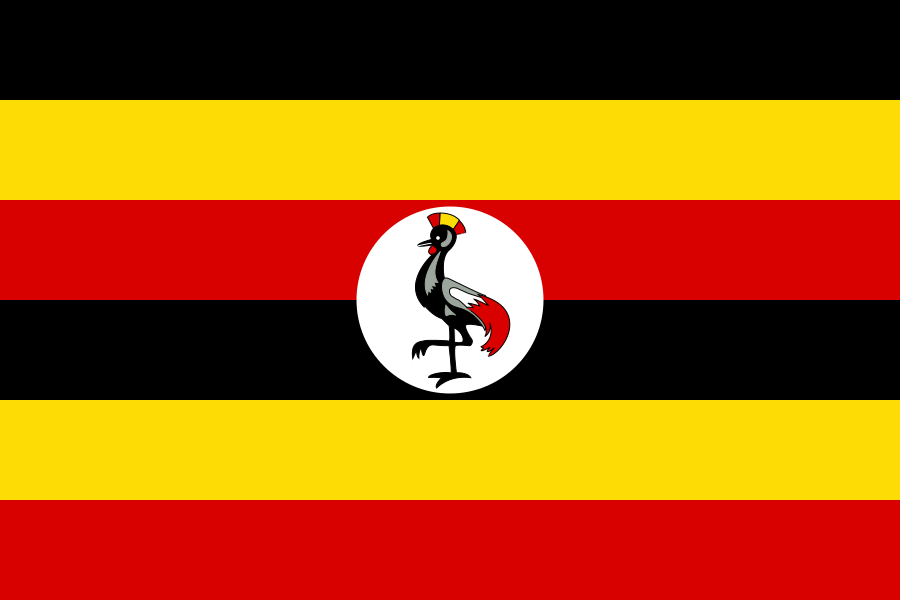
Identity
Formal name: Republic of Uganda.
CIA 2026
Loading TerraBrawl
Data as of May 28, 2026
Uganda ranks #6 globally in renewable energy. Think you know what else Uganda excels at?
Uganda ranks #6 globally in renewable energy. At 90.9%, it outperforms most of the world. Think you know what else Uganda excels at?
Area
242K km²
Pop.
50.86M
Stats
126
Uganda is a country in Africa with a population of 50.86M and an area of 241,550 km². Life expectancy is 68.3 years.
Short factual summary generated from the same country data used in game rounds.
Core numbers
Fast scan first, deep dive later.
Population Density
242.65 /km²How many people live in each square kilometer of land.
Land Area
200.5K km²Total land area in square kilometers, excluding lakes, rivers, and territorial waters.
Life Expectancy
68.3 yearsHow many years a newborn can expect to live, based on current mortality rates.
Human Development Index
0.58Composite 0-1 index of life expectancy, education, and income, from Our World in Data using the latest available country values in TerraBrawl.
Country briefing
A quick real-world briefing before you dive deeper into rankings, surprises, and matchups.
Identity
Formal name: Republic of Uganda.
Curated stat
Uganda's Rwenzori Mountains include Africa's third-highest peak and glaciers near the equator.
Geography
Size snapshot: slightly more than two times the size of Pennsylvania.
Cities
Browse this country's cities before City Detective asks you to guess.
Kampala
Central Region, Uganda
Gulu
Northern Region, Uganda
Kasese
Western Region, Uganda
Arua
Northern Region, Uganda
Jinja
Eastern Region, Uganda
Mbale
Eastern Region, Uganda
Mbarara
Western Region, Uganda
Lira
Northern Region, Uganda
Top stats
The strongest source-backed stats before the deeper data table.
Renewable Energy (%)
90.9%The percentage of energy consumption that comes from renewable sources like solar, wind, and hydro.
Birth Rate
38.91 per 1kThe number of babies born per 1,000 people each year.
Lowest Elevation
614 mLowest point elevation from CIA World Factbook.
Alcohol Consumption
11.3 L/adult/yrLiters of pure alcohol the average adult aged 15+ consumes per year, from Our World in Data using the latest available country values in TerraBrawl.
Reality checks
The stats that tend to surprise players in real rounds.
Only ranks #231 in internet users (%)
The percentage of people who have used the internet in the last 3 months.
Only ranks #235 in coastline length
Total coastline length from CIA World Factbook.
Ranks #8 globally in fertility rate
The average number of children a woman would have over her lifetime based on current birth rates.
Keeps co2 per capita unusually low
Annual carbon dioxide emissions in tonnes per person, from Our World in Data using the latest available country values in TerraBrawl.
Only ranks #210 in elderly population (%)
Share of the population ages 65 and older, from World Bank Open Data.
Compared with the region
Country vs continent vs world averages
GDP per person, adjusted for purchasing power parity (PPP) so costs of living are comparable across countries.
How many years a newborn can expect to live, based on current mortality rates.
Composite 0-1 index of life expectancy, education, and income, from Our World in Data using the latest available country values in TerraBrawl.
The percentage of people who have used the internet in the last 3 months.
Think you can guess which countries rank higher?
Play this countryFactbook notes
Country briefing
An ancient crossroads for various migrations, Uganda has as many as 65 ethnic groups that speak languages from three of Africa’s four major linguistic families.
An ancient crossroads for various migrations, Uganda has as many as 65 ethnic groups that speak languages from three of Africa’s four major linguistic families. As early as 1200, fertile soils and regular rainfall in the south fostered the formation of several large, centralized kingdoms, including Buganda, from which the country derives its name. Muslim traders from Egypt reached northern Uganda in the 1820s, and Swahili merchants from the Indian Ocean coast arrived in the south by the 1840s. The area attracted the attention of British explorers seeking the source of the Nile River in the 1860s, and this influence expanded in subsequent decades with the arrival of Christian missionaries and trade agreements; Uganda was declared a British protectorate in 1894. Buganda and other southern kingdoms negotiated agreements with Britain to secure privileges and a level of autonomy that were rare during the colonial period in Africa. Uganda's colonial boundaries grouped together a wide range of ethnic groups with different political systems and cultures, and the disparities between how Britain governed southern and northern areas compounded these differences, complicating efforts to establish a cohesive independent country.
Uganda gained independence in 1962 with one of the more developed economies and one of the strongest education systems in Sub-Saharan Africa, but it descended within a few years into political turmoil and internal conflict that lasted more than two decades. In 1966, Prime Minister Milton OBOTE suspended the constitution and violently deposed President Edward MUTESA, who was also the king of Buganda. Idi AMIN seized power in 1971 through a military coup and led the country into economic ruin and rampant mass atrocities that killed as many as 500,000 civilians. AMIN’s annexation of Tanzanian territory in 1979 provoked Tanzania to invade Uganda, depose AMIN, and install a coalition government. In the aftermath, Uganda continued to experience atrocities, looting, and political instability and had four different heads of state between 1979 and 1980. OBOTE regained the presidency in 1980 through a controversial election that sparked renewed guerrilla warfare, killing as an estimated 300,000 civilians. Gen. Tito OKELLO seized power in a coup in 1985, but his rule was short-lived, with Yoweri MUSEVENI becoming president in 1986 after his insurgency captured the capital. MUSEVENI is widely credited with restoring relative stability and economic growth to Uganda but has resisted calls to leave office. In 2017, parliament removed presidential age limits, making it possible for MUSEVENI to remain in office for life.
Data vault
Every tracked stat, grouped for fast scanning.
Keep exploring
Open the head-to-head pages people naturally search after reading this profile.
Jump straight to the rankings where this country has its strongest edge.
Turn Uganda's strongest number into a challenge card.
The total number of people living in the country.
Uganda has a population of 50.86M, ranking #29 globally by population.
Uganda is located in Africa. It has an area of 241,550 km².
Life expectancy in Uganda is 68.3 years, ranking #163 globally.
Uganda's GDP per capita (PPP) is $3,273.27, ranking #181 globally.
Uganda ranks particularly high in Population (#29), Population Density (#54), Land Area (#85).
Uganda has an HDI of 0.582, ranking #158 globally. The HDI combines life expectancy, education, and income indicators.
Uganda has a population density of 242.7 people per km², ranking #54 globally.