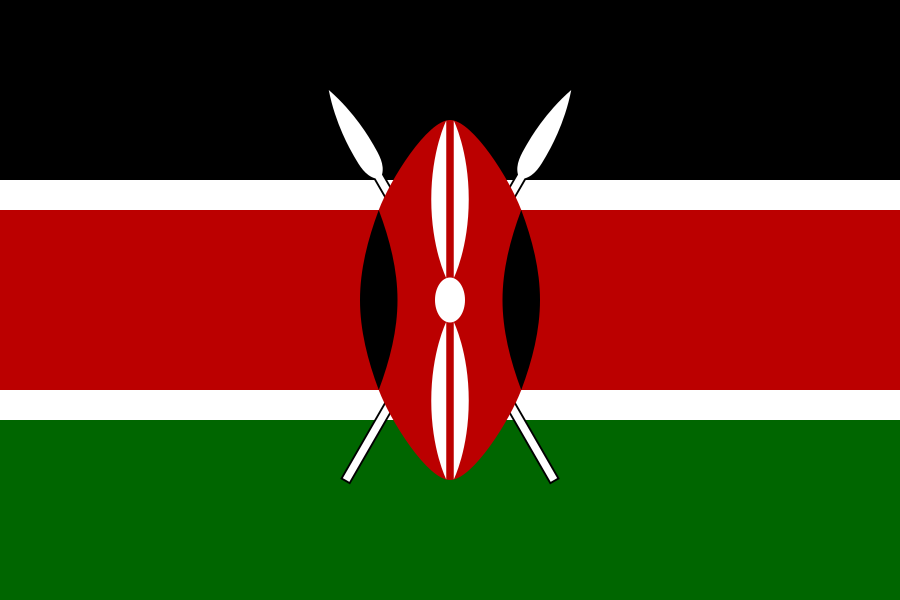
Identity
Formal name: Republic of Kenya.
CIA 2026
Loading TerraBrawl
Data as of May 28, 2026
Kenya excels and struggles in equal measure. See what other surprises Kenya holds.
Kenya excels and struggles in equal measure. It ranks #30 in renewable energy, yet surprisingly lags in life expectancy. See what other surprises Kenya holds.
Area
580K km²
Pop.
55.75M
Stats
127
Kenya is a country in Africa with a population of 55.75M and an area of 580,367 km². Life expectancy is 63.6 years.
Short factual summary generated from the same country data used in game rounds.
Core numbers
Fast scan first, deep dive later.
Land Area
580.9K km²Total land area in square kilometers, excluding lakes, rivers, and territorial waters.
Population Density
95.27 /km²How many people live in each square kilometer of land.
Human Development Index
0.63Composite 0-1 index of life expectancy, education, and income, from Our World in Data using the latest available country values in TerraBrawl.
GDP Per Capita
$5,823.41GDP per person adjusted for purchasing power in constant 2017 international dollars, from Our World in Data using the latest available country values in TerraBrawl.
GDP Per Capita (PPP)
$6,644.13GDP per person, adjusted for purchasing power parity (PPP) so costs of living are comparable across countries.
Country briefing
A quick real-world briefing before you dive deeper into rankings, surprises, and matchups.
Identity
Formal name: Republic of Kenya.
Curated stat
Kenya's Lake Turkana is the world's largest desert lake.
Geography
Size snapshot: five times the size of Ohio.
Cities
Browse this country's cities before City Detective asks you to guess.
Nairobi
Nairobi County, Kenya
Mombasa
Mombasa County, Kenya
Eldoret
Uasin Gishu County, Kenya
Kakamega
Kakamega County, Kenya
Kisumu
Kisumu County, Kenya
Nakuru
Nakuru County, Kenya
Meru
Meru County, Kenya
Kitale
Trans Nzoia, Kenya
Top stats
The strongest source-backed stats before the deeper data table.
Airports
344Large, medium, and small airport records by country from the open OurAirports dataset.
Highest Elevation
5.2K mHighest point elevation from CIA World Factbook.
Renewable Energy (%)
67.7%The percentage of energy consumption that comes from renewable sources like solar, wind, and hydro.
Infant Mortality
34.7 per 1k birthsInfant deaths before age 1 per 1,000 live births, from World Bank Open Data.
Reality checks
The stats that tend to surprise players in real rounds.
Only ranks #216 in life expectancy
Average number of years a newborn would be expected to live if current mortality patterns stayed the same, from Our World in Data.
Only ranks #195 in broadband access (%)
Fixed broadband subscriptions per 100 people, from World Bank Open Data.
Only ranks #194 in elderly population (%)
Share of the population ages 65 and older, from World Bank Open Data.
Only ranks #136 in university enrollment rate
Total university and college enrollment as a percentage of the typical college-age population.
Only ranks #201 in death rate
The number of deaths per 1,000 people each year.
Compared with the region
Country vs continent vs world averages
GDP per person, adjusted for purchasing power parity (PPP) so costs of living are comparable across countries.
How many years a newborn can expect to live, based on current mortality rates.
Composite 0-1 index of life expectancy, education, and income, from Our World in Data using the latest available country values in TerraBrawl.
The percentage of people who have used the internet in the last 3 months.
Think you can guess which countries rank higher?
Play this countryFactbook notes
Country briefing
Trade centers such as Mombasa have existed along the Kenyan and Tanzanian coastlines, known as the Land of Zanj, since at least the 2nd century.
Trade centers such as Mombasa have existed along the Kenyan and Tanzanian coastlines, known as the Land of Zanj, since at least the 2nd century. These centers traded with the outside world, including China, India, Indonesia, the Middle East, North Africa, and Persia. By around the 9th century, the mix of Africans, Arabs, and Persians who lived and traded there became known as Swahili ("people of the coast") with a distinct language (KiSwahili) and culture. The Portuguese arrived in the 1490s and, using Mombasa as a base, sought to monopolize trade in the Indian Ocean. The Portuguese were pushed out in the late 1600s by the combined forces of Oman and Pate, an island off the coast. In 1890, Germany and the UK divided up the region, with the UK taking the north and the Germans the south, including present-day Tanzania, Burundi, and Rwanda. In 1895, the British established the East Africa Protectorate, which in 1920 was converted into a colony, and named Kenya after its highest mountain. Numerous political disputes between the colony and the UK led to the violent Mau Mau Uprising, which began in 1952, and the eventual declaration of independence in 1963.
Jomo KENYATTA, the founding president and an icon of the liberation struggle, led Kenya from independence in 1963 until his death in 1978, when Vice President Daniel Arap MOI took power in a constitutional succession. The country was a de facto one-party state from 1969 until 1982, after which time the ruling Kenya African National Union (KANU) changed the constitution to make itself the sole legal political party. MOI gave in to internal and external pressure for political liberalization in 1991, but the ethnically fractured opposition failed to dislodge KANU from power in elections in 1992 and 1997, which were marred by violence and fraud. MOI stepped down in 2002 after fair and peaceful elections. Mwai KIBAKI, running as the candidate of the multiethnic, united opposition group, the National Rainbow Coalition (NARC), defeated KANU candidate Uhuru KENYATTA, the son of the founding president, and assumed the presidency following a campaign centered on an anticorruption platform.
Opposition candidate Raila ODINGA challenged KIBAKI's reelection in 2007 on the grounds of widespread vote rigging, leading to two months of ethnic violence that caused more than 1,100 deaths and displaced hundreds of thousands. African Union-sponsored mediation resulted in a power-sharing accord that brought ODINGA into the government as prime minister and outlined a reform agenda. In 2010, Kenyans overwhelmingly voted to adopt a new constitution that eliminated the prime minister, introduced additional checks and balances to executive power, and devolved power and resources to 47 newly created counties. Uhuru KENYATTA won the first presidential election under the new constitution in 2013. He won a second and final term in office in 2017 after a contentious repeat election. In 2022, William RUTO won a close presidential election; he assumed the office the following month after the Kenyan Supreme Court upheld the victory.
Data vault
Every tracked stat, grouped for fast scanning.
Keep exploring
Open the head-to-head pages people naturally search after reading this profile.
Jump straight to the rankings where this country has its strongest edge.
Turn Kenya's strongest number into a challenge card.
The total number of people living in the country.
Kenya has a population of 55.75M, ranking #27 globally by population.
Kenya is located in Africa. It has an area of 580,367 km².
Life expectancy in Kenya is 63.6 years, ranking #195 globally.
Kenya's GDP per capita (PPP) is $6,644.13, ranking #153 globally.
Kenya ranks particularly high in Population (#27), Land Area (#45), Population Density (#108).
Kenya has an HDI of 0.628, ranking #144 globally. The HDI combines life expectancy, education, and income indicators.
Kenya has a population density of 95.3 people per km², ranking #108 globally.