Curated stat
Tuvalu's islands are so low that most land sits only about 4 to 5 m above sea level.
Loading TerraBrawl
Data as of May 28, 2026
Tuvalu excels and struggles in equal measure. See what other surprises Tuvalu holds.
Tuvalu excels and struggles in equal measure. A top performer in education spending (#2), it falls behind in life expectancy. See what other surprises Tuvalu holds.
Area
26 km²
Pop.
11.8K
Stats
75
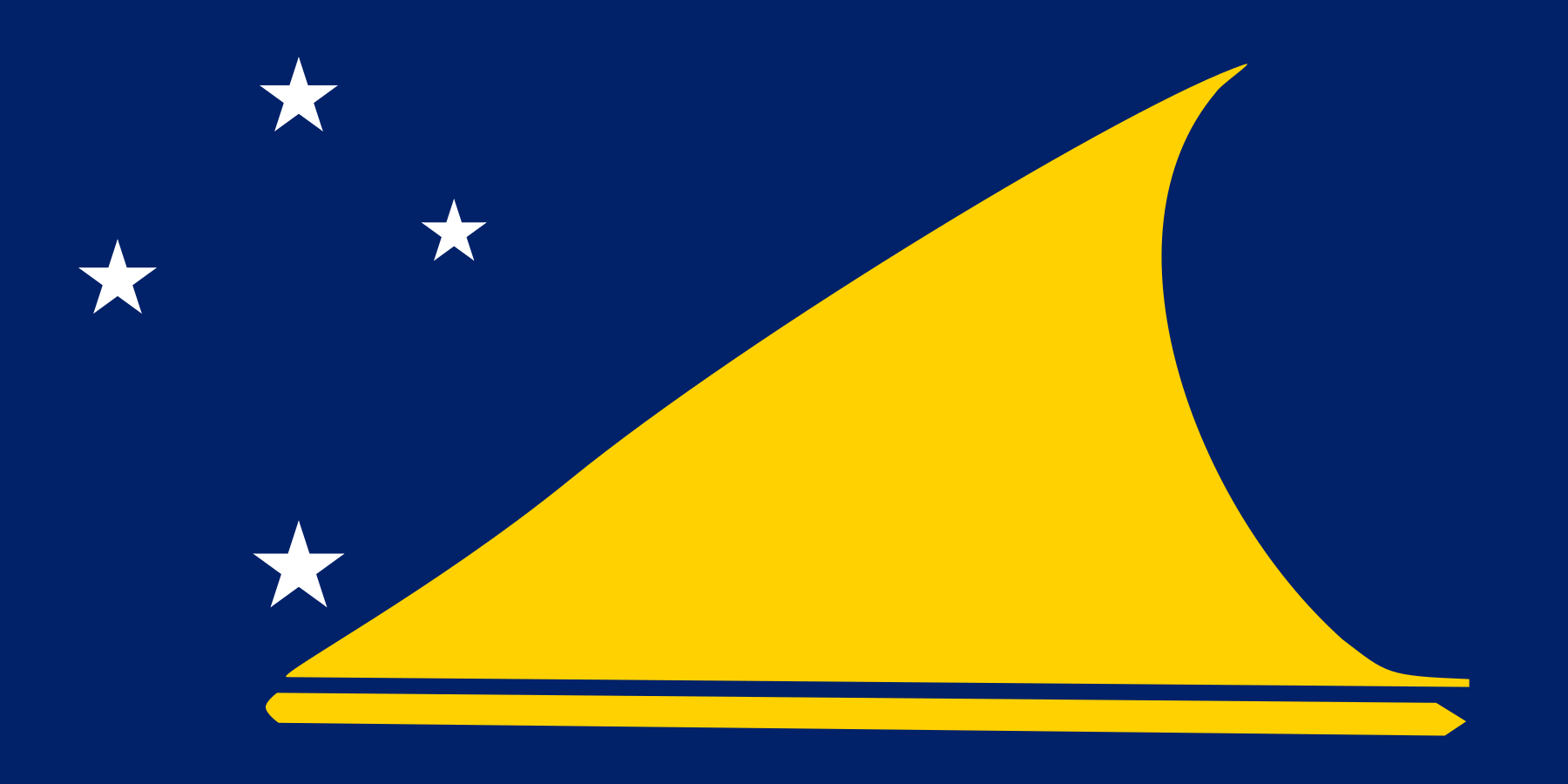
Tuvalu is a country in Oceania with a population of 11.8K and an area of 26 km². Life expectancy is 67.1 years.
Short factual summary generated from the same country data used in game rounds.
Core numbers
Fast scan first, deep dive later.
Population Density
327.2 /km²How many people live in each square kilometer of land.
Internet Users (%)
74%The percentage of people who have used the internet in the last 3 months.
Human Development Index
0.69Composite 0-1 index of life expectancy, education, and income, from Our World in Data using the latest available country values in TerraBrawl.
CO2 Per Capita
1.2 t/person/yrAnnual carbon dioxide emissions in tonnes per person, from Our World in Data using the latest available country values in TerraBrawl.
GDP Per Capita
$5,812.4GDP per person adjusted for purchasing power in constant 2017 international dollars, from Our World in Data using the latest available country values in TerraBrawl.
GDP Per Capita (PPP)
$6,151.01GDP per person, adjusted for purchasing power parity (PPP) so costs of living are comparable across countries.
Country briefing
A quick real-world briefing before you dive deeper into rankings, surprises, and matchups.
Curated stat
Tuvalu's islands are so low that most land sits only about 4 to 5 m above sea level.
Geography
Size snapshot: about the size of Washington, D.C.
Culture
Major languages include Tuvaluan (official), English (official), Samoan, Kiribati (on the island of Nui).
Top stats
The strongest source-backed stats before the deeper data table.
Education Spending (% GDP)
12.85% of GDPGovernment education spending as a share of GDP, from World Bank Open Data.
Health Spending (% GDP)
18.38% of GDPCurrent health expenditure as a share of GDP, from World Bank Open Data.
Obesity Rate
63.93%Share of adults with obesity, from Our World in Data using the latest available country values in TerraBrawl.
Inflation Rate
11.5%How much prices increased over the year, based on the cost of everyday goods and services.
Reality checks
The stats that tend to surprise players in real rounds.
Only ranks #209 in gdp (nominal)
The country's total economic output in current US dollars.
Keeps total co2 emissions unusually low
Total carbon dioxide emissions excluding LULUCF from the World Bank latest available country value.
Only ranks #189 in women in parliament (%)
The percentage of parliament seats held by women.
Only ranks #236 in airports
Large, medium, and small airport records by country from the open OurAirports dataset.
Only ranks #214 in irrigated land
Irrigated land area from CIA World Factbook.
Compared with the region
Country vs continent vs world averages
GDP per person, adjusted for purchasing power parity (PPP) so costs of living are comparable across countries.
How many years a newborn can expect to live, based on current mortality rates.
Composite 0-1 index of life expectancy, education, and income, from Our World in Data using the latest available country values in TerraBrawl.
The percentage of people who have used the internet in the last 3 months.
Think you can guess which countries rank higher?
Play this countryFactbook notes
Country briefing
Voyagers from either Samoa or Tonga first populated Tuvalu in the first millennium A.D., and the islands provided a stepping-stone for various Polynesian communities that subsequently settled in Melanesia and Micronesia.
Voyagers from either Samoa or Tonga first populated Tuvalu in the first millennium A.D., and the islands provided a stepping-stone for various Polynesian communities that subsequently settled in Melanesia and Micronesia. Tuvalu eventually came under Samoan and Tongan spheres of influence, although proximity to Micronesia allowed some Micronesian communities to flourish in Tuvalu, in particular on Nui Atoll. In the late 1700s and early 1800s, a series of American, British, Dutch, and Russian ships visited the islands, which were named the Ellice Islands in 1819.
The UK declared a protectorate over islands in 1892 and merged them with the Micronesian Gilbert Islands. The Gilbert and Ellice Islands Protectorate became a colony in 1916. During World War II, the US set up military bases on a few islands, and in 1943, after Japan captured many of the northern Gilbert Islands, the UK transferred administration of the colony southward to Funafuti. After the war, Tarawa in the Gilbert Islands was once again made the colony’s capital, and the center of power was firmly in the Gilbert Islands, including the colony’s only secondary school. Amid growing tensions with the Gilbertese, Tuvaluans voted to secede from the colony in 1974, were granted self-rule in 1975, and gained independence in 1978 as Tuvalu. In 1979, the US relinquished its claims to the Tuvaluan islands in a treaty of friendship.
Data vault
Every tracked stat, grouped for fast scanning.
Keep exploring
Open the head-to-head pages people naturally search after reading this profile.
Jump straight to the rankings where this country has its strongest edge.
Turn Tuvalu's strongest number into a challenge card.
How many people live in each square kilometer of land.
Tuvalu has a population of 11.8K, ranking #219 globally by population.
Tuvalu is located in Oceania. It has an area of 26 km².
Life expectancy in Tuvalu is 67.1 years, ranking #172 globally.
Tuvalu's GDP per capita (PPP) is $6,151.01, ranking #156 globally.
Tuvalu ranks particularly high in Population Density (#35), Internet Users (%) (#137), Human Development Index (#129).
Tuvalu has an HDI of 0.689, ranking #129 globally. The HDI combines life expectancy, education, and income indicators.
Tuvalu has a population density of 327.2 people per km², ranking #35 globally.