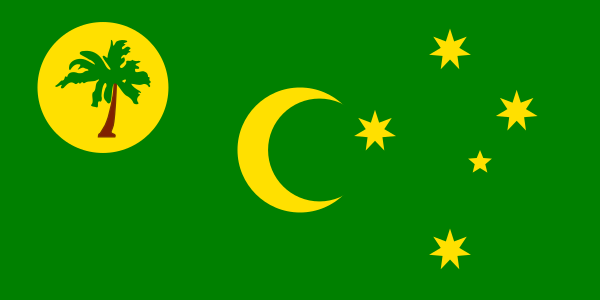
Geography
Location: Oceania, group of islands in the South Pacific Ocean, about halfway between Hawaii and New Zealand.
CIA 2026
Loading TerraBrawl
Data as of May 28, 2026
Few places match Cook Islands's #5 ranking in hospital beds. See if you can spot its other strengths.
Few places match Cook Islands's #5 ranking in hospital beds. With 8.2%, the numbers speak for themselves. See if you can spot its other strengths.
Area
236 km²
Pop.
7.6K
Stats
44
Cook Islands is a country in Oceania with a population of 7.6K and an area of 236 km².
Short factual summary generated from the same country data used in game rounds.
Core numbers
Fast scan first, deep dive later.
CO2 Per Capita
5.8 t/person/yrAnnual carbon dioxide emissions in tonnes per person, from Our World in Data using the latest available country values in TerraBrawl.
Life Expectancy
75.3 yearsAverage number of years a newborn would be expected to live if current mortality patterns stayed the same, from Our World in Data.
Internet Users (%)
64.8%The percentage of people who have used the internet in the last 3 months.
Spirits Consumption
6.5 L/person/yrLiters of spirits consumed per person per year, from Our World in Data using the latest available country values in TerraBrawl.
Solar Electricity Share
50%Share of national electricity generation from solar power.
Country briefing
A quick real-world briefing before you dive deeper into rankings, surprises, and matchups.
Geography
Location: Oceania, group of islands in the South Pacific Ocean, about halfway between Hawaii and New Zealand.
Culture
Major languages include English (official) 86.4%, Cook Islands Maori (Rarotongan) (official) 76.2%, other 8.3% (2011 est.).
Economy
Key industries include fishing, fruit processing, tourism, clothing, and more.
Top stats
The strongest source-backed stats before the deeper data table.
Alcohol Consumption
12.97 L/adult/yrLiters of pure alcohol the average adult aged 15+ consumes per year, from Our World in Data using the latest available country values in TerraBrawl.
Obesity Rate
68.42%Share of adults with obesity, from Our World in Data using the latest available country values in TerraBrawl.
Hospital Beds (per 1,000)
8.2 per 1kThe number of hospital beds available per 1,000 people.
Inflation Rate
10.6%How much prices increased over the year, based on the cost of everyday goods and services.
Reality checks
The stats that tend to surprise players in real rounds.
Only ranks #204 in electric generating capacity
Installed electricity generating capacity in kilowatts from the frozen public-domain CIA World Factbook snapshot.
Compared with the region
Country vs continent vs world averages
The percentage of people who have used the internet in the last 3 months.
Think you can guess which countries rank higher?
Play this countryFactbook notes
Country briefing
Polynesians from Tahiti were probably the first people to settle Rarotonga -- the largest of the Cook Islands -- around A.D.
Polynesians from Tahiti were probably the first people to settle Rarotonga -- the largest of the Cook Islands -- around A.D. 900. Over time, Samoans and Tongans also settled in Rarotonga, and Rarotongans voyaged to the northern Cook Islands, settling Manihiki and Rakahanga. Pukapuka and Penrhyn in the northern Cook Islands were settled directly from Samoa. Prior to European contact, there was considerable travel and trade between inhabitants of the different islands and atolls, but they were not united in a single political entity. Spanish navigators were the first Europeans to spot the northern Cook Islands in 1595, followed by the first landing in 1606, but no further European contact occurred until the 1760s. In 1773, British explorer James COOK spotted Manuae in the southern Cook Islands, and Russian mapmakers named the islands after COOK in the 1820s.
Fearing France would militarily occupy the islands as it did in Tahiti, Rarotongans asked the UK for protectorate status in the 1840s and 1860s, a request the UK ignored. In 1888, Queen MAKEA TAKAU of Rarotonga formally petitioned for protectorate status, to which the UK reluctantly agreed. In 1901, the UK placed Rarotonga and the rest of the islands in the New Zealand Colony, and in 1915, the Cook Islands Act organized the islands into one political entity. It remained a protectorate until 1965, when New Zealand granted the Cook Islands self-governing status. The Cook Islands has a great deal of local autonomy and is an independent member of international organizations, but it is in free association with New Zealand, which is responsible for its defense and foreign affairs. In September 2023, the US recognized the Cook Islands as a sovereign and independent state.
Data vault
Every tracked stat, grouped for fast scanning.
Keep exploring
Open the head-to-head pages people naturally search after reading this profile.
Jump straight to the rankings where this country has its strongest edge.
Turn Cook Islands's strongest number into a challenge card.
Annual carbon dioxide emissions in tonnes per person, from Our World in Data using the latest available country values in TerraBrawl.
Cook Islands has a population of 7.6K, ranking #222 globally by population.
Cook Islands is located in Oceania. It has an area of 236 km².
Cook Islands ranks particularly high in CO2 Per Capita (#56), Life Expectancy (#119), Internet Users (%) (#154).