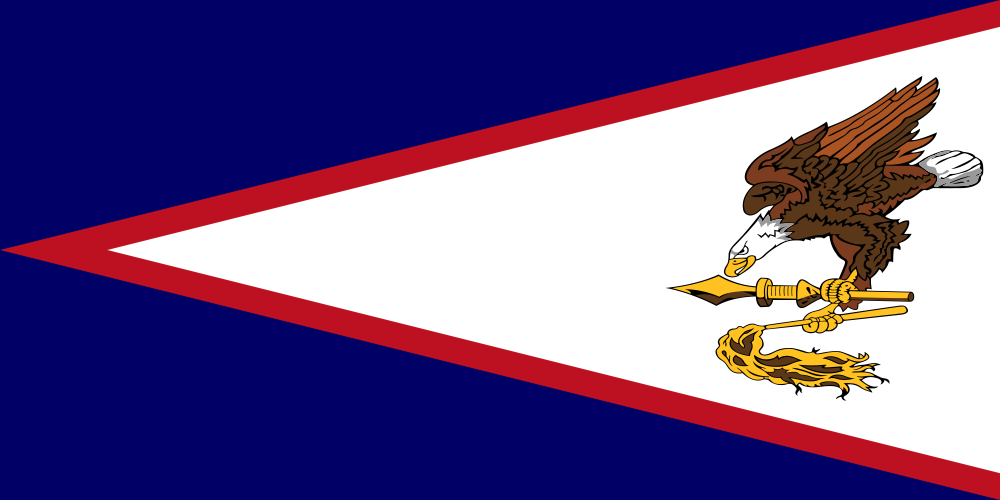
Geography
Size snapshot: slightly larger than Washington, D.C.
CIA 2026
Loading TerraBrawl
Data as of May 28, 2026
The numbers tell two very different stories about American Samoa. Think you can explain the gap?
The numbers tell two very different stories about American Samoa. #1 in obesity rate but near the bottom in renewable energy. Think you can explain the gap?
Area
199 km²
Pop.
43.3K
Stats
50
American Samoa is a country in Oceania with a population of 43.3K and an area of 199 km². Life expectancy is 72.9 years.
Short factual summary generated from the same country data used in game rounds.
Core numbers
Fast scan first, deep dive later.
Population Density
237.6 /km²How many people live in each square kilometer of land.
Life Expectancy
72.9 yearsHow many years a newborn can expect to live, based on current mortality rates.
Internet Users (%)
40.3%The percentage of people who have used the internet in the last 3 months.
Land Area
200 km²Total land area in square kilometers, excluding lakes, rivers, and territorial waters.
Country briefing
A quick real-world briefing before you dive deeper into rankings, surprises, and matchups.
Geography
Size snapshot: slightly larger than Washington, D.C.
Culture
Major languages include Samoan 87.9% (closely related to Hawaiian and other Polynesian languages), English 3.3%, Tongan 2.1%, other Pacific Islander 4.1%, and more.
Economy
Key industries include tuna canneries (largely supplied by foreign fishing vessels), handicrafts.
Top stats
The strongest source-backed stats before the deeper data table.
Obesity Rate
75.56%Share of adults with obesity, from Our World in Data using the latest available country values in TerraBrawl.
Forest Coverage (%)
85.2%The percentage of land covered by forests - natural or planted trees at least 5 meters tall (excludes orchards and urban parks).
Lowest Elevation
0 mLowest point elevation from CIA World Factbook.
Urban Population (%)
80.94%The percentage of people living in cities and urban areas.
Reality checks
The stats that tend to surprise players in real rounds.
Only ranks #223 in mobile subscriptions (%)
Mobile cellular subscriptions per 100 people, from World Bank Open Data.
Only ranks #132 in tourist arrivals
How many international tourists visit the country each year.
Keeps total co2 emissions unusually low
Total carbon dioxide emissions excluding LULUCF from the World Bank latest available country value.
Only ranks #199 in gdp (nominal)
The country's total economic output in current US dollars.
Only ranks #200 in renewable energy (%)
The percentage of energy consumption that comes from renewable sources like solar, wind, and hydro.
Compared with the region
Country vs continent vs world averages
How many years a newborn can expect to live, based on current mortality rates.
The percentage of people who have used the internet in the last 3 months.
Think you can guess which countries rank higher?
Play this countryFactbook notes
Country briefing
Tutuila -- the largest island in American Samoa -- was settled by 1000 B.C., and the island served as a refuge for exiled chiefs and defeated warriors from the other Samoan islands.
Tutuila -- the largest island in American Samoa -- was settled by 1000 B.C., and the island served as a refuge for exiled chiefs and defeated warriors from the other Samoan islands. The Manu’a Islands, which are also now part of American Samoa, developed a traditional chiefdom that maintained autonomy by controlling oceanic trade. In 1722, Dutch explorer Jacob ROGGEVEEN was the first European to sail through the Manu’a Islands, and he was followed by French explorer Louis Antoine DE BOUGAINVILLE in 1768. Whalers and missionaries arrived in American Samoa in the 1830s, but American and European traders tended to favor the port in Apia -- now in independent Samoa -- over the smaller and less-developed Pago Pago on Tutuila. In the mid-1800s, a dispute arose in Samoa over control of the Samoan archipelago, with different chiefs gaining support from Germany, the UK, and the US. In 1872, the high chief of Tutuila offered the US exclusive rights to Pago Pago in return for US protection, but the US rejected this offer. As fighting resumed, the US agreed to the chief’s request in 1878 and set up a coaling station at Pago Pago. In 1899, with continued disputes over succession, Germany and the US agreed to divide the Samoan islands, while the UK withdrew its claims in exchange for parts of the Solomon Islands. Local chiefs on Tutuila formally ceded their land to the US in 1900, followed by the chief of Manu’a in 1904. The territory was officially named “American Samoa” in 1911.
The US administered the territory through the Department of the Navy. In 1949, there was an attempt to organize the territory, granting it formal self-government, but local chiefs helped defeat the measure in the US Congress. Administration was transferred to the Department of the Interior in 1951, and in 1967, American Samoa adopted a constitution that provides significant protections for traditional Samoan land-tenure rules, language, and culture. In 1977, after four attempts, voters approved a measure to directly elect their governor. Nevertheless, American Samoa officially remains an unorganized territory, and people born in American Samoa are US nationals rather than US citizens.
Data vault
Every tracked stat, grouped for fast scanning.
Keep exploring
Open the head-to-head pages people naturally search after reading this profile.
Jump straight to the rankings where this country has its strongest edge.
Turn American Samoa's strongest number into a challenge card.
How many people live in each square kilometer of land.
American Samoa has a population of 43.3K, ranking #209 globally by population.
American Samoa is located in Oceania. It has an area of 199 km².
Life expectancy in American Samoa is 72.9 years, ranking #124 globally.
American Samoa ranks particularly high in Population Density (#57), Life Expectancy (#124), Life Expectancy (#143).
American Samoa has a population density of 237.6 people per km², ranking #57 globally.