Geography
Natural resources include alumina, coal, iron ore, copper, and more.
CIA 2026
Loading TerraBrawl
Data as of May 28, 2026
Australia ranks #6 globally in land area. Think you know what else Australia excels at?
Australia ranks #6 globally in land area. At 7.7 million, it outperforms most of the world. Think you know what else Australia excels at?
Area
7.7M km²
Pop.
27.49M
Stats
178
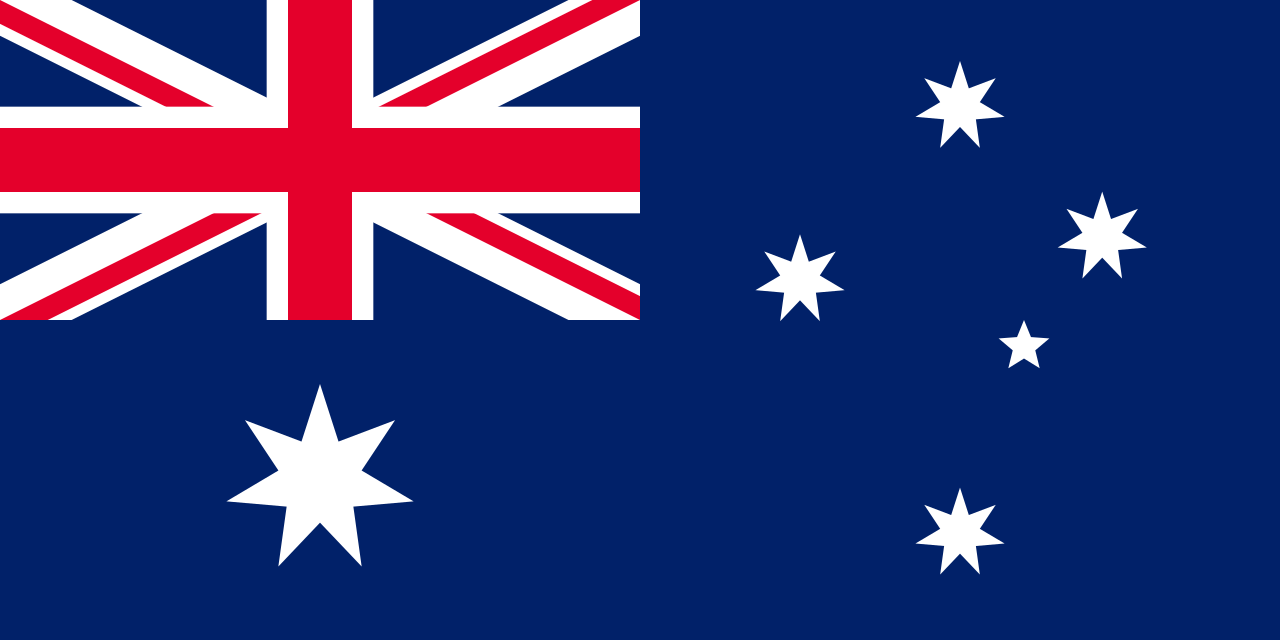
Australia is a country in Oceania with a population of 27.49M and an area of 7,692,024 km². Life expectancy is 83.1 years.
Short factual summary generated from the same country data used in game rounds.
Core numbers
Fast scan first, deep dive later.
Land Area
7.69M km²Total land area in square kilometers, excluding lakes, rivers, and territorial waters.
Human Development Index
0.96Composite 0-1 index of life expectancy, education, and income, from Our World in Data using the latest available country values in TerraBrawl.
Life Expectancy
83.9 yearsAverage number of years a newborn would be expected to live if current mortality patterns stayed the same, from Our World in Data.
University Enrollment Rate
104.65%Total university and college enrollment as a percentage of the typical college-age population.
CO2 Per Capita
14.48 t/person/yrAnnual carbon dioxide emissions in tonnes per person, from Our World in Data using the latest available country values in TerraBrawl.
Internet Users (%)
97%The percentage of people who have used the internet in the last 3 months.
Country briefing
A quick real-world briefing before you dive deeper into rankings, surprises, and matchups.
Geography
Natural resources include alumina, coal, iron ore, copper, and more.
Culture
Major languages include English 72%, Mandarin 2.7%, Arabic 1.4%, Vietnamese 1.3%, and more.
Identity
Formal name: Commonwealth of Australia.
Cities
Browse this country's cities before City Detective asks you to guess.
Perth
Western Australia, Australia
Newcastle
New South Wales, Australia
Hobart
Tasmania, Australia
Townsville
Queensland, Australia
Mackay
Queensland, Australia
Sydney
New South Wales, Australia
Melbourne
Victoria, Australia
Canberra
Australian Capital Territory, Australia
Top stats
The strongest source-backed stats before the deeper data table.
Airports
2.3KLarge, medium, and small airport records by country from the open OurAirports dataset.
Forest Area
1.34M km²Total forest area in square kilometers, including natural and planted trees at least 5 meters tall.
Coastline Length
25.8K kmTotal coastline length from CIA World Factbook.
Foreign Patents
29.4KHow many patent applications are filed by non-residents each year.
GDP (Nominal)
$1,757,022,451,652.83The country's total economic output in current US dollars.
Reality checks
The stats that tend to surprise players in real rounds.
Only ranks #213 in population density
How many people live in each square kilometer of land.
Ranks #8 globally in electricity access (%)
The percentage of the population with access to electricity.
Ranks #7 globally in railway length
Total railway length from CIA World Factbook.
Only ranks #22 in leisure time
Average leisure and personal-care time per day, from OECD How's Life / Well-Being.
Ranks #15 globally in electric generating capacity
Installed electricity generating capacity in kilowatts from the frozen public-domain CIA World Factbook snapshot.
Compared with the region
Country vs continent vs world averages
GDP per person, adjusted for purchasing power parity (PPP) so costs of living are comparable across countries.
How many years a newborn can expect to live, based on current mortality rates.
Composite 0-1 index of life expectancy, education, and income, from Our World in Data using the latest available country values in TerraBrawl.
The percentage of people who have used the internet in the last 3 months.
Think you can guess which countries rank higher?
Play this countryFactbook notes
Country briefing
Aboriginal Australians arrived on the continent at least 60,000 years ago and developed complex hunter-gatherer societies and oral histories.
Aboriginal Australians arrived on the continent at least 60,000 years ago and developed complex hunter-gatherer societies and oral histories. Dutch navigators led by Abel TASMAN were the first Europeans to land in Australia in 1606, and they mapped the western and northern coasts. They named the continent New Holland but made no attempts to permanently settle it. In 1770, Englishman James COOK sailed to the east coast of Australia, named it New South Wales, and claimed it for Great Britain. In 1788 and 1825 respectively, Great Britain established New South Wales and then Tasmania as penal colonies. Great Britain and Ireland sent more than 150,000 convicts to Australia before ending the practice in 1868. As Europeans began settling areas away from the coasts, they came into more direct contact with Aboriginal Australians. Europeans also cleared land for agriculture, impacting Aboriginal Australians’ ways of life. These issues, along with disease and a policy in the 1900s that forcefully removed Aboriginal children from their parents, reduced the Aboriginal Australian population from more than 700,000 pre-European contact to a low of 74,000 in 1933.
Four additional colonies were established in Australia in the mid-1800s: Western Australia (1829), South Australia (1836), Victoria (1851), and Queensland (1859). Gold rushes beginning in the 1850s brought thousands of new immigrants to New South Wales and Victoria, helping to reorient Australia away from its penal colony roots. In the second half of the 1800s, the colonies were all gradually granted self-government, and in 1901, they federated and became the Commonwealth of Australia. Australia contributed more than 400,000 troops to Allied efforts during World War I, and Australian troops played a large role in the defeat of Japanese troops in the Pacific in World War II. Australia severed most constitutional links with the UK in 1942 but remained part of the British Commonwealth. Australia’s post-war economy boomed and by the 1970s, racial policies that prevented most non-Whites from immigrating to Australia were removed, greatly increasing Asian immigration to the country. In recent decades, Australia has become an internationally competitive, advanced market economy due in large part to economic reforms adopted in the 1980s and its proximity to East and Southeast Asia.
In the early 2000s, Australian politics became unstable with frequent attempts to oust party leaders, including five changes of prime minister between 2010 and 2018. As a result, both major parties instituted rules to make it harder to remove a party leader.
Data vault
Every tracked stat, grouped for fast scanning.
Keep exploring
Open the head-to-head pages people naturally search after reading this profile.
Jump straight to the rankings where this country has its strongest edge.
Turn Australia's strongest number into a challenge card.
Total land area in square kilometers, excluding lakes, rivers, and territorial waters.
Australia has a population of 27.49M, ranking #54 globally by population.
Australia is located in Oceania. It has an area of 7,692,024 km².
Life expectancy in Australia is 83.1 years, ranking #21 globally.
Australia's GDP per capita (PPP) is $71,410.42, ranking #25 globally.
Australia ranks particularly high in Land Area (#6), Human Development Index (#7), Life Expectancy (#10).
Australia has an HDI of 0.958, ranking #7 globally. The HDI combines life expectancy, education, and income indicators.
Australia has a population density of 3.5 people per km², ranking #213 globally.