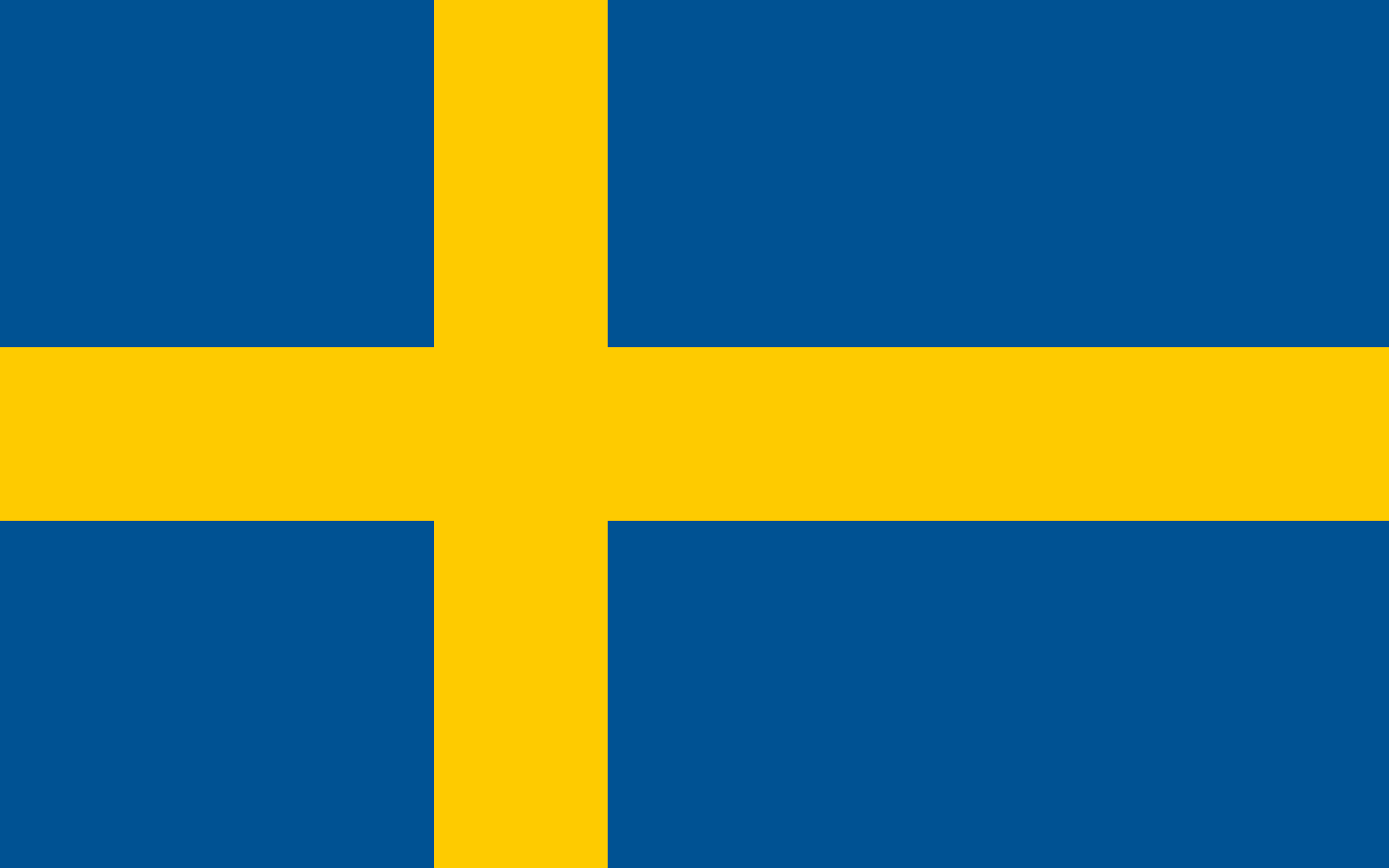
Sweden

EuropeGlobal Leader

Sweden claims the 3rd spot worldwide for renewable energy. That 51.3% figure is hard to beat. How well do you really know Sweden?

Sweden is a country in Europe with a population of 10.64M and an area of 450,295 km². Life expectancy is 83.3 years.

At a Glance

The numbers that define this country

Human Development Index

0.96
#6globally

The Human Development Index (HDI), combining life expectancy, education, and income into a single score from 0 to 1.

Life Expectancy

83.3 years
#15globally

How many years a newborn can expect to live, based on current mortality rates.

Life Expectancy

83.3 years
#21globally

How many years a newborn can expect to live, based on current mortality rates.

GDP Per Capita

$63.3K
#23globally

GDP per person, adjusted for purchasing power parity (PPP) so costs of living are comparable across countries.

University Enrollment Rate

81.4%
#21globally

Total university and college enrollment as a percentage of the typical college-age population.

Internet Users (%)

95.5%
#30globally

The percentage of people who have used the internet in the last 3 months.

Where They Stand Out

Global rankings worth knowing

🚀Human Development Index

0.96
#6globallyTop performer

The Human Development Index (HDI), combining life expectancy, education, and income into a single score from 0 to 1.

🚀R&D Spending (% GDP)

3.4%
#4globallyTop performer

Spending on research and development as a percentage of GDP.

🌱Renewable Energy (%)

51.3%
#3globallyTop performer

The percentage of energy consumption that comes from renewable sources.

🤝Women in Parliament (%)

46.7%
#8globallyTop performer

The percentage of parliament seats held by women.

❤️Life Expectancy

83.3 years
#15globallyTop performer

How many years a newborn can expect to live, based on current mortality rates.

Did You Know?

Facts that catch players off guard

🌱

Has one of the highest rates of air pollution (pm2.5)

Air Pollution (PM2.5): 5.64

The average level of fine particle air pollution (PM2.5) that people are exposed to.

World Bank 2023
🚀

Ranks #6 globally in human development index

Human Development Index: 0.96

The Human Development Index (HDI), combining life expectancy, education, and income into a single score from 0 to 1.

Our World in Data 2023
🤝

Ranks #8 globally in women in parliament (%)

Women in Parliament (%): 46.7%

The percentage of parliament seats held by women.

World Bank 2023
❤️

Has one of the highest rates of child mortality

Child Mortality: 2.50

The probability that a newborn will die before age 5, per 1,000 live births.

World Bank 2023
❤️

Has one of the highest rates of infant mortality

Infant Mortality: 2.00

The number of babies who die before their first birthday, per 1,000 live births.

World Bank 2023

Surprised? See how you stack up.

Play Now

How Sweden Compares

Country vs continent vs world averages

Sweden
Europe avg
World avg

GDP per Capita

Above avg

GDP per person, adjusted for purchasing power parity (PPP) so costs of living are comparable across countries.

World Bank 2023
Sweden71.0K
Europe57.5K
World31.8K

Life Expectancy

Above avg

How many years a newborn can expect to live, based on current mortality rates.

World Bank 2023
Sweden83.3 years
Europe80.0 years
World73.7 years

Human Development Index

Above avg

The Human Development Index (HDI), combining life expectancy, education, and income into a single score from 0 to 1.

Our World in Data 2023
Sweden0.96
Europe0.89
World0.74

Internet Users

Above avg

The percentage of people who have used the internet in the last 3 months.

World Bank 2023
Sweden95.5%
Europe90.1%
World70.3%

Think you can guess which countries rank higher?

Test Your Intuition
Regional comparison for Sweden across 4 key metrics, comparing with Europe and world averages.

About Sweden

A military power during the 17th century, Sweden maintained a policy of military non-alignment until it applied to join NATO in 2022. Sweden has not participated in any war for two centuries. Stockholm preserved an armed neutrality in both World Wars. Since then, Sweden has pursued a successful economic formula consisting of a capitalist system intermixed with substantial welfare elements. Sweden joined the EU in 1995, but the public rejected the introduction of the euro in a 2003 referendum. The share of Sweden’s population born abroad increased from 11.3% in 2000 to 20% in 2022.

🌍Geography & Climate6 facts
Location
Northern Europe, bordering the Baltic Sea, Gulf of Bothnia, Kattegat, and Skagerrak, between Finland and Norway
Climate
temperate in south with cold, cloudy winters and cool, partly cloudy summers; subarctic in north
Terrain
mostly flat or gently rolling lowlands; mountains in west
Natural Resources
iron ore, copper, lead, zinc, gold, silver, tungsten, uranium, arsenic, feldspar, timber, hydropower
Natural Hazards
ice floes in the surrounding waters, especially in the Gulf of Bothnia, can interfere with maritime traffic
Size Comparison
almost three times the size of Georgia; slightly larger than California
👥People & Culture4 facts
Languages
Swedish (official)
Religions
Church of Sweden (Lutheran) 53.9%, other (includes Roman Catholic, Orthodox, Baptist, Muslim, Jewish, and Buddhist) 8.9%, none or unspecified 37.2% (2021 est.)
Ethnic Groups
Swedish 79.6%, Syrian 1.9%, Iraqi 1.4%, Finnish 1.3%, other 15.8% (2022 est.)
Major Cities
1.700 million STOCKHOLM (capital) (2023)
🏛️Government & History10 facts
Government Type
parliamentary constitutional monarchy
Capital
Stockholm
Capital Coordinates
59 20 N, 18 03 E
Capital Timezone
UTC+1 (6 hours ahead of Washington, DC, during Standard Time)
Official Name
Kingdom of Sweden
Name Origin
name derives from the North Germanic Svea tribe that inhabited central Sweden; the tribe's name probably comes from the Old German word sweba, meaning "independent;" the local form of the country's name, Sverige, means "kingdom of the Svea"
Independence
6 June 1523 (Gustav VASA elected king of Sweden, marking the abolishment of the Kalmar Union of Denmark, Norway, and Sweden)
National Symbols
three crowns, lion
National Anthem
"Kungssangen" (Royal Song)
UNESCO Heritage
15 (13 cultural, 1 natural, 1 mixed)
💼Economy & Trade7 facts
Overview
high-income, largest Nordic economy; EU member but does not use the euro; export-oriented, led by automotive, electronics, machinery, and pharmaceuticals; highly ranked for competitiveness, R&D investments and governance; recovery, with falling inflation and real wage growth balanced by risks from trade uncertainty
Industries
iron and steel, precision equipment (bearings, radio and telephone parts, armaments), wood pulp and paper products, processed foods, motor vehicles
Agricultural Products
milk, wheat, sugar beets, barley, potatoes, oats, rapeseed, pork, chicken, beef (2023)
Export Partners
Germany 10%, USA 10%, Denmark 8%, Norway 6%, Netherlands 5% (2023)
Export Commodities
cars, refined petroleum, packaged medicine, paper, vehicle parts/accessories (2023)
Import Partners
Germany 17%, Netherlands 10%, Norway 9%, Denmark 6%, China 6% (2023)
Import Commodities
cars, crude petroleum, refined petroleum, vehicle parts/accessories, garments (2023)
🔧Infrastructure & Defense5 facts
Military Forces
Swedish Armed Forces (Försvarsmakten): Army, Navy, Air Force, Home Guard (202)
Military Service
18 years of age for voluntary and selective conscripted service for men and women; conscript service obligation typically 9-15 months depending on the branch of service and position, with a reserve commitment up to age 45 (2026)
Energy Mix
fossil fuels: 0.5% of total installed capacity (2023 est.); nuclear: 28.6% of total installed capacity (2023 est.); solar: 1.9% of total installed capacity (2023 est.); wind: 21% of total installed capacity (2023 est.); hydroelectricity: 40.2% of total installed capacity (2023 est.); biomass and waste: 7.8% of total installed capacity (2023 est.)
Broadcast Media
publicly owned TV broadcaster has 2 terrestrial networks plus regional stations; multiple privately owned TV broadcasters operating nationally, regionally, and locally; about 50 local TV stations; widespread access to pan-Nordic and international broadcasters through multi-channel cable and satellite TV; publicly owned radio broadcaster has 3 national stations and a network of 25 regional channels; roughly 100 privately owned local radio stations, with some consolidating into near-national networks; an estimated 900 community and neighborhood radio stations broadcast intermittently
Space Program
aims to have one of Europe's leading space programs; produces and operates satellites; builds and launches sounding rockets; involved in the research, development, production, and operations of a variety of other space-related areas, including astronomy, atmospheric monitoring, geographic information systems, infrared imaging, meteorology, propulsion systems, remote sensing, satellite subsystems, spacecraft systems and structures, research, and telecommunications; member of the ESA and program is integrated into its framework; works extensively with foreign space agencies, in particular through the ESA and EU and their member states, as well as with the US; participates in programs such as Europe's Copernicus Earth observation and the Galileo global navigation satellite system, France's Pleiades project, and the Square Kilometer Array Project; has a large commercial space industry, including state-owned enterprises (2025)

Deep Dive

78 of 151 metrics

Every stat we track, organized by category

🌱Environment10 metricsBest: #3
Renewable Energy (%)
51.3%#3OWID
Forest Coverage (%)
68.7%#18WB
Forest Area
279.8K#21WB
Renewable Energy (%)
57.9%#40WB
Carbon Emissions (Total)
43.96M#61
CO2 Per Capita
3.59#100OWID
Electricity Access (%)
100.0%#104WB
Irrigated Land
510#109
Protected Land (%)
15.5%#122WB
Air Pollution (PM2.5)
5.64#198WB
💰Wealth & Economy13 metricsBest: #4
Employment Rate (%)
84.2%#4OECD
GDP Per Capita
$63.3K#23OWID
GDP (Nominal)
603.72B#25WB
GDP Per Capita (PPP)
71.0K#27WB
Youth Unemployment Rate
23.8%#37
FDI Inflows (% GDP)
5.2%#43WB
High-Tech Exports (%)
17.7%#40WB
Unemployment Rate
8.5%#49WB
Long-Term Unemployment
1.4%#15OECD
Inflation Rate
2.8%#131WB
Government Debt (% GDP)
36.9%#143WB
Gender Pay Gap (%)
7.5%#28OECD
GDP Growth Rate
0.8%#175WB
🚀Education & Future7 metricsBest: #4
Human Development Index
0.96#6OWID
R&D Spending (% GDP)
3.4%#4WB
Education Spending (% GDP)
7.3%#11WB
University Enrollment Rate
81.4%#21WB
Domestic Patents
1.8K#22WB
Life Expectancy
83.4 years#8OECD
Foreign Patents
425#46WB
🤝Society & Equality6 metricsBest: #8
Women in Parliament (%)
46.7%#8WB
Safety at Night
80.0%#13OECD
Homicide Rate
1.10#14OECD
Life Satisfaction
7.45#17OECD
Inequality (Gini)
29.3#88WB
Road Deaths
2.17#34OECD
Energy2 metricsBest: #14
Electricity Capacity
55.31M#28
Nuclear Electricity Share
28.6%#14
❤️Health & Survival10 metricsBest: #15
Life Expectancy
83.3 years#15WB
Life Expectancy
83.3 years#21OWID
Health Spending (% GDP)
10.9%#17WB
Doctors (per 1,000)
4.41#20WB
Suicide Rate
13.84#36WB
Smoking Rate
22.7%#60WB
Hospital Beds (per 1,000)
2.00#96WB
Obesity Rate
16.4%#136OWID
Child Mortality
2.50#186WB
Infant Mortality
2.00#186WB
🔧Infrastructure3 metricsBest: #22
Airports
206#30
Railway Length
10.9K#22
Merchant Ships
361#52
👥Demographics12 metricsBest: #26
Elderly Population (%)
20.7%#26WB
Urban Population (%)
88.9%#39WB
Death Rate
9.63#43WB
Median Age
41.2 years#55
Land Area
407.3K#59WB
Dependency Ratio
60.598#69WB
Population
10.64M#88WB
Fertility Rate
1.66#157WB
Youth Population (%)
17.0%#155WB
Birth Rate
10.56#166WB
Population Density
25.871#179WB
Teen Birth Rate
1.79#203WB
📡Technology3 metricsBest: #30
Internet Users (%)
95.5%#30WB
Mobile Subscriptions (%)
141#43WB
Broadband Access (%)
41#54WB
🍻Lifestyle5 metricsBest: #35
Alcohol Consumption
9.57#35OWID
Air Passengers
19.55M#35WB
Beer Consumption
2.68#60OWID
Tourist Arrivals
1.96M#44WB
Spirits Consumption
1.13#82OWID
🌍Land & Sea5 metricsBest: #38
Coastline Length
3.2K#38
Land Boundaries Length
2.2K#85
Highest Elevation
2.1K#118
Border Countries Count
2.00#136
Lowest Elevation
-2.4#210
🛡️Military & Defense2 metricsBest: #49
Military Spend (% GDP)
2.5%#49
Active Military Personnel
25.0K#84

Neighboring Countries

Compare Sweden with...

Share a Fact

Share something surprising about Sweden!

Sweden
#6 in Human Development Index

The Human Development Index (HDI), combining life expectancy, education, and income into a single score from 0 to 1.

Top 5% globally
0.96

Frequently Asked Questions about Sweden

What is the population of Sweden?

Sweden has a population of 10.64M, ranking #88 globally by population.

What continent is Sweden in?

Sweden is located in Europe. It has an area of 450,295 km².

What is the life expectancy in Sweden?

Life expectancy in Sweden is 83.3 years, ranking #15 globally.

What is the GDP per capita of Sweden?

Sweden's GDP per capita (PPP) is 71.0K, ranking #27 globally.

What is Sweden known for in global statistics?

Sweden ranks particularly high in Human Development Index (#6), Life Expectancy (#15), Life Expectancy (#21).

What is Sweden's Human Development Index?

Sweden has an HDI of 0.959, ranking #6 globally. The HDI combines life expectancy, education, and income indicators.

How densely populated is Sweden?

Sweden has a population density of 25.9 people per km², ranking #179 globally.
Think you know Sweden?

Compare countries, guess statistics, and prove you know your stuff.