Culture
Major languages include Azerbaijani 96.1%, other 1.4%; less than 1%: Russian, Avar, Talyshi, and more.
CIA 2026
Loading TerraBrawl
Data as of May 28, 2026
Azerbaijan is an unsung leader in literacy rate. Think you know this overlooked gem?
Azerbaijan is an unsung leader in literacy rate. Ranking #8 with 99.8%, it's an overlooked achiever. Think you know this overlooked gem?
Area
87K km²
Pop.
10.69M
Stats
130
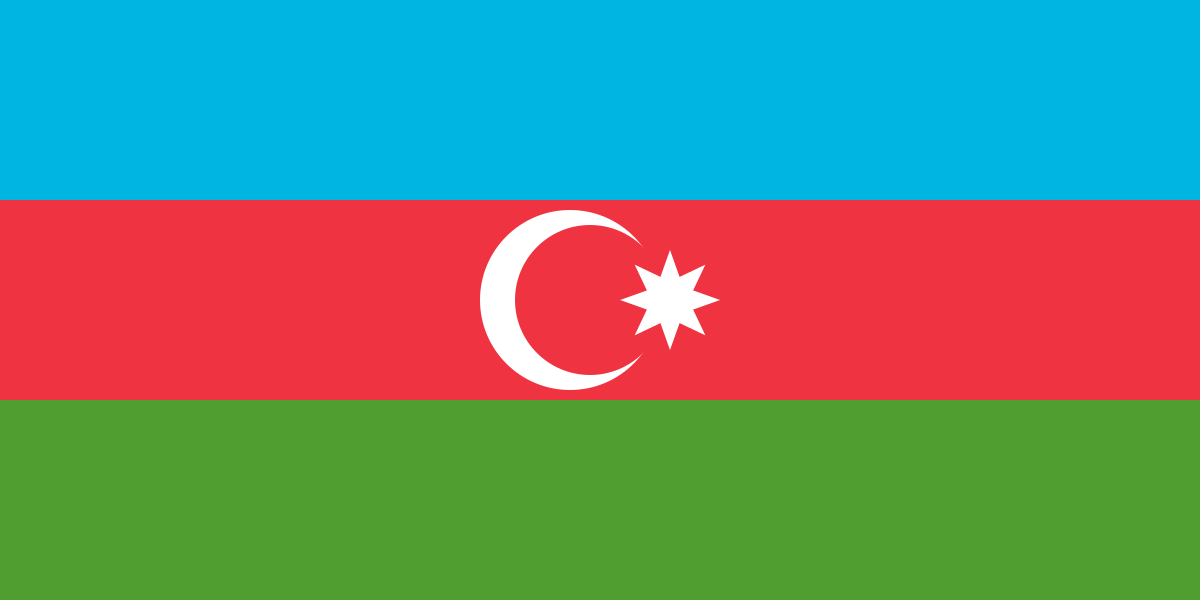
Azerbaijan is a country in Europe with a population of 10.69M and an area of 86,600 km². Life expectancy is 74.4 years.
Short factual summary generated from the same country data used in game rounds.
Core numbers
Fast scan first, deep dive later.
Internet Users (%)
89%The percentage of people who have used the internet in the last 3 months.
Population Density
122.85 /km²How many people live in each square kilometer of land.
Human Development Index
0.79Composite 0-1 index of life expectancy, education, and income, from Our World in Data using the latest available country values in TerraBrawl.
CO2 Per Capita
3.9 t/person/yrAnnual carbon dioxide emissions in tonnes per person, from Our World in Data using the latest available country values in TerraBrawl.
GDP Per Capita
$22,072.1GDP per person adjusted for purchasing power in constant 2017 international dollars, from Our World in Data using the latest available country values in TerraBrawl.
Country briefing
A quick real-world briefing before you dive deeper into rankings, surprises, and matchups.
Culture
Major languages include Azerbaijani 96.1%, other 1.4%; less than 1%: Russian, Avar, Talyshi, and more.
Identity
Formal name: Republic of Azerbaijan.
Curated stat
Azerbaijan has mud-volcano islands in the Caspian that can appear, erupt, and erode back into the sea.
Cities
Browse this country's cities before City Detective asks you to guess.
Baku
Baki, Azerbaijan
Ganja
Ganja City, Azerbaijan
Sumqayıt
Sumqayit, Azerbaijan
Lankaran
Azerbaijan
Tovuz
Tovuz District, Azerbaijan
Naxçıvan
Nakhchivan, Azerbaijan
Şirvan
Shirvan, Azerbaijan
Yevlakh
Yevlax City, Azerbaijan
Top stats
The strongest source-backed stats before the deeper data table.
Electricity Access (%)
100%The percentage of the population with access to electricity.
Military Spending
5.0% of GDPMilitary expenditure as a share of GDP, from World Bank Open Data.
Irrigated Land
14.7K km²Irrigated land area from CIA World Factbook.
Highest Elevation
4.5K mHighest point elevation from CIA World Factbook.
Reality checks
The stats that tend to surprise players in real rounds.
Keeps suicide rate unusually low
Suicide mortality rate per 100,000 people, from World Bank Open Data.
Keeps government debt (% gdp) unusually low
Central government debt as a share of GDP, from World Bank Open Data.
Only ranks #221 in lowest elevation
Lowest point elevation from CIA World Factbook.
Only ranks #186 in dependency ratio
Dependents as a share of the working-age population, from World Bank Open Data.
Only ranks #184 in renewable energy (%)
The percentage of energy consumption that comes from renewable sources like solar, wind, and hydro.
Compared with the region
Country vs continent vs world averages
GDP per person, adjusted for purchasing power parity (PPP) so costs of living are comparable across countries.
How many years a newborn can expect to live, based on current mortality rates.
Composite 0-1 index of life expectancy, education, and income, from Our World in Data using the latest available country values in TerraBrawl.
The percentage of people who have used the internet in the last 3 months.
Think you can guess which countries rank higher?
Play this countryFactbook notes
Country briefing
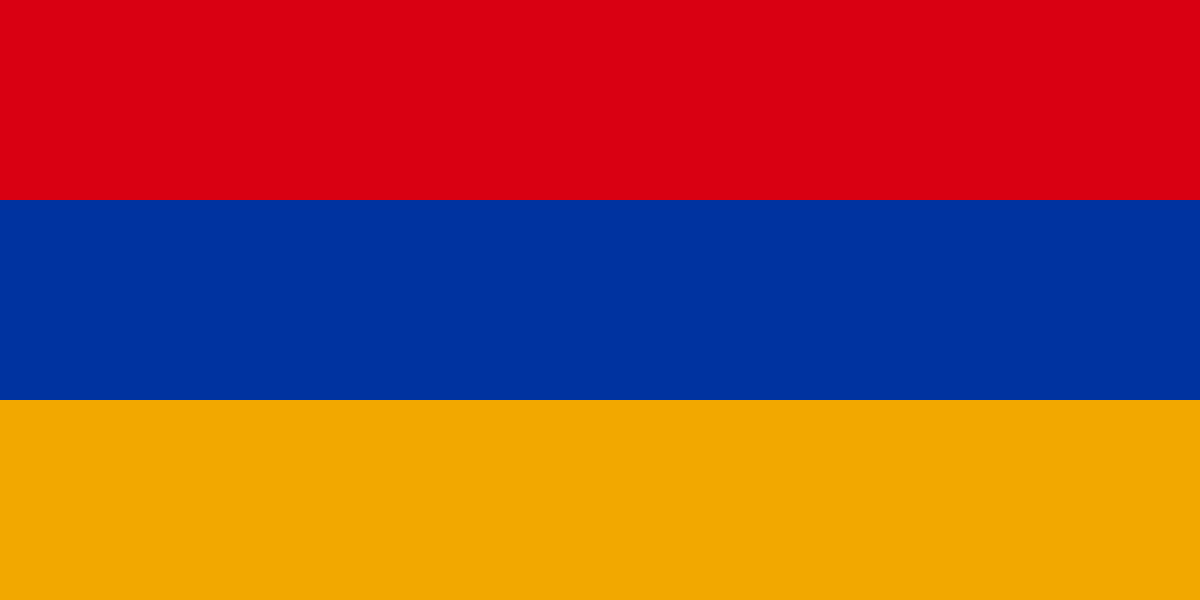
Azerbaijan -- a secular nation with a majority-Turkic and majority-Shia Muslim population -- was briefly independent (from 1918 to 1920) following the collapse of the Russian Empire; it was subsequently incorporated into the Soviet Union for seven decades.
Azerbaijan -- a secular nation with a majority-Turkic and majority-Shia Muslim population -- was briefly independent (from 1918 to 1920) following the collapse of the Russian Empire; it was subsequently incorporated into the Soviet Union for seven decades.
Beginning in 1988, Azerbaijan and Armenia fought over the Nagorno-Karabakh region, which was populated largely by ethnic Armenians but incorporated into Soviet Azerbaijan as an autonomous oblast in the early 1920s. In the late Soviet period, an ethnic-Armenian separatist movement sought to end Azerbaijani control over the region. Fighting over Nagorno-Karabakh escalated after Armenia and Azerbaijan gained independence from the Soviet Union in 1991. By the time a ceasefire took effect in 1994, separatists with Armenian support controlled Nagorno‑Karabakh and seven surrounding Azerbaijani territories. After decades of cease-fire violations and sporadic flare-ups, a second sustained conflict began in 2020 when Azerbaijan tried to win back the territories it had lost in the 1990s. After significant Azerbaijani gains, Armenia returned the southern part of Nagorno-Karabakh and the surrounding territories to Azerbaijan. In September 2023, Azerbaijan took military action to regain the rest of Nagorno-Karabakh; after a conflict that lasted only one day, nearly the entire ethnic Armenian population of Nagorno-Karabakh fled to Armenia.
Since gaining its independence in 1991, Azerbaijan has significantly reduced the poverty rate and has directed some revenue from its oil and gas production to develop the country’s infrastructure. However, corruption remains a burden on the economy, and Western observers and members of the country’s political opposition have accused the government of authoritarianism. The country’s leadership has remained in the ALIYEV family since Heydar ALIYEV, the most highly ranked Azerbaijani member of the Communist Party during the Soviet period, became president during the first Nagorno-Karabakh War in 1993.
Data vault
Every tracked stat, grouped for fast scanning.
Keep exploring
Open the head-to-head pages people naturally search after reading this profile.
Jump straight to the rankings where this country has its strongest edge.
Turn Azerbaijan's strongest number into a challenge card.
The percentage of people who have used the internet in the last 3 months.
Azerbaijan has a population of 10.69M, ranking #87 globally by population.
Azerbaijan is located in Europe. It has an area of 86,600 km².
Life expectancy in Azerbaijan is 74.4 years, ranking #109 globally.
Azerbaijan's GDP per capita (PPP) is $25,089, ranking #88 globally.
Azerbaijan ranks particularly high in Internet Users (%) (#64), Population (#87), Population Density (#88).
Azerbaijan has an HDI of 0.789, ranking #81 globally. The HDI combines life expectancy, education, and income indicators.
Azerbaijan has a population density of 122.9 people per km², ranking #88 globally.