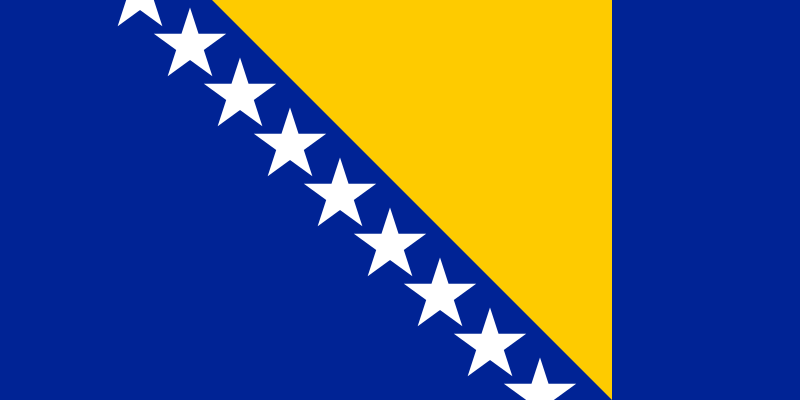
Bosnia and Herzegovina

EuropeLand of Contrasts

Expect the unexpected when it comes to Bosnia and Herzegovina. A top performer in beer consumption (#26), it falls behind in fertility rate. Discover more about this complex place.

Bosnia and Herzegovina is a country in Europe with a population of 3.65M and an area of 51,209 km². Life expectancy is 77.8 years.

At a Glance

The numbers that define this country

CO2 Per Capita

6.14
#51globally

How many tonnes of CO2 the average person produces per year.

Life Expectancy

77.8 years
#67globally

How many years a newborn can expect to live, based on current mortality rates.

Life Expectancy

77.9 years
#77globally

How many years a newborn can expect to live, based on current mortality rates.

Human Development Index

0.80
#74globally

The Human Development Index (HDI), combining life expectancy, education, and income into a single score from 0 to 1.

Internet Users (%)

86.1%
#90globally

The percentage of people who have used the internet in the last 3 months.

GDP Per Capita

$20.4K
#89globally

GDP per person, adjusted for purchasing power parity (PPP) so costs of living are comparable across countries.

Where They Stand Out

Global rankings worth knowing

🌱Electricity Access (%)

100.0%
#11globallyTop performer

The percentage of the population with access to electricity.

👥Death Rate

12.29
#14globallyTop performer

The number of deaths per 1,000 people each year.

👥Median Age

45.7 years
#18globallyTop performer

Median age from CIA World Factbook.

❤️Smoking Rate

36.2%
#12globallyTop performer

The percentage of people aged 15 and older who use tobacco products.

🍻Beer Consumption

3.73
#26globallyTop performer

How many liters of beer the average adult (15+) drinks per year.

Did You Know?

Facts that catch players off guard

🍻

Only ranks #157 in air passengers

Air Passengers: 1.6K

Total passengers carried by airlines registered in that country, regardless of where flights originated or ended.

World Bank 2023
👥

Only ranks #223 in fertility rate

Fertility Rate: 1.15

The average number of children a woman would have over her lifetime based on current birth rates.

World Bank 2023
🌱

Ranks #11 globally in electricity access (%)

Electricity Access (%): 100.0%

The percentage of the population with access to electricity.

World Bank 2023
👥

Ranks #14 globally in death rate

Death Rate: 12.29

The number of deaths per 1,000 people each year.

World Bank 2023
👥

Only ranks #204 in youth population (%)

Youth Population (%): 13.0%

The percentage of the population aged 0 to 14.

World Bank 2023

Surprised? See how you stack up.

Play Now

How Bosnia and Herzegovina Compares

Country vs continent vs world averages

Bosnia and Herzegovina
Europe avg
World avg

GDP per Capita

GDP per person, adjusted for purchasing power parity (PPP) so costs of living are comparable across countries.

World Bank 2023
Bosnia and...23.0K
Europe57.5K
World31.8K

Life Expectancy

Above avg

How many years a newborn can expect to live, based on current mortality rates.

World Bank 2023
Bosnia and...77.8 years
Europe80.0 years
World73.7 years

Human Development Index

Above avg

The Human Development Index (HDI), combining life expectancy, education, and income into a single score from 0 to 1.

Our World in Data 2023
Bosnia and...0.80
Europe0.89
World0.74

Internet Users

Above avg

The percentage of people who have used the internet in the last 3 months.

World Bank 2023
Bosnia and...86.1%
Europe90.1%
World70.3%

Think you can guess which countries rank higher?

Test Your Intuition
Regional comparison for Bosnia and Herzegovina across 4 key metrics, comparing with Europe and world averages.

About Bosnia and Herzegovina

After four centuries of Ottoman rule over Bosnia and Herzegovina, Austria-Hungary took control in 1878 and held the region until 1918, when it was incorporated into the newly created Kingdom of Serbs, Croats, and Slovenes. After World War II, Bosnia and Herzegovina joined the Socialist Federal Republic of Yugoslavia (SFRY).

Bosnia and Herzegovina declared sovereignty in October 1991 and independence from the SFRY on 3 March 1992 after a referendum boycotted by ethnic Serbs. Bosnian Serb militias, with the support of Serbia and Croatia, then tried to take control of territories they claimed as their own. From 1992 to 1995, ethnic cleansing campaigns killed thousands and displaced more than two million people. On 21 November 1995, in Dayton, Ohio, the warring parties initialed a peace agreement, and the final agreement was signed in Paris on 14 December 1995.

The Dayton Accords retained Bosnia and Herzegovina's international boundaries and created a multiethnic and democratic government composed of two entities roughly equal in size: the predominantly Bosniak-Bosnian Croat Federation of Bosnia and Herzegovina and the predominantly Bosnian Serb-led Republika Srpska (RS). The Dayton Accords also established the Office of the High Representative to oversee the agreement's implementation. In 1996, the NATO-led Stabilization Force (SFOR) took over responsibility for enforcing the peace. In 2004, European Union peacekeeping troops (EUFOR) replaced SFOR. As of 2022, EUFOR deploys around 1,600 troops in Bosnia in a peacekeeping capacity. Bosnia and Herzegovina became an official candidate for EU membership in 2022.

🌍Geography & Climate6 facts
Location
Southeastern Europe, bordering the Adriatic Sea and Croatia
Climate
hot summers and cold winters; areas of high elevation have short, cool summers and long, severe winters; mild, rainy winters along coast
Terrain
mountains and valleys
Natural Resources
coal, iron ore, antimony, bauxite, copper, lead, zinc, chromite, cobalt, manganese, nickel, clay, gypsum, salt, sand, timber, hydropower
Natural Hazards
destructive earthquakes
Size Comparison
slightly smaller than West Virginia
👥People & Culture4 facts
Languages
Bosnian (official) 52.9%, Serbian (official) 30.8%, Croatian (official) 14.6%, other 1.6%, no answer 0.2% (2013 est.)
Religions
Muslim 50.7%, Orthodox 30.7%, Roman Catholic 15.2%, atheist 0.8%, agnostic 0.3%, other 1.2%, undeclared/no answer 1.1% (2013 est.)
Ethnic Groups
Bosniak 50.1%, Serb 30.8%, Croat 15.4%, other 2.7%, not declared/no answer 1% (2013 est.)
Major Cities
346,000 SARAJEVO (capital) (2023)
🏛️Government & History9 facts
Government Type
parliamentary republic
Capital
Sarajevo
Capital Coordinates
43 52 N, 18 25 E
Capital Timezone
UTC+1 (6 hours ahead of Washington, DC, during Standard Time)
Name Origin
the larger northern territory is named for the Bosna River; the smaller southern section takes its name from the Old Serbian word herceg, meaning "duke," combined with the possessive -ov and the suffix -ina, meaning "country," to denote "dukedom"
Independence
1 March 1992 (from Yugoslavia)
National Symbols
golden lily
National Anthem
"Drzavna himna Bosne i Hercegovine" (The National Anthem of Bosnia and Herzegovina)
UNESCO Heritage
5 (3 cultural, 2 natural)
💼Economy & Trade7 facts
Overview
import-dominated economy; remains consumption-heavy; lack of private sector investments and diversification; jointly addressing structural economic challenges; Chinese energy infrastructure investments; high unemployment; tourism industry impacted by COVID-19
Industries
steel, coal, iron ore, lead, zinc, manganese, bauxite, aluminum, motor vehicle assembly, textiles, tobacco products, wooden furniture, ammunition, domestic appliances, oil refining
Agricultural Products
maize, milk, vegetables, potatoes, plums, wheat, apples, barley, chicken, tomatoes (2023)
Export Partners
Germany 15%, Croatia 14%, Serbia 12%, Austria 10%, Slovenia 9% (2023)
Export Commodities
footwear, electricity, garments, plastic products, insulated wire (2023)
Import Partners
Italy 13%, Germany 11%, Serbia 11%, China 9%, Croatia 8% (2023)
Import Commodities
refined petroleum, cars, garments, plastic products, packaged medicine (2023)
🔧Infrastructure & Defense4 facts
Military Forces
Armed Forces of Bosnia and Herzegovina (AFBiH or Oruzanih Snaga Bosne i Hercegovine, OSBiH): Army, Air, Air Defense forces organized into an Operations Command and a Support Command Ministry of Security: Border Police (2025)
Military Service
18 -27 years of age for voluntary military service; conscription ended in January 2006 (2025)
Energy Mix
fossil fuels: 64% of total installed capacity (2023 est.); solar: 0.9% of total installed capacity (2023 est.); wind: 2.2% of total installed capacity (2023 est.); hydroelectricity: 31.1% of total installed capacity (2023 est.); biomass and waste: 1.8% of total installed capacity (2023 est.)
Broadcast Media
3 public TV broadcasters: Radio and TV of Bosnia and Herzegovina, Federation TV (operating 2 networks), and Republika Srpska Radio-TV; a local commercial network of 5 TV stations; 3 private, near-national TV stations and dozens of small independent TV stations; 3 large public radio broadcasters and many private radio stations (2019)

Deep Dive

66 of 82 metrics

Every stat we track, organized by category

🌱Environment9 metricsBest: #11
Electricity Access (%)
100.0%#11WB
CO2 Per Capita
6.14#51OWID
Renewable Energy (%)
36.6%#65WB
Air Pollution (PM2.5)
26.602#61WB
Forest Coverage (%)
42.7%#68WB
Carbon Emissions (Total)
24.51M#78
Forest Area
21.9K#103WB
Protected Land (%)
9.5%#153WB
Irrigated Land
30#157
❤️Health & Survival10 metricsBest: #12
Smoking Rate
36.2%#12WB
Health Spending (% GDP)
8.7%#50WB
Life Expectancy
77.8 years#67WB
Life Expectancy
77.9 years#77OWID
Suicide Rate
8.97#64WB
Doctors (per 1,000)
2.58#79WB
Obesity Rate
25.5%#94OWID
Hospital Beds (per 1,000)
2.30#85WB
Infant Mortality
5.30#143WB
Child Mortality
6.00#148WB
👥Demographics12 metricsBest: #14
Death Rate
12.29#14WB
Elderly Population (%)
22.2%#15WB
Median Age
45.7 years#18
Dependency Ratio
54.483#110WB
Population
3.65M#131WB
Land Area
51.2K#126WB
Population Density
62.209#141WB
Urban Population (%)
52.1%#158WB
Teen Birth Rate
11.217#153WB
Youth Population (%)
13.0%#204WB
Birth Rate
6.88#222WB
Fertility Rate
1.15#223WB
💰Wealth & Economy10 metricsBest: #26
Youth Unemployment Rate
27.3%#26
Unemployment Rate
10.7%#36WB
FDI Inflows (% GDP)
3.4%#71WB
GDP Per Capita
$20.4K#89OWID
GDP Per Capita (PPP)
23.0K#91WB
High-Tech Exports (%)
6.2%#88WB
GDP (Nominal)
29.61B#112WB
GDP Growth Rate
3.0%#116WB
Government Debt (% GDP)
39.9%#130WB
Inflation Rate
1.7%#168WB
🍻Lifestyle5 metricsBest: #26
Beer Consumption
3.73#26OWID
Alcohol Consumption
5.87#77OWID
Spirits Consumption
0.51#110OWID
Tourist Arrivals
197.0K#103WB
Air Passengers
1.6K#157WB
🌍Land & Sea5 metricsBest: #47
Lowest Elevation
0#47
Highest Elevation
2.4K#106
Land Boundaries Length
1.5K#110
Border Countries Count
3.00#86
Coastline Length
20#191
🚀Education & Future6 metricsBest: #74
Human Development Index
0.80#74OWID
University Enrollment Rate
45.5%#84WB
Domestic Patents
53#80WB
Education Spending (% GDP)
3.2%#128WB
R&D Spending (% GDP)
0.2%#79WB
Foreign Patents
8.00#113WB
🔧Infrastructure2 metricsBest: #90
Airports
20#135
Railway Length
965#90
📡Technology3 metricsBest: #90
Internet Users (%)
86.1%#90WB
Mobile Subscriptions (%)
121#93WB
Broadband Access (%)
29#98WB
Energy1 metricsBest: #93
Electricity Capacity
4.68M#93
🛡️Military & Defense2 metricsBest: #119
Active Military Personnel
10.0K#119
Military Spend (% GDP)
0.8%#134
🤝Society & Equality1 metricsBest: #134
Women in Parliament (%)
19.0%#134WB

Neighboring Countries

Countries with Similar GDP

Compare Bosnia and Herzegovina with...

Share a Fact

Share something surprising about Bosnia and Herzegovina!

Bosnia and Herzegovina
#51 in CO2 Per Capita

How many tonnes of CO2 the average person produces per year.

Top 20% globally
6.14

Frequently Asked Questions about Bosnia and Herzegovina

What is the population of Bosnia and Herzegovina?

Bosnia and Herzegovina has a population of 3.65M, ranking #131 globally by population.

What continent is Bosnia and Herzegovina in?

Bosnia and Herzegovina is located in Europe. It has an area of 51,209 km².

What is the life expectancy in Bosnia and Herzegovina?

Life expectancy in Bosnia and Herzegovina is 77.8 years, ranking #67 globally.

What is the GDP per capita of Bosnia and Herzegovina?

Bosnia and Herzegovina's GDP per capita (PPP) is 23.0K, ranking #91 globally.

What is Bosnia and Herzegovina known for in global statistics?

Bosnia and Herzegovina ranks particularly high in CO2 Per Capita (#51), Life Expectancy (#67), Life Expectancy (#77).

What is Bosnia and Herzegovina's Human Development Index?

Bosnia and Herzegovina has an HDI of 0.804, ranking #74 globally. The HDI combines life expectancy, education, and income indicators.

How densely populated is Bosnia and Herzegovina?

Bosnia and Herzegovina has a population density of 62.2 people per km², ranking #141 globally.
Think you know Bosnia and Herzegovina?

Compare countries, guess statistics, and prove you know your stuff.