Geography
Location: Northern South America, bordering the North Atlantic Ocean, between French Guiana and Guyana.
CIA 2026
Loading TerraBrawl
Data as of May 28, 2026
The numbers tell two very different stories about Suriname. Think you can explain the gap?
The numbers tell two very different stories about Suriname. #1 in forest coverage but near the bottom in population density. Think you can explain the gap?
Area
164K km²
Pop.
653.6K
Stats
112
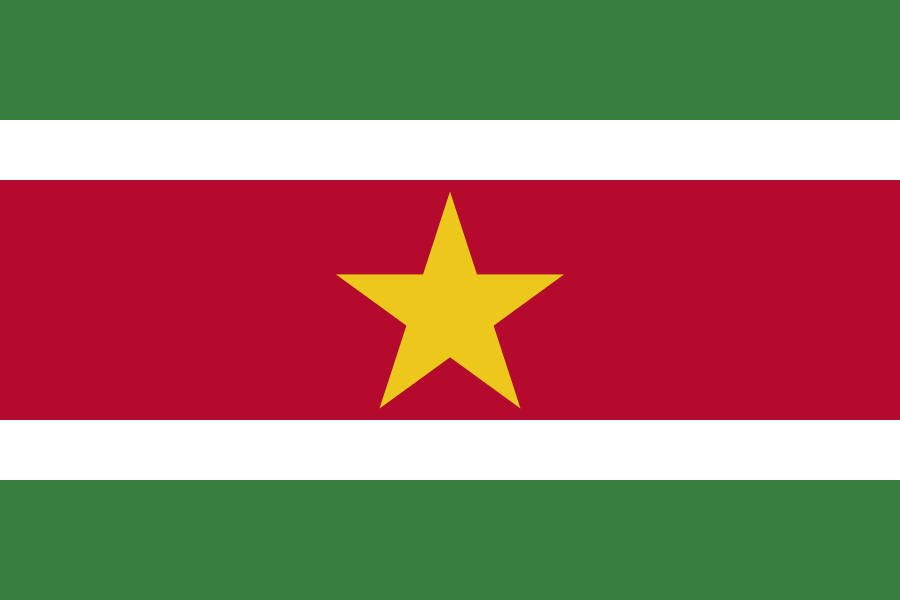
Suriname is a country in North America with a population of 653.6K and an area of 163,820 km². Life expectancy is 73.6 years.
Short factual summary generated from the same country data used in game rounds.
Core numbers
Fast scan first, deep dive later.
CO2 Per Capita
4.7 t/person/yrAnnual carbon dioxide emissions in tonnes per person, from Our World in Data using the latest available country values in TerraBrawl.
Land Area
160.5K km²Total land area in square kilometers, excluding lakes, rivers, and territorial waters.
GDP Per Capita
$19,413.3GDP per person adjusted for purchasing power in constant 2017 international dollars, from Our World in Data using the latest available country values in TerraBrawl.
GDP Per Capita (PPP)
$21,800.53GDP per person, adjusted for purchasing power parity (PPP) so costs of living are comparable across countries.
Life Expectancy
73.6 yearsHow many years a newborn can expect to live, based on current mortality rates.
Internet Users (%)
78%The percentage of people who have used the internet in the last 3 months.
Country briefing
A quick real-world briefing before you dive deeper into rankings, surprises, and matchups.
Geography
Location: Northern South America, bordering the North Atlantic Ocean, between French Guiana and Guyana.
Culture
Major languages include Dutch (official), English (widely spoken), Sranang Tongo (Surinamese, sometimes called Taki-Taki, and more.
Identity
Formal name: Republic of Suriname.
Cities
Browse this country's cities before City Detective asks you to guess.
Top stats
The strongest source-backed stats before the deeper data table.
Forest Coverage (%)
94.45%The percentage of land covered by forests - natural or planted trees at least 5 meters tall (excludes orchards and urban parks).
Suicide Rate
22.26 per 100kSuicide mortality rate per 100,000 people, from World Bank Open Data.
Inflation Rate
16.2%How much prices increased over the year, based on the cost of everyday goods and services.
Mobile Subscriptions (%)
142 per 100 peopleMobile cellular subscriptions per 100 people, from World Bank Open Data.
Spirits Consumption
2.4 L/person/yrLiters of spirits consumed per person per year, from Our World in Data using the latest available country values in TerraBrawl.
Reality checks
The stats that tend to surprise players in real rounds.
Only ranks #209 in population density
How many people live in each square kilometer of land.
Only ranks #149 in university enrollment rate
Total university and college enrollment as a percentage of the typical college-age population.
Only ranks #159 in armed forces personnel
Total armed forces personnel from the World Bank latest available country value.
Only ranks #183 in fdi inflows (% gdp)
Foreign direct investment net inflows as a share of GDP, from World Bank Open Data.
Only ranks #209 in lowest elevation
Lowest point elevation from CIA World Factbook.
Compared with the region
Country vs continent vs world averages
GDP per person, adjusted for purchasing power parity (PPP) so costs of living are comparable across countries.
How many years a newborn can expect to live, based on current mortality rates.
Composite 0-1 index of life expectancy, education, and income, from Our World in Data using the latest available country values in TerraBrawl.
The percentage of people who have used the internet in the last 3 months.
Think you can guess which countries rank higher?
Play this countryFactbook notes
Country briefing
The Spaniards first explored Suriname in the 16th century, and the English then settled it in the mid-17th century.
The Spaniards first explored Suriname in the 16th century, and the English then settled it in the mid-17th century. Suriname became a Dutch colony in 1667. With the abolition of African slavery in 1863, workers were brought in from India and Java. The Netherlands granted the colony independence in 1975. Five years later, the civilian government was replaced by a military regime that soon declared Suriname a socialist republic. It continued to exert control through a succession of nominally civilian administrations until 1987, when international pressure finally forced a democratic election. In 1990, the military overthrew the civilian leadership, but a democratically elected government -- a four-party coalition -- returned to power in 1991. The coalition expanded to eight parties in 2005 and ruled until 2010, when voters returned former military leader Desire BOUTERSE and his opposition coalition to power. President BOUTERSE ran unopposed in 2015 and was reelected. Opposition parties campaigned hard against BOUTERSE in the run-up to the 2020 elections, and a multi-party coalition led by Chandrikapersad SANTOKHI's VHP and Ronnie Brunswijk's ABOP was installed.
Data vault
Every tracked stat, grouped for fast scanning.
Keep exploring
Open the head-to-head pages people naturally search after reading this profile.
Jump straight to the rankings where this country has its strongest edge.
Turn Suriname's strongest number into a challenge card.
Annual carbon dioxide emissions in tonnes per person, from Our World in Data using the latest available country values in TerraBrawl.
Suriname has a population of 653.6K, ranking #167 globally by population.
Suriname is located in North America. It has an area of 163,820 km².
Life expectancy in Suriname is 73.6 years, ranking #115 globally.
Suriname's GDP per capita (PPP) is $21,800.53, ranking #94 globally.
Suriname ranks particularly high in CO2 Per Capita (#74), Land Area (#91), GDP Per Capita (#93).
Suriname has an HDI of 0.722, ranking #114 globally. The HDI combines life expectancy, education, and income indicators.
Suriname has a population density of 3.9 people per km², ranking #209 globally.