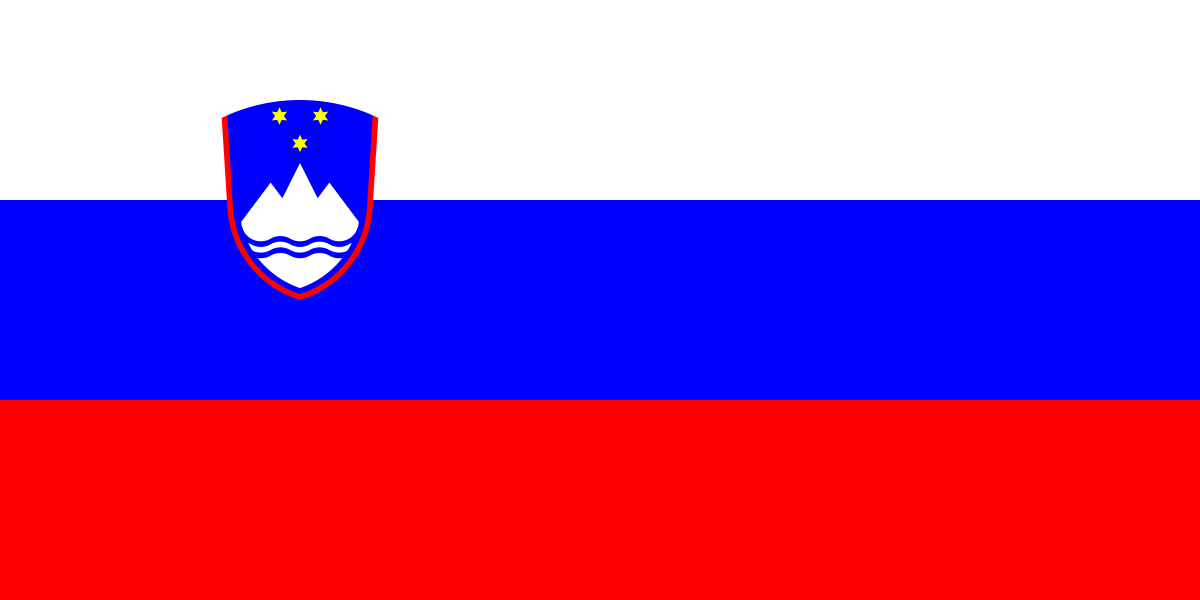
Slovenia

EuropeLand of Contrasts

Expect the unexpected when it comes to Slovenia. #19 in beer consumption but near the bottom in fertility rate. Discover more about this complex place.

Slovenia is a country in Europe with a population of 2.10M and an area of 20,273 km². Life expectancy is 82.0 years.

At a Glance

The numbers that define this country

Life Satisfaction

7.67
#7globally

How satisfied people are with their lives, rated on a scale from 0 to 10.

Human Development Index

0.93
#21globally

The Human Development Index (HDI), combining life expectancy, education, and income into a single score from 0 to 1.

Life Expectancy

82.0 years
#32globally

How many years a newborn can expect to live, based on current mortality rates.

University Enrollment Rate

80.1%
#26globally

Total university and college enrollment as a percentage of the typical college-age population.

GDP Per Capita

$48.5K
#37globally

GDP per person, adjusted for purchasing power parity (PPP) so costs of living are comparable across countries.

Life Expectancy

81.6 years
#44globally

How many years a newborn can expect to live, based on current mortality rates.

Where They Stand Out

Global rankings worth knowing

🌱Protected Land (%)

40.5%
#11globallyTop performer

The percentage of land area designated as protected natural reserves or parks.

❤️Suicide Rate

18.85
#13globallyTop performer

The number of suicide deaths per 100,000 people each year.

👥Median Age

46.0 years
#16globallyTop performer

Median age from CIA World Factbook.

🚀Human Development Index

0.93
#21globallyTop performer

The Human Development Index (HDI), combining life expectancy, education, and income into a single score from 0 to 1.

🍻Beer Consumption

4.01
#19globallyTop performer

How many liters of beer the average adult (15+) drinks per year.

Did You Know?

Facts that catch players off guard

🍻

Only ranks #156 in air passengers

Air Passengers: 1.9K

Total passengers carried by airlines registered in that country, regardless of where flights originated or ended.

World Bank 2023
❤️

Has one of the highest rates of child mortality

Child Mortality: 2.20

The probability that a newborn will die before age 5, per 1,000 live births.

World Bank 2023
🤝

Has one of the highest rates of inequality (gini)

Inequality (Gini): 24.7

A measure of income inequality where 0 means everyone earns the same and 100 means one person has everything.

World Bank 2023
🌱

Ranks #11 globally in protected land (%)

Protected Land (%): 40.5%

The percentage of land area designated as protected natural reserves or parks.

World Bank 2023
❤️

Ranks #13 in suicide rate (lower is better)

Suicide Rate: 18.85

The number of suicide deaths per 100,000 people each year.

World Bank 2023

Surprised? See how you stack up.

Play Now

How Slovenia Compares

Country vs continent vs world averages

Slovenia
Europe avg
World avg

GDP per Capita

Above avg

GDP per person, adjusted for purchasing power parity (PPP) so costs of living are comparable across countries.

World Bank 2023
Slovenia56.5K
Europe57.5K
World31.8K

Life Expectancy

Above avg

How many years a newborn can expect to live, based on current mortality rates.

World Bank 2023
Slovenia82.0 years
Europe80.0 years
World73.7 years

Human Development Index

Above avg

The Human Development Index (HDI), combining life expectancy, education, and income into a single score from 0 to 1.

Our World in Data 2023
Slovenia0.93
Europe0.89
World0.74

Internet Users

Above avg

The percentage of people who have used the internet in the last 3 months.

World Bank 2023
Slovenia90.8%
Europe90.1%
World70.3%

Think you can guess which countries rank higher?

Test Your Intuition
Regional comparison for Slovenia across 4 key metrics, comparing with Europe and world averages.

About Slovenia

The Slovene lands were part of the Austro-Hungarian Empire until the latter's dissolution at the end of World War I. In 1918, Slovenia became part of the Kingdom of Serbs, Croats, and Slovenes, which was renamed Yugoslavia in 1929. After World War II, Slovenia joined Bosnia and Herzegovina, Croatia, Macedonia, Montenegro, and Serbia as one of the constituent republics in the new Socialist Federal Republic of Yugoslavia (SFRY). In 1990, Slovenia held its first multiparty elections, as well as a referendum on independence. Serbia responded with an economic blockade and military action, but after a short 10-day war, Slovenia declared independence in 1991. Slovenia acceded to both NATO and the EU in the spring of 2004; it joined the euro zone and the Schengen Area in 2007.

🌍Geography & Climate6 facts
Location
south Central Europe, Julian Alps between Austria and Croatia
Climate
Mediterranean climate on the coast, continental climate with mild to hot summers and cold winters in the plateaus and valleys to the east
Terrain
a short southwestern coastal strip of Karst topography on the Adriatic; an alpine mountain region lies adjacent to Italy and Austria in the north; mixed mountains and valleys with numerous rivers to the east
Natural Resources
lignite, lead, zinc, building stone, hydropower, forests
Natural Hazards
flooding; earthquakes
Size Comparison
slightly smaller than New Jersey
👥People & Culture4 facts
Languages
Slovene (official) 87.7%, Croatian 2.8%, Serbo-Croatian 1.8%, Bosnian 1.6%, Serbian 1.6%, Hungarian 0.4% (official, only in municipalities where Hungarian nationals reside), Italian 0.2% (official, only in municipalities where Italian nationals reside), other or unspecified 3.9% (2002 est.)
Religions
Catholic 69%, Orthodox 4%, Muslim 3%, Christian 1%, other 3%, atheist 14%, non-believer/agnostic 4%, refused to answer 2% (2019 est.)
Ethnic Groups
Slovene 83.1%, Serb 2%, Croat 1.8%, Bosniak 1.1%, other or unspecified 12% (2002 est.)
Major Cities
286,000 LJUBLJANA (capital) (2018)
🏛️Government & History10 facts
Government Type
parliamentary republic
Capital
Ljubljana
Capital Coordinates
46 03 N, 14 31 E
Capital Timezone
UTC+1 (6 hours ahead of Washington, DC, during Standard Time)
Official Name
Republic of Slovenia
Name Origin
the country's name means "Land of the Slavs" in Slovene; the origin of the Slav name is unclear, although early forms were used in Medieval Latin (Sclavus) and Byzantine Greek (Sklabos)
Independence
25 June 1991 (from Yugoslavia)
National Symbols
Mount Triglav
National Anthem
"Zdravljica" (A Toast)
UNESCO Heritage
5 (3 cultural, 2 natural)
💼Economy & Trade7 facts
Overview
high-income EU and eurozone economy; high per-capita income and low inequality; key exports in automotive and pharmaceuticals; tight labor market with low unemployment; growth supported by private consumption and public investment, with risks from tight labor market and trade conditions; narrowing fiscal deficit and declining public debt
Industries
ferrous metallurgy and aluminum products, lead and zinc smelting; electronics (including military electronics), trucks, automobiles, electric power equipment, wood products, textiles, chemicals, machine tools
Agricultural Products
milk, maize, wheat, barley, grapes, chicken, potatoes, beef, apples, pork (2023)
Export Partners
Switzerland 22%, Germany 12%, Italy 10%, Croatia 8%, Austria 6% (2023)
Export Commodities
packaged medicine, cars, refined petroleum, vehicle parts/accessories, plastic products (2023)
Import Partners
Switzerland 17%, China 15%, Germany 11%, Italy 9%, Austria 6% (2023)
Import Commodities
nitrogen compounds, packaged medicine, refined petroleum, cars, vaccines (2023)
🔧Infrastructure & Defense4 facts
Military Forces
Slovenian Armed Forces (Slovenska Vojska, SV): structured as a combined force with air, land, maritime, and special operations components Ministry of Interior: National Police (2025)
Military Service
18-30 years of age for voluntary military service for men and women; recruits sign up for 3-, 5-, or 10-year service contracts; no conscription (2026)
Energy Mix
fossil fuels: 24.6% of total installed capacity (2023 est.); nuclear: 35.2% of total installed capacity (2023 est.); solar: 6.7% of total installed capacity (2023 est.); hydroelectricity: 31.5% of total installed capacity (2023 est.); biomass and waste: 2% of total installed capacity (2023 est.)
Broadcast Media
public TV broadcaster, Radiotelevizija Slovenija (RTV), operates a system of national and regional TV stations; 35 commercial TV stations; about 60% of households connected to multi-channel cable TV; public radio broadcaster with 3 national and 4 regional stations; more than 75 regional and local commercial and non-commercial radio stations

Deep Dive

78 of 153 metrics

Every stat we track, organized by category

🤝Society & Equality6 metricsBest: #5
Safety at Night
87.5%#5OECD
Life Satisfaction
7.67#7OECD
Women in Parliament (%)
37.8%#38WB
Road Deaths
3.87#21OECD
Homicide Rate
0.70#24OECD
Inequality (Gini)
24.7#106WB
Energy2 metricsBest: #9
Nuclear Electricity Share
36.8%#9
Electricity Capacity
4.74M#92
🌱Environment10 metricsBest: #11
Protected Land (%)
40.5%#11WB
Forest Coverage (%)
61.2%#26WB
Renewable Energy (%)
24.7%#20OWID
CO2 Per Capita
6.02#54OWID
Renewable Energy (%)
23.4%#98WB
Electricity Access (%)
100.0%#106WB
Carbon Emissions (Total)
10.77M#105
Forest Area
12.3K#117WB
Air Pollution (PM2.5)
14.291#137WB
Irrigated Land
50#150
❤️Health & Survival10 metricsBest: #13
Suicide Rate
18.85#13WB
Life Expectancy
82.0 years#32WB
Life Expectancy
81.6 years#44OWID
Health Spending (% GDP)
9.4%#40WB
Doctors (per 1,000)
3.37#51WB
Hospital Beds (per 1,000)
4.20#42WB
Smoking Rate
20.1%#79WB
Obesity Rate
22.2%#110OWID
Child Mortality
2.20#192WB
Infant Mortality
1.80#192WB
👥Demographics12 metricsBest: #16
Median Age
46.0 years#16
Elderly Population (%)
21.8%#18WB
Death Rate
11.2#26WB
Dependency Ratio
57.449#90WB
Population Density
105.315#99WB
Urban Population (%)
55.8%#145WB
Population
2.10M#150WB
Land Area
20.1K#151WB
Fertility Rate
1.49#186WB
Youth Population (%)
14.7%#187WB
Teen Birth Rate
3.50#195WB
Birth Rate
7.52#212WB
💰Wealth & Economy13 metricsBest: #17
GDP Per Capita
$48.5K#37OWID
GDP Per Capita (PPP)
56.5K#39WB
Government Debt (% GDP)
73.6%#48WB
GDP (Nominal)
72.97B#87WB
Employment Rate (%)
80.5%#17OECD
High-Tech Exports (%)
8.3%#76WB
FDI Inflows (% GDP)
2.6%#91WB
Long-Term Unemployment
1.1%#18OECD
Gender Pay Gap (%)
9.2%#25OECD
Youth Unemployment Rate
9.4%#126
GDP Growth Rate
1.7%#149WB
Unemployment Rate
3.4%#134WB
Inflation Rate
2.0%#163WB
🚀Education & Future7 metricsBest: #17
Human Development Index
0.93#21OWID
University Enrollment Rate
80.1%#26WB
R&D Spending (% GDP)
2.1%#18WB
Education Spending (% GDP)
5.3%#48WB
Life Expectancy
82.0 years#17OECD
Domestic Patents
222#58WB
Foreign Patents
17#94WB
🍻Lifestyle5 metricsBest: #19
Beer Consumption
4.01#19OWID
Alcohol Consumption
10.41#23OWID
Spirits Consumption
1.20#79OWID
Tourist Arrivals
1.22M#57WB
Air Passengers
1.9K#156WB
📡Technology3 metricsBest: #58
Internet Users (%)
90.8%#58WB
Mobile Subscriptions (%)
129.228#60WB
Broadband Access (%)
32#86WB
🌍Land & Sea5 metricsBest: #79
Highest Elevation
2.9K#79
Land Boundaries Length
1.2K#116
Border Countries Count
4.00#81
Lowest Elevation
0#174
Coastline Length
46.6#180
🛡️Military & Defense2 metricsBest: #83
Military Spend (% GDP)
2.0%#83
Active Military Personnel
6.0K#141
🔧Infrastructure3 metricsBest: #86
Airports
42#101
Railway Length
1.2K#86
Merchant Ships
8.00#163

Countries with Similar GDP

Compare Slovenia with...

Share a Fact

Share something surprising about Slovenia!

Slovenia
#7 in Life Satisfaction

How satisfied people are with their lives, rated on a scale from 0 to 10.

Top 5% globally
7.67

Frequently Asked Questions about Slovenia

What is the population of Slovenia?

Slovenia has a population of 2.10M, ranking #150 globally by population.

What continent is Slovenia in?

Slovenia is located in Europe. It has an area of 20,273 km².

What is the life expectancy in Slovenia?

Life expectancy in Slovenia is 82.0 years, ranking #32 globally.

What is the GDP per capita of Slovenia?

Slovenia's GDP per capita (PPP) is 56.5K, ranking #39 globally.

What is Slovenia known for in global statistics?

Slovenia ranks particularly high in Life Satisfaction (#7), Human Development Index (#21), Life Expectancy (#32).

What is Slovenia's Human Development Index?

Slovenia has an HDI of 0.931, ranking #21 globally. The HDI combines life expectancy, education, and income indicators.

How densely populated is Slovenia?

Slovenia has a population density of 105.3 people per km², ranking #99 globally.
Think you know Slovenia?

Compare countries, guess statistics, and prove you know your stuff.