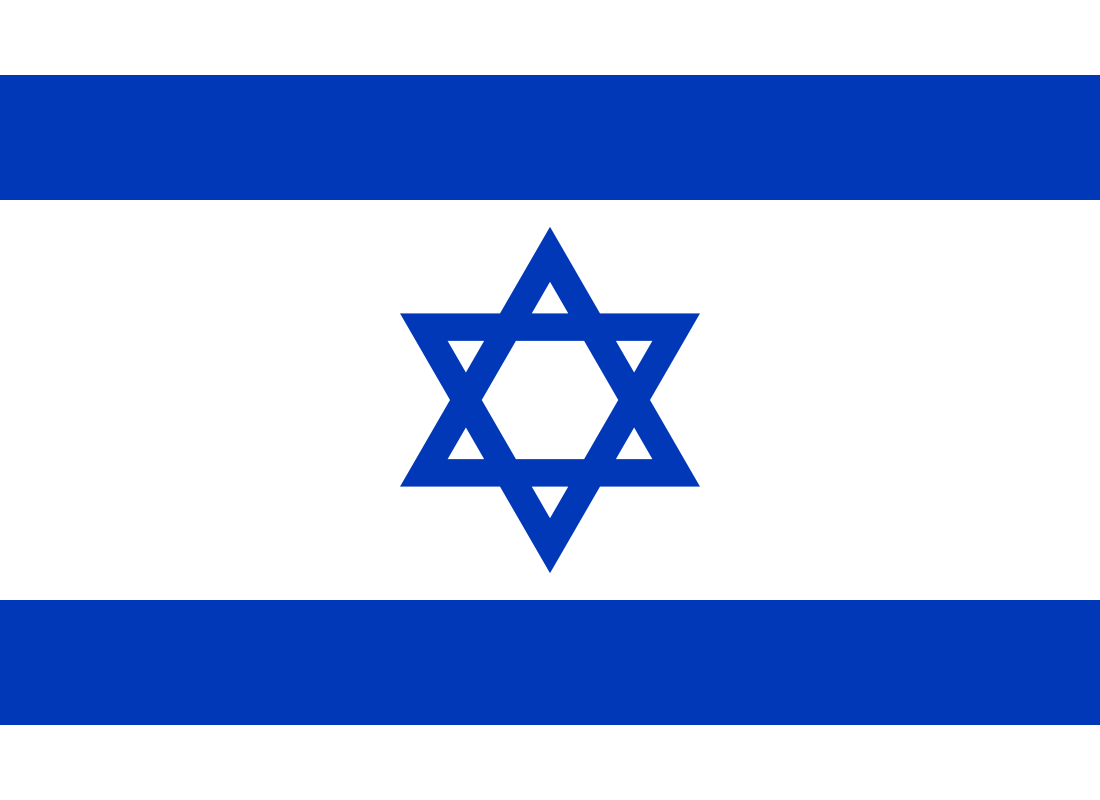
Identity
Formal name: State of Israel.
CIA 2026
Loading TerraBrawl
Data as of May 28, 2026
Expect the unexpected when it comes to Israel. Discover more about this complex place.
Expect the unexpected when it comes to Israel. It ranks #12 in high-tech exports, yet surprisingly lags in forest coverage. Discover more about this complex place.
Area
22K km²
Pop.
9.40M
Stats
178
Israel is a country in Asia with a population of 9.40M and an area of 21,937 km². Life expectancy is 83.2 years.
Short factual summary generated from the same country data used in game rounds.
Core numbers
Fast scan first, deep dive later.
Life Satisfaction
8.0 ptsAverage self-reported life satisfaction on a 0-10 scale, from OECD How's Life / Well-Being.
Life Expectancy
83.2 yearsHow many years a newborn can expect to live, based on current mortality rates.
Population Density
455.13 /km²How many people live in each square kilometer of land.
Human Development Index
0.92Composite 0-1 index of life expectancy, education, and income, from Our World in Data using the latest available country values in TerraBrawl.
GDP Per Capita
$47,338.84GDP per person adjusted for purchasing power in constant 2017 international dollars, from Our World in Data using the latest available country values in TerraBrawl.
Country briefing
A quick real-world briefing before you dive deeper into rankings, surprises, and matchups.
Identity
Formal name: State of Israel.
Geography
Size snapshot: slightly larger than New Jersey.
Culture
Major languages include Hebrew (official), Arabic (special status under Israeli law), English (most commonly used foreign language).
Cities
Browse this country's cities before City Detective asks you to guess.
Top stats
The strongest source-backed stats before the deeper data table.
R&D Spending (% GDP)
6.0% of GDPResearch and development spending as a share of GDP, from World Bank Open Data.
Military Spending
8.8% of GDPMilitary expenditure as a share of GDP, from World Bank Open Data.
Gender Pay Gap (%)
20.85% of male wagesWomen's earnings shortfall compared with men in the same wage decile, from OECD How's Life / Well-Being.
Urban Population (%)
91.54%The percentage of people living in cities and urban areas.
Mobile Subscriptions (%)
153.34 per 100 peopleMobile cellular subscriptions per 100 people, from World Bank Open Data.
Reality checks
The stats that tend to surprise players in real rounds.
Only ranks #239 in lowest elevation
Lowest point elevation from CIA World Factbook.
Ranks #12 globally in high-tech exports (%)
High-tech products (like computers, pharmaceuticals, and aerospace) as a percentage of total manufactured exports.
Ranks #15 globally in foreign patents
How many patent applications are filed by non-residents each year.
Keeps infant mortality unusually low
Infant deaths before age 1 per 1,000 live births, from World Bank Open Data.
Keeps child mortality unusually low
Deaths before age 5 per 1,000 live births, from World Bank Open Data.
Compared with the region
Country vs continent vs world averages
GDP per person, adjusted for purchasing power parity (PPP) so costs of living are comparable across countries.
How many years a newborn can expect to live, based on current mortality rates.
Composite 0-1 index of life expectancy, education, and income, from Our World in Data using the latest available country values in TerraBrawl.
The percentage of people who have used the internet in the last 3 months.
Think you can guess which countries rank higher?
Play this countryFactbook notes
Country briefing
Israel has become a regional economic and military powerhouse, leveraging its prosperous high-tech sector, large defense industry, and concerns about Iran to foster partnerships around the world.
Israel has become a regional economic and military powerhouse, leveraging its prosperous high-tech sector, large defense industry, and concerns about Iran to foster partnerships around the world. The State of Israel was established in 1948. The UN General Assembly proposed in 1947 partitioning the British Mandate for Palestine into an Arab and Jewish state. The Jews accepted the proposal, but the local Arabs and the Arab states rejected the UN plan and launched a war. The Arabs were subsequently defeated in the 1947-1949 war that followed the UN proposal and the British withdrawal. Israel joined the UN in 1949 and saw rapid population growth, primarily due to Jewish refugee migration from Europe and the Middle East. Israel and its Arab neighbors fought wars in 1956, 1967, and 1973, and Israel signed peace treaties with Egypt in 1979 and Jordan in 1994. Israel took control of the West Bank, the eastern part of Jerusalem, the Gaza Strip, the Sinai Peninsula, and the Golan Heights in the course of the 1967 war. It ceded the Sinai back to Egypt in the 1979-1982 period but has continued to administer the other territories through military authorities. Israel and Palestinian officials signed interim agreements in the 1990s that created a period of Palestinian self-rule in parts of the West Bank and Gaza. Israel withdrew from Gaza in 2005. The most recent formal efforts between Israel and the Palestinian Authority to negotiate final status issues occurred in 2013 and 2014, and the US continues its efforts to advance peace. Israel signed the US-brokered normalization agreements (the Abraham Accords) with Bahrain, the UAE, and Morocco in 2020 and reached an agreement with Sudan in 2021. Immigration to Israel continues, with more than 44,000 estimated new immigrants, mostly Jewish, in the first 11 months of 2023.
Former Prime Minister Benjamin NETANYAHU returned to office in 2022, continuing his dominance of Israel's political landscape at the head of Israel's most rightwing and religious government. NETANYAHU previously served as premier from 1996 to 1999 and from 2009 to 2021, becoming Israel's longest serving prime minister.
On 7 October 2023, HAMAS militants launched a combined unguided rocket and ground terrorist attack from Gaza into southern Israel. The same day Israel’s Air Force launched air strikes inside Gaza and initiated a sustained air campaign against HAMAS targets across the Gaza Strip. The following day, NETANYAHU formally declared war on HAMAS, and on 28 October, the Israel Defense Forces launched a large-scale ground assault inside Gaza.
The Israeli economy has undergone a dramatic transformation in the last 30 years, led by cutting-edge high-tech sectors. Offshore gas discoveries in the Mediterranean place Israel at the center of a potential regional natural gas market. In 2022, a US-brokered agreement between Israel and Lebanon established their maritime boundary, allowing Israel to begin production on additional gas fields in the Mediterranean. However, Israel's economic development has been uneven. Structural issues such as low labor-force participation among religious and minority populations, low workforce productivity, high costs for housing and consumer staples, and high income inequality concern both economists and the general population. The current war with Hamas disrupted Israel’s solid economic fundamentals, but it is not likely to have long-term structural implications for the economy.
Data vault
Every tracked stat, grouped for fast scanning.
Keep exploring
Open the head-to-head pages people naturally search after reading this profile.
Jump straight to the rankings where this country has its strongest edge.
Turn Israel's strongest number into a challenge card.
Average self-reported life satisfaction on a 0-10 scale, from OECD How's Life / Well-Being.
Israel has a population of 9.40M, ranking #98 globally by population.
Israel is located in Asia. It has an area of 21,937 km².
Life expectancy in Israel is 83.2 years, ranking #16 globally.
Israel's GDP per capita (PPP) is $55,690.74, ranking #40 globally.
Israel ranks particularly high in Life Satisfaction (#3), Life Expectancy (#16), Life Expectancy (#29).
Israel has an HDI of 0.919, ranking #27 globally. The HDI combines life expectancy, education, and income indicators.
Israel has a population density of 455.1 people per km², ranking #26 globally.