Geography
Natural resources include phosphates, potash, shale oil.
CIA 2026
Loading TerraBrawl
Data as of May 28, 2026
Expect the unexpected when it comes to Jordan. Discover more about this complex place.
Expect the unexpected when it comes to Jordan. A top performer in urban population (#26), it falls behind in forest coverage. Discover more about this complex place.
Area
89K km²
Pop.
11.31M
Stats
128
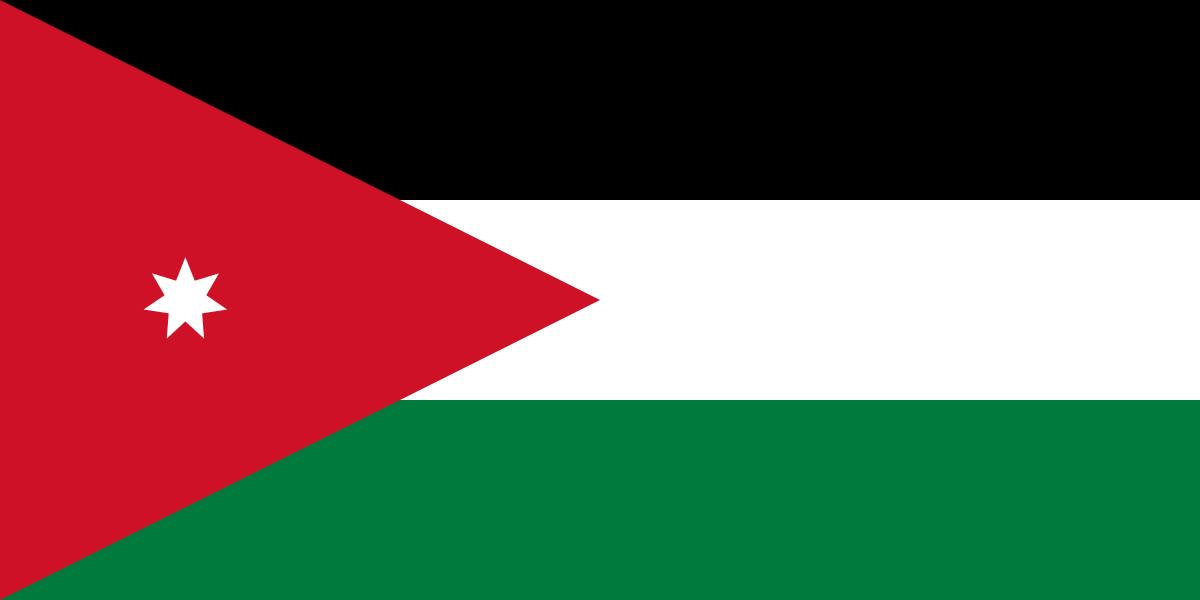
Jordan is a country in Asia with a population of 11.31M and an area of 89,342 km². Life expectancy is 77.8 years.
Short factual summary generated from the same country data used in game rounds.
Core numbers
Fast scan first, deep dive later.
Internet Users (%)
93%The percentage of people who have used the internet in the last 3 months.
Life Expectancy
77.8 yearsHow many years a newborn can expect to live, based on current mortality rates.
Population Density
128.83 /km²How many people live in each square kilometer of land.
Land Area
88.8K km²Total land area in square kilometers, excluding lakes, rivers, and territorial waters.
Country briefing
A quick real-world briefing before you dive deeper into rankings, surprises, and matchups.
Geography
Natural resources include phosphates, potash, shale oil.
Culture
Major languages include Arabic (official), English (widely understood among upper and middle classes).
Identity
Formal name: Hashemite Kingdom of Jordan.
Cities
Browse this country's cities before City Detective asks you to guess.
Top stats
The strongest source-backed stats before the deeper data table.
Youth Unemployment Rate
38.88% of youth labor forceShare of the labor force ages 15-24 that is unemployed from the World Bank latest available country value.
Unemployment Rate
18%The percentage of the workforce that is unemployed but actively looking for work.
Smoking Rate
35.6%The percentage of people aged 15 and older who use tobacco products.
Military Spending
4.8% of GDPMilitary expenditure as a share of GDP, from World Bank Open Data.
Urban Population (%)
92.95%The percentage of people living in cities and urban areas.
Reality checks
The stats that tend to surprise players in real rounds.
Only ranks #240 in lowest elevation
Lowest point elevation from CIA World Factbook.
Keeps suicide rate unusually low
Suicide mortality rate per 100,000 people, from World Bank Open Data.
Only ranks #221 in death rate
The number of deaths per 1,000 people each year.
Only ranks #194 in forest coverage (%)
The percentage of land covered by forests - natural or planted trees at least 5 meters tall (excludes orchards and urban parks).
Has one of the highest government debt (% gdp) figures
Central government debt as a share of GDP, from World Bank Open Data.
Compared with the region
Country vs continent vs world averages
GDP per person, adjusted for purchasing power parity (PPP) so costs of living are comparable across countries.
How many years a newborn can expect to live, based on current mortality rates.
Composite 0-1 index of life expectancy, education, and income, from Our World in Data using the latest available country values in TerraBrawl.
The percentage of people who have used the internet in the last 3 months.
Think you can guess which countries rank higher?
Play this countryFactbook notes
Country briefing
After World War I and the dissolution of the Ottoman Empire, the League of Nations awarded Britain the mandate to govern much of the Middle East.
After World War I and the dissolution of the Ottoman Empire, the League of Nations awarded Britain the mandate to govern much of the Middle East. In 1921, Britain demarcated from Palestine a semi-autonomous region of Transjordan and recognized ABDALLAH I from the Hashemite family as the country's first leader. The Hashemites also controlled the Hijaz, or the western coastal area of modern-day Saudi Arabia, until 1925, when IBN SAUD and Wahhabi tribes pushed them out. The country gained its independence in 1946 and thereafter became the Hashemite Kingdom of Jordan.
The country has had four kings. Long-time ruler King HUSSEIN (r. 1953-99) successfully navigated competing pressures from the major powers (US, UK, and Soviet Union), various Arab states, Israel, and Palestinian militants, the latter of which led to a brief civil war in 1970 that is known as "Black September" and ended in King HUSSEIN ousting the militants.
Jordan's borders have changed since it gained independence. In 1948, Jordan took control of the West Bank and East Jerusalem in the first Arab-Israeli War, eventually annexing those territories in 1950 and granting its new Palestinian residents Jordanian citizenship. In 1967, Jordan lost the West Bank and East Jerusalem to Israel in the Six-Day War but retained administrative claims to the West Bank until 1988, when King HUSSEIN permanently relinquished Jordanian claims to the West Bank in favor of the Palestine Liberation Organization (PLO). King HUSSEIN signed a peace treaty with Israel in 1994, after Israel and the PLO signed the Oslo Accords in 1993.
Jordanian kings continue to claim custodianship of the Muslim holy sites in Jerusalem by virtue of their Hashemite heritage as descendants of the Prophet Mohammad and agreements with Israel and Jerusalem-based religious and Palestinian leaders. After Israel captured East Jerusalem in the 1967 War, it authorized the Jordanian-controlled Islamic Trust, or Waqf, to continue administering the Al Haram ash Sharif/Temple Mount holy compound, and the Jordan-Israel peace treaty reaffirmed Jordan's "special role" in administering the Muslim holy shrines in Jerusalem. Jordanian kings claim custodianship of the Christian sites in Jerusalem on the basis of the 7th-century Pact of Omar, when the Muslim leader, after conquering Jerusalem, agreed to permit Christian worship.
King HUSSEIN died in 1999 and was succeeded by his eldest son and current King ABDALLAH II. In 2009, ABDALLAH II designated his son HUSSEIN as the Crown Prince. During his reign, ABDALLAH II has contended with a series of challenges, including the Arab Spring influx of refugees from neighboring states, the COVID-19 pandemic, the effects of the war in Ukraine, a perennially weak economy, and the Israel-HAMAS conflict that began in October 2023.
Data vault
Every tracked stat, grouped for fast scanning.
Keep exploring
Open the head-to-head pages people naturally search after reading this profile.
Jump straight to the rankings where this country has its strongest edge.
Turn Jordan's strongest number into a challenge card.
The percentage of people who have used the internet in the last 3 months.
Jordan has a population of 11.31M, ranking #84 globally by population.
Jordan is located in Asia. It has an area of 89,342 km².
Life expectancy in Jordan is 77.8 years, ranking #69 globally.
Jordan's GDP per capita (PPP) is $10,821.49, ranking #135 globally.
Jordan ranks particularly high in Internet Users (%) (#45), Life Expectancy (#69), Life Expectancy (#79).
Jordan has an HDI of 0.754, ranking #101 globally. The HDI combines life expectancy, education, and income indicators.
Jordan has a population density of 128.8 people per km², ranking #84 globally.