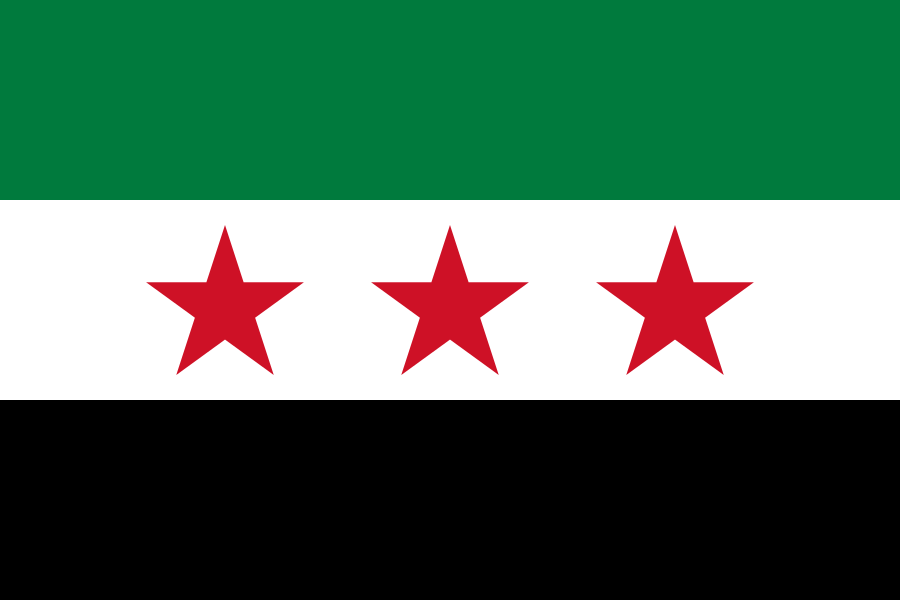
Identity
Formal name: Syrian Arab Republic.
CIA 2026
Loading TerraBrawl
Data as of May 28, 2026
Don't sleep on Syria's who road traffic deaths ranking. Ready to discover more?
Don't sleep on Syria's who road traffic deaths ranking. Ranking #5 with 29.9, it's an overlooked achiever. Ready to discover more?
Area
185K km²
Pop.
24.26M
Stats
107
Syria is a country in Asia with a population of 24.26M and an area of 185,180 km². Life expectancy is 72.1 years.
Short factual summary generated from the same country data used in game rounds.
Core numbers
Fast scan first, deep dive later.
Population Density
128.49 /km²How many people live in each square kilometer of land.
Land Area
183.6K km²Total land area in square kilometers, excluding lakes, rivers, and territorial waters.
Life Expectancy
72.1 yearsHow many years a newborn can expect to live, based on current mortality rates.
CO2 Per Capita
1.3 t/person/yrAnnual carbon dioxide emissions in tonnes per person, from Our World in Data using the latest available country values in TerraBrawl.
Country briefing
A quick real-world briefing before you dive deeper into rankings, surprises, and matchups.
Identity
Formal name: Syrian Arab Republic.
Geography
Size snapshot: slightly more than 1.5 times the size of Pennsylvania.
Culture
Major languages include Arabic (official), Kurdish, Armenian, Aramaic, and more.
Cities
Browse this country's cities before City Detective asks you to guess.
Damascus
Damascus Governorate, Syria
Aleppo
Syria
Homs
Syria
Latakia
Syria
Ar Raqqah
Raqqa, Syria
Ḩamāh
Hama, Syria
Al Ḩasakah
Al-Hasakah, Syria
Ţarţūs
Tartus, Syria
Top stats
The strongest source-backed stats before the deeper data table.
Inflation Rate
94.1%How much prices increased over the year, based on the cost of everyday goods and services.
Youth Unemployment Rate
33.1% of youth labor forceShare of the labor force ages 15-24 that is unemployed from the World Bank latest available country value.
Unemployment Rate
12.96%The percentage of the workforce that is unemployed but actively looking for work.
Armed Forces Personnel
269.0KTotal armed forces personnel from the World Bank latest available country value.
Irrigated Land
9.8K km²Irrigated land area from CIA World Factbook.
Reality checks
The stats that tend to surprise players in real rounds.
Keeps suicide rate unusually low
Suicide mortality rate per 100,000 people, from World Bank Open Data.
Only ranks #207 in protected land (%)
The percentage of land area designated as protected natural reserves or parks.
Only ranks #181 in beer consumption
Liters of beer consumed per person per year, from Our World in Data using the latest available country values in TerraBrawl.
Only ranks #179 in alcohol consumption
Liters of pure alcohol the average adult aged 15+ consumes per year, from Our World in Data using the latest available country values in TerraBrawl.
Only ranks #95 in r&d spending (% gdp)
Research and development spending as a share of GDP, from World Bank Open Data.
Compared with the region
Country vs continent vs world averages
GDP per person, adjusted for purchasing power parity (PPP) so costs of living are comparable across countries.
How many years a newborn can expect to live, based on current mortality rates.
Composite 0-1 index of life expectancy, education, and income, from Our World in Data using the latest available country values in TerraBrawl.
The percentage of people who have used the internet in the last 3 months.
Think you can guess which countries rank higher?
Play this countryFactbook notes
Country briefing
After World War I, France acquired a mandate over the northern portion of the former Ottoman Empire province of Syria.
After World War I, France acquired a mandate over the northern portion of the former Ottoman Empire province of Syria. The French administered the area until granting it independence in 1946. The new country lacked political stability and experienced a series of military coups. Syria united with Egypt in 1958 to form the United Arab Republic. In 1961, the two entities separated, and the Syrian Arab Republic was reestablished. In the 1967 Arab-Israeli War, Syria lost control of the Golan Heights region to Israel. During the 1990s, Syria and Israel held occasional, albeit unsuccessful, peace talks over its return. In 1970, Hafiz al-ASAD, a member of the socialist Ba'ath Party and the minority Alawi sect, seized power in a bloodless coup and brought political stability to the country. Following the death of al-ASAD, his son, Bashar al-ASAD, was approved as president by popular referendum in 2000. Syrian troops that were stationed in Lebanon since 1976 in an ostensible peacekeeping role were withdrawn in 2005. During the 2006 conflict between Israel and Hizballah, Syria placed its military forces on alert but did not intervene directly on behalf of its ally Hizballah. In 2007, Bashar al-ASAD's second term as president was again approved in a referendum.
In the wake of major uprisings elsewhere in the region, antigovernment protests broke out in the southern province of Dar'a in 2011. Protesters called for the legalization of political parties, the removal of corrupt local officials, and the repeal of the restrictive Emergency Law allowing arrests without charge. Demonstrations and violent unrest spread across Syria, and the government responded with concessions, but also with military force and detentions that led to extended clashes and eventually civil war. International pressure on the Syrian Government intensified after 2011, as the Arab League, the EU, Turkey, and the US expanded economic sanctions against the ASAD regime and those entities that supported it. In 2012, more than 130 countries recognized the Syrian National Coalition as the sole legitimate representative of the Syrian people. In 2015, Russia launched a military intervention on behalf of the ASAD regime, and domestic and foreign-government-aligned forces recaptured swaths of territory from opposition forces. With foreign support, the regime continued to periodically regain opposition-held territory until 2020, when Turkish firepower halted a regime advance and forced a stalemate between regime and opposition forces. The government lacks territorial control over much of the northeastern part of the country, which the predominantly Kurdish Syrian Democratic Forces (SDF) hold, and a smaller area dominated by Turkey.
Since 2016, Turkey has conducted three large-scale military operations to capture territory along Syria's northern border. Some opposition forces organized under the Turkish-backed Syrian National Army and Turkish forces have maintained control of northwestern Syria along the Turkish border with the Afrin area of Aleppo Province since 2018. The violent extremist organization Hay’at Tahrir al-Sham (formerly the Nusrah Front) emerged in 2017 as the predominant opposition force in Idlib Province, and still dominates an area also hosting Turkish forces. Negotiations have failed to produce a resolution to the conflict, and the UN estimated in 2022 that at least 306,000 people have died during the civil war. Approximately 6.7 million Syrians were internally displaced as of 2022, and 14.6 million people were in need of humanitarian assistance across the country. An additional 5.6 million Syrians were registered refugees in Turkey, Jordan, Iraq, Egypt, and North Africa. The conflict in Syria remains one of the two largest displacement crises worldwide (the other is the full-scale invasion of Ukraine).
On 8 December 2024, Syrian Islamist rebels captured the capital city of Damascus and overthrew President Bashar al-ASAD. The former president and his family f
Data vault
Every tracked stat, grouped for fast scanning.
Keep exploring
Open the head-to-head pages people naturally search after reading this profile.
Jump straight to the rankings where this country has its strongest edge.
Turn Syria's strongest number into a challenge card.
The total number of people living in the country.
Syria has a population of 24.26M, ranking #57 globally by population.
Syria is located in Asia. It has an area of 185,180 km².
Life expectancy in Syria is 72.1 years, ranking #133 globally.
Syria's GDP per capita (PPP) is $4,772.46, ranking #164 globally.
Syria ranks particularly high in Population (#57), Population Density (#85), Land Area (#88).
Syria has an HDI of 0.564, ranking #162 globally. The HDI combines life expectancy, education, and income indicators.
Syria has a population density of 128.5 people per km², ranking #85 globally.