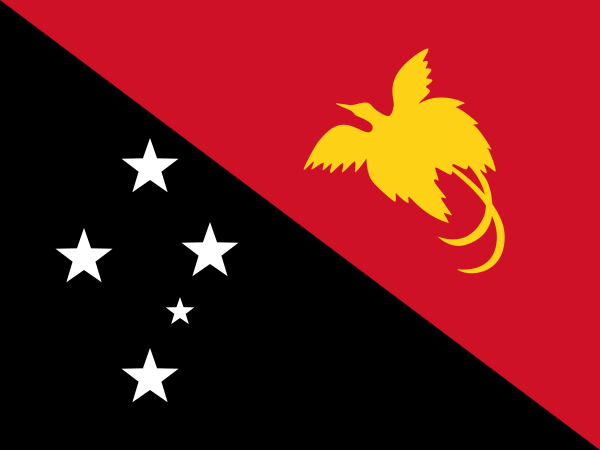
Papua New Guinea

OceaniaRegional Champion

No place in Oceania outperforms Papua New Guinea in economic output. This regional dominance shapes its continental identity. Test your knowledge of Oceania's top performer.

Papua New Guinea is a country in Oceania with a population of 10.27M and an area of 462,840 km². Life expectancy is 66.1 years.

At a Glance

The numbers that define this country

Land Area

452.9K
#54globally

Total land area in square kilometers, excluding lakes, rivers, and territorial waters.

Population

10.27M
#91globally

The total number of people living in the country.

CO2 Per Capita

0.79
#166globally

How many tonnes of CO2 the average person produces per year.

GDP Per Capita

$4.3K
#162globally

GDP per person, adjusted for purchasing power parity (PPP) so costs of living are comparable across countries.

Human Development Index

0.58
#160globally

The Human Development Index (HDI), combining life expectancy, education, and income into a single score from 0 to 1.

GDP Per Capita (PPP)

4.9K
#163globally

GDP per person, adjusted for purchasing power parity (PPP) so costs of living are comparable across countries.

Where They Stand Out

Global rankings worth knowing

❤️Smoking Rate

39.6%
#4globallyTop performer

The percentage of people aged 15 and older who use tobacco products.

🌱Forest Coverage (%)

79.0%
#9globallyTop performer

The percentage of land covered by forests - natural or planted trees at least 5 meters tall (excludes orchards and urban parks).

🔧Airports

569
#14globallyTop performer

Total airports from CIA World Factbook.

🌍Coastline Length

5.2K
#25globallyTop performer

Total coastline length from CIA World Factbook.

📡Broadband Access (%)

202
#22globallyTop performer

The number of high-speed fixed broadband subscriptions per 100 people.

Did You Know?

Facts that catch players off guard

❤️

Only ranks #157 in hospital beds (per 1,000)

Hospital Beds (per 1,000): 0.20

The number of hospital beds available per 1,000 people.

World Bank 2023
🛡️

Only ranks #164 in military spend (% gdp)

Military Spend (% GDP): 0.3%

Military expenditures as percent of GDP from CIA World Factbook.

👥

Only ranks #225 in urban population (%)

Urban Population (%): 15.4%

The percentage of people living in cities and urban areas.

World Bank 2023
🌱

Only ranks #208 in electricity access (%)

Electricity Access (%): 20.5%

The percentage of the population with access to electricity.

World Bank 2023
📡

Only ranks #218 in mobile subscriptions (%)

Mobile Subscriptions (%): 39

The number of mobile phone subscriptions per 100 people.

World Bank 2023

Surprised? See how you stack up.

Play Now

How Papua New Guinea Compares

Country vs continent vs world averages

Papua New Guinea
Oceania avg
World avg

GDP per Capita

GDP per person, adjusted for purchasing power parity (PPP) so costs of living are comparable across countries.

World Bank 2023
Papua New ...4.9K
Oceania16.1K
World31.8K

Life Expectancy

How many years a newborn can expect to live, based on current mortality rates.

World Bank 2023
Papua New ...66.1 years
Oceania72.5 years
World73.7 years

Human Development Index

The Human Development Index (HDI), combining life expectancy, education, and income into a single score from 0 to 1.

Our World in Data 2023
Papua New ...0.58
Oceania0.72
World0.74

Internet Users

The percentage of people who have used the internet in the last 3 months.

World Bank 2023
Papua New ...24.0%
Oceania61.7%
World70.3%

Think you can guess which countries rank higher?

Test Your Intuition
Regional comparison for Papua New Guinea across 4 key metrics, comparing with Oceania and world averages.

About Papua New Guinea

Papua New Guinea (PNG) occupies the eastern half of the island of New Guinea; the western half is part of Indonesia. PNG was first settled between 50,000 and 60,000 years ago. Its harsh geography of mountains, jungles, and numerous river valleys kept many of the arriving groups isolated, giving rise to PNG’s ethnic and linguistic diversity. Around 500 B.C., Austronesian voyagers settled along the coast. Spanish and Portuguese explorers periodically visited the island starting in the 1500s, but none made it into the country’s interior. American and British whaling ships frequented the islands off the coast of New Guinea in the mid-1800s. In 1884, Germany declared a protectorate -- and eventually a colony -- over the northern part of what would become PNG and named it German New Guinea; days later the UK followed suit on the southern part and nearby islands and called it Papua. Most of their focus was on the coastal regions, leaving the highlands largely unexplored.

The UK put its colony under Australian administration in 1902 and formalized the act in 1906. At the outbreak of World War I, Australia occupied German New Guinea and continued to rule it after the war as a League of Nations Mandate. The discovery of gold along the Bulolo River in the 1920s led prospectors to venture into the highlands, where they found about 1 million people living in isolated communities. The New Guinea campaign of World War II lasted from January 1942 to the Japanese surrender in August 1945. After the war, Australia combined the two territories and administered PNG as a UN trusteeship. In 1975, PNG gained independence and became a member of the Commonwealth.

Between 1988-1997, a secessionist movement on the island province of Bougainville, located off the eastern PNG coast, fought the PNG Government, resulting in 15,000-20,000 deaths. In 1997, the PNG Government and Bougainville leaders reached a cease-fire and subsequently signed a peace agreement in 2001. The Autonomous Bougainville Government was formally established in 2005. Bougainvilleans voted in favor of independence in a 2019 non-binding referendum. The Bougainville and PNG governments are in the process of negotiating a roadmap for independence, which requires approval by the PNG parliament.

🌍Geography & Climate6 facts
Location
Oceania, group of islands including the eastern half of the island of New Guinea between the Coral Sea and the South Pacific Ocean, east of Indonesia
Climate
tropical; northwest monsoon (December to March), southeast monsoon (May to October); slight seasonal temperature variation
Terrain
mostly mountains with coastal lowlands and rolling foothills
Natural Resources
gold, copper, silver, natural gas, timber, oil, fisheries
Natural Hazards
active volcanism; frequent and sometimes severe earthquakes; mud slides; tsunamis volcanism: severe volcanic activity; Ulawun (2,334 m), one of Papua New Guinea's potentially most dangerous volcanoes, has been deemed a Decade Volcano by the International Association of Volcanology and Chemistry of the Earth's Interior, worthy of study due to its explosive history and close proximity to human populations; Rabaul (688 m) destroyed the city of Rabaul in 1937 and 1994; Lamington erupted in 1951, killing 3,000 people; Manam's 2004 eruption forced the island's abandonment; other historically active volcanoes include Bam, Bagana, Garbuna, Karkar, Langila, Lolobau, Long Island, Pago, St. Andrew Strait, Victory, and Waiowa; see note 2 under "Geography - note"
Size Comparison
slightly larger than California
👥People & Culture4 facts
Languages
Tok Pisin (official), English (official), Hiri Motu (official), some 839 living indigenous languages are spoken (about 12% of the world's total)
Religions
Protestant 64.3% (Evangelical Lutheran 18.4%, Seventh Day Adventist 12.9%, Pentecostal 10.4%, United Church 10.3%, Evangelical Alliance 5.9%, Anglican 3.2%, Baptist 2.8%, Salvation Army 0.4%), Roman Catholic 26%, other Christian 5.3%, non-Christian 1.4%, unspecified 3.1% (2011 est.)
Ethnic Groups
Melanesian, Papuan, Negrito, Micronesian, Polynesian
Major Cities
410,000 PORT MORESBY (capital) (2023)
🏛️Government & History10 facts
Government Type
parliamentary democracy under a constitutional monarchy; a Commonwealth realm
Capital
Port Moresby
Capital Coordinates
9 27 S, 147 11 E
Capital Timezone
UTC+10 (15 hours ahead of Washington, DC, during Standard Time)
Official Name
Independent State of Papua New Guinea
Name Origin
the name derives from the Malay word pua-pua, describing the tightly curled hair of the Papuan people; Spanish explorer Ynigo ORTIZ de RETEZ applied the term "Nueva Guinea" to the island in 1545 because he thought the locals resembled the peoples of the Guinea coast of Africa
Independence
16 September 1975 (from the Australia-administered UN trusteeship)
National Symbols
bird of paradise
National Anthem
"O Arise, All You Sons"
UNESCO Heritage
1 (cultural)
💼Economy & Trade7 facts
Overview
lower-middle-income Pacific island economy; primarily informal agrarian sector; natural-resource-rich and key exporter of liquified natural gas; collapse in betel nut prices, tighter monetary policy, and improved foreign-exchange availability contributing to declining inflation; challenges include lack of progress in infrastructure, agricultural reform, and corruption
Industries
oil and gas; mining (gold, copper, and nickel); palm oil processing; plywood and wood chip production; copra crushing; construction; tourism; fishing; livestock (pork, poultry, cattle) and dairy farming; spice products (turmeric, vanilla, ginger, cardamom, chili, pepper, citronella, and nutmeg)
Agricultural Products
oil palm fruit, coconuts, bananas, fruits, sweet potatoes, game meat, yams, root vegetables, vegetables, sugarcane (2023)
Export Partners
China 28%, Japan 25%, Australia 17%, Taiwan 8%, India 4% (2023)
Export Commodities
natural gas, gold, copper ore, palm oil, nickel (2023)
Import Partners
Australia 27%, China 24%, Singapore 15%, Malaysia 9%, Japan 4% (2023)
Import Commodities
refined petroleum, trucks, rice, plastic products, excavation machinery (2023)
🔧Infrastructure & Defense4 facts
Military Forces
Papua New Guinea Defense Force (PNGDF): Land, Air, Maritime elements Ministry of Internal Security: Royal Papua New Guinea Constabulary (RPNGC) (2025)
Military Service
18-27 (30 for officers) for voluntary military service for men and women; no conscription (2025)
Energy Mix
fossil fuels: 76.4% of total installed capacity (2023 est.); solar: 0.1% of total installed capacity (2023 est.); hydroelectricity: 21.2% of total installed capacity (2023 est.); geothermal: 2% of total installed capacity (2023 est.); biomass and waste: 0.3% of total installed capacity (2023 est.)
Broadcast Media
5 TV stations: 1 commercial (TV Wan), 2 state-run (National Broadcasting Corporation and EMTV); 1 digital free-to-view network, and 1 satellite network (Click TV or PNGTV); the state-run NBC operates 3 radio networks with multiple repeaters and about 20 provincial stations; several commercial radio stations with multiple transmission points as well as several community stations; transmissions of several international broadcasters are accessible (2023)

Deep Dive

63 of 75 metrics

Every stat we track, organized by category

❤️Health & Survival10 metricsBest: #4
Smoking Rate
39.6%#4WB
Child Mortality
40.3#38WB
Infant Mortality
32#42WB
Obesity Rate
20.1%#122OWID
Life Expectancy
66.1 years#181WB
Life Expectancy
66.1 years#202OWID
Suicide Rate
1.82#168WB
Health Spending (% GDP)
2.6%#186WB
Doctors (per 1,000)
0.06#198WB
Hospital Beds (per 1,000)
0.20#157WB
🌱Environment9 metricsBest: #9
Forest Coverage (%)
79.0%#9WB
Forest Area
357.6K#19WB
Renewable Energy (%)
54.6%#43WB
Air Pollution (PM2.5)
17.311#118WB
Carbon Emissions (Total)
5.80M#132
CO2 Per Capita
0.79#166OWID
Protected Land (%)
3.7%#190WB
Irrigated Land
0#202
Electricity Access (%)
20.5%#208WB
🔧Infrastructure2 metricsBest: #14
Airports
569#14
Merchant Ships
205#65
📡Technology3 metricsBest: #22
Broadband Access (%)
202#22WB
Internet Users (%)
24.0%#215WB
Mobile Subscriptions (%)
39#218WB
🌍Land & Sea5 metricsBest: #25
Coastline Length
5.2K#25
Highest Elevation
4.5K#36
Land Boundaries Length
824#127
Lowest Elevation
0#158
Border Countries Count
1.00#155
👥Demographics12 metricsBest: #29
Fertility Rate
3.72#29WB
Birth Rate
27.57#35WB
Land Area
452.9K#54WB
Youth Population (%)
33.5%#57WB
Teen Birth Rate
54.069#65WB
Population
10.27M#91WB
Dependency Ratio
58.59#82WB
Death Rate
5.36#181WB
Elderly Population (%)
3.5%#175WB
Median Age
21.9 years#188
Population Density
22.942#181WB
Urban Population (%)
15.4%#225WB
💰Wealth & Economy10 metricsBest: #63
High-Tech Exports (%)
10.2%#63WB
GDP Growth Rate
3.8%#82WB
Government Debt (% GDP)
52.4%#92WB
GDP (Nominal)
31.80B#111WB
GDP Per Capita
$4.3K#162OWID
GDP Per Capita (PPP)
4.9K#163WB
Unemployment Rate
2.7%#155WB
Youth Unemployment Rate
3.8%#173
FDI Inflows (% GDP)
-0.6%#182WB
Inflation Rate
0.6%#197WB
🍻Lifestyle5 metricsBest: #86
Air Passengers
1.55M#86WB
Spirits Consumption
0.27#133OWID
Beer Consumption
0.45#137OWID
Alcohol Consumption
1.13#152OWID
Tourist Arrivals
39.0K#123WB
🚀Education & Future3 metricsBest: #87
Foreign Patents
29#87WB
Human Development Index
0.58#160OWID
Education Spending (% GDP)
0.8%#181WB
Energy1 metricsBest: #131
Electricity Capacity
1.15M#131
🛡️Military & Defense2 metricsBest: #148
Active Military Personnel
4.0K#148
Military Spend (% GDP)
0.3%#164
🤝Society & Equality1 metricsBest: #186
Women in Parliament (%)
2.7%#186WB

Neighboring Countries

Countries with Similar GDP

Compare Papua New Guinea with...

Share a Fact

Share something surprising about Papua New Guinea!

Papua New Guinea
#54 in Land Area

Total land area in square kilometers, excluding lakes, rivers, and territorial waters.

Top 25% globally
452.9K

Frequently Asked Questions about Papua New Guinea

What is the population of Papua New Guinea?

Papua New Guinea has a population of 10.27M, ranking #91 globally by population.

What continent is Papua New Guinea in?

Papua New Guinea is located in Oceania. It has an area of 462,840 km².

What is the life expectancy in Papua New Guinea?

Life expectancy in Papua New Guinea is 66.1 years, ranking #181 globally.

What is the GDP per capita of Papua New Guinea?

Papua New Guinea's GDP per capita (PPP) is 4.9K, ranking #163 globally.

What is Papua New Guinea known for in global statistics?

Papua New Guinea ranks particularly high in Land Area (#54), Population (#91), CO2 Per Capita (#166).

What is Papua New Guinea's Human Development Index?

Papua New Guinea has an HDI of 0.576, ranking #160 globally. The HDI combines life expectancy, education, and income indicators.

How densely populated is Papua New Guinea?

Papua New Guinea has a population density of 22.9 people per km², ranking #181 globally.
Think you know Papua New Guinea?

Compare countries, guess statistics, and prove you know your stuff.