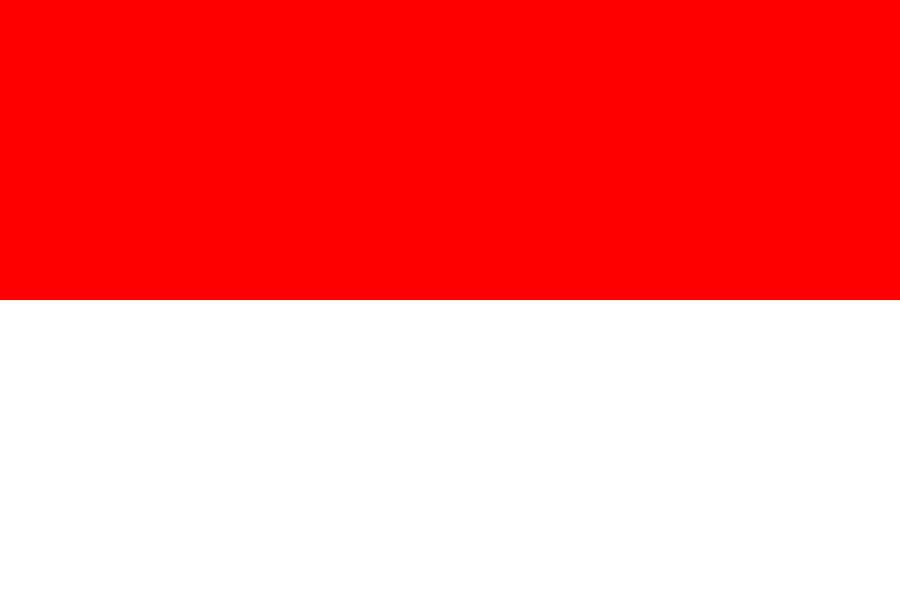
Identity
Name origin: the name is an 18th-century construct of two Greek words, "Indos" (India) and "nesoi" (islands), meaning "Indian islands".
CIA 2026
Loading TerraBrawl
Data as of May 28, 2026
Globally, Indonesia places #4 in population. Ready to explore more about Indonesia?
Globally, Indonesia places #4 in population. This ranking reflects a standout track record. Ready to explore more about Indonesia?
Area
1.9M km²
Pop.
283.59M
Stats
132
Indonesia is a country in Asia with a population of 283.59M and an area of 1,904,569 km². Life expectancy is 71.1 years.
Short factual summary generated from the same country data used in game rounds.
Core numbers
Fast scan first, deep dive later.
Land Area
1.89M km²Total land area in square kilometers, excluding lakes, rivers, and territorial waters.
Population Density
148.58 /km²How many people live in each square kilometer of land.
CO2 Per Capita
2.9 t/person/yrAnnual carbon dioxide emissions in tonnes per person, from Our World in Data using the latest available country values in TerraBrawl.
GDP Per Capita (PPP)
$16,448.28GDP per person, adjusted for purchasing power parity (PPP) so costs of living are comparable across countries.
University Enrollment Rate
44.88%Total university and college enrollment as a percentage of the typical college-age population.
Country briefing
A quick real-world briefing before you dive deeper into rankings, surprises, and matchups.
Identity
Name origin: the name is an 18th-century construct of two Greek words, "Indos" (India) and "nesoi" (islands), meaning "Indian islands".
Geography
Size snapshot: slightly less than three times the size of Texas.
Culture
Major languages include Bahasa Indonesia (official, modified form of Malay), English, Dutch, and more.
Cities
Browse this country's cities before City Detective asks you to guess.
Jakarta
Indonesia
Bandung
West Java, Indonesia
Medan
North Sumatra, Indonesia
Surabaya
East Java, Indonesia
Palembang
South Sumatra, Indonesia
Semarang
Central Java, Indonesia
Makassar
South Sulawesi, Indonesia
Padang
West Sumatra, Indonesia
Top stats
The strongest source-backed stats before the deeper data table.
Coastline Length
54.7K kmTotal coastline length from CIA World Factbook.
Merchant Fleet Size
11.4KNumber of merchant marine ships from the frozen public-domain CIA World Factbook snapshot.
Forest Area
903.2K km²Total forest area in square kilometers, including natural and planted trees at least 5 meters tall.
Smoking Rate
38.2%The percentage of people aged 15 and older who use tobacco products.
Air Passengers
97.05MTotal passengers carried by airlines registered in that country, regardless of where flights originated or ended.
Reality checks
The stats that tend to surprise players in real rounds.
Ranks #8 globally in irrigated land
Irrigated land area from CIA World Factbook.
Ranks #9 globally in armed forces personnel
Total armed forces personnel from the World Bank latest available country value.
Keeps suicide rate unusually low
Suicide mortality rate per 100,000 people, from World Bank Open Data.
Only ranks #181 in alcohol consumption
Liters of pure alcohol the average adult aged 15+ consumes per year, from Our World in Data using the latest available country values in TerraBrawl.
Ranks #13 globally in airports
Large, medium, and small airport records by country from the open OurAirports dataset.
Compared with the region
Country vs continent vs world averages
GDP per person, adjusted for purchasing power parity (PPP) so costs of living are comparable across countries.
How many years a newborn can expect to live, based on current mortality rates.
Composite 0-1 index of life expectancy, education, and income, from Our World in Data using the latest available country values in TerraBrawl.
The percentage of people who have used the internet in the last 3 months.
Think you can guess which countries rank higher?
Play this countryFactbook notes
Country briefing
The archipelago was once largely under the control of Buddhist and Hindu rulers.
The archipelago was once largely under the control of Buddhist and Hindu rulers. By around the 7th century, a Buddhist kingdom arose on Sumatra and expanded into Java and the Malay Peninsula until it was conquered in the late 13th century by the Hindu Majapahit Empire from Java. Majapahit (1290-1527) united most of modern-day Indonesia and Malaysia. Traders introduced Islam around the 11th century, and the religion gradually expanded over the next 500 years. The Portuguese conquered parts of Indonesia in the 16th century, but the Dutch ousted them (except in East Timor) and began colonizing the islands in the early 17th century. It would be the early 20th century before Dutch colonial rule was established across the entirety of what would become the boundaries of the modern Indonesian state.
Japan occupied the islands from 1942 to 1945. Indonesia declared its independence shortly before Japan's surrender, but it required four years of sometimes brutal fighting, intermittent negotiations, and UN mediation before the Netherlands agreed to transfer sovereignty in 1949. A period of sometimes unruly parliamentary democracy ended in 1957 when President SOEKARNO declared martial law and instituted "Guided Democracy." After an abortive coup in 1965 by alleged communist sympathizers, SOEKARNO was gradually eased from power. From 1967 until 1998, President SUHARTO ruled Indonesia with his "New Order" government. After street protests toppled SUHARTO in 1998, free and fair legislative elections took place in 1999 while the country's first direct presidential election occurred in 2004. Indonesia has since become a robust democracy, holding four direct presidential elections, each considered by international observers to have been largely free and fair.
Indonesia is now the world's third-most-populous democracy and the world's largest Muslim-majority nation. It has had strong economic growth since overcoming the Asian financial crisis of the late 1990s. By the 2020s, it had the largest economy in Southeast Asia, and its economy ranked in the world's top 10 in terms of purchasing power parity. It has also made considerable gains in reducing poverty. Although relations amongst its diverse population--there are more than 300 ethnic groups--have been harmonious in the 2000s, there have been areas of sectarian discontent and violence, as well as instances of religious extremism and terrorism. A political settlement to an armed separatist conflict in Aceh was achieved in 2005, but a separatist group in Papua continued to conduct a low-intensity conflict as of 2024.
Data vault
Every tracked stat, grouped for fast scanning.
Keep exploring
Open the head-to-head pages people naturally search after reading this profile.
Jump straight to the rankings where this country has its strongest edge.
Turn Indonesia's strongest number into a challenge card.
The total number of people living in the country.
Indonesia has a population of 283.59M, ranking #4 globally by population.
Indonesia is located in Asia. It has an area of 1,904,569 km².
Life expectancy in Indonesia is 71.1 years, ranking #144 globally.
Indonesia's GDP per capita (PPP) is $16,448.28, ranking #112 globally.
Indonesia ranks particularly high in Population (#4), Land Area (#14), Population Density (#75).
Indonesia has an HDI of 0.728, ranking #113 globally. The HDI combines life expectancy, education, and income indicators.
Indonesia has a population density of 148.6 people per km², ranking #75 globally.