Curated stat
Malaysia is split by the South China Sea: one part on the Malay Peninsula, another on Borneo.
Loading TerraBrawl
Data as of May 28, 2026
Malaysia ranks high and low in ways you wouldn't predict. Can you guess what else is surprising?
Malaysia ranks high and low in ways you wouldn't predict. It ranks #6 in high-tech exports, yet surprisingly lags in renewable energy. Can you guess what else is surprising?
Area
331K km²
Pop.
34.91M
Stats
132
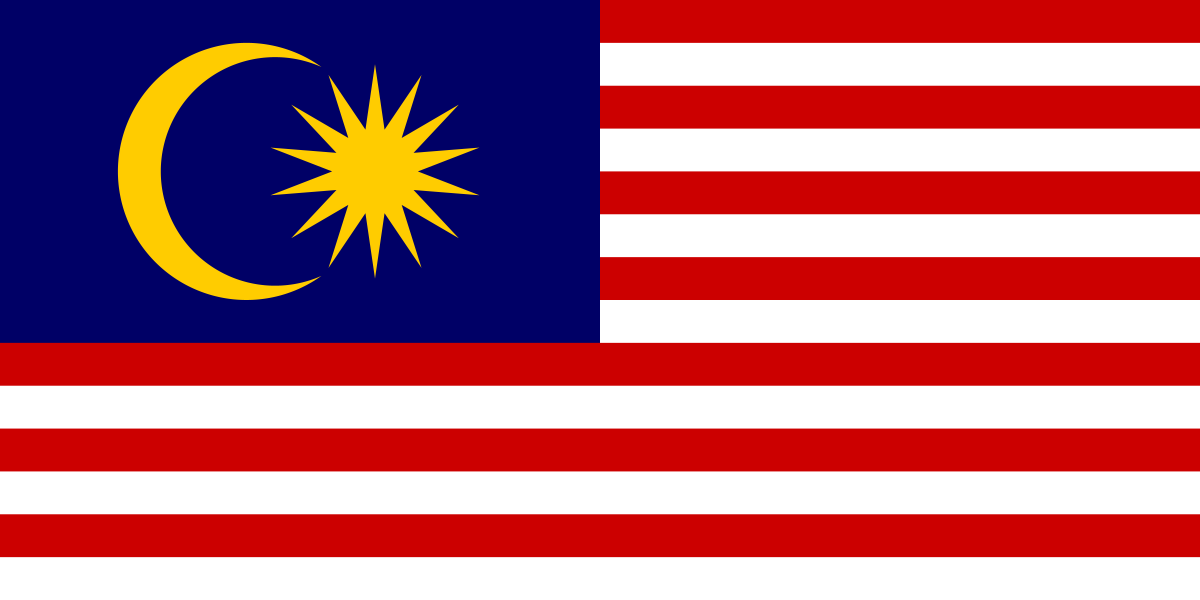
Malaysia is a country in Asia with a population of 34.91M and an area of 330,803 km². Life expectancy is 76.7 years.
Short factual summary generated from the same country data used in game rounds.
Core numbers
Fast scan first, deep dive later.
Internet Users (%)
98.02%The percentage of people who have used the internet in the last 3 months.
CO2 Per Capita
8.2 t/person/yrAnnual carbon dioxide emissions in tonnes per person, from Our World in Data using the latest available country values in TerraBrawl.
Land Area
328.6K km²Total land area in square kilometers, excluding lakes, rivers, and territorial waters.
GDP Per Capita
$34,071.94GDP per person adjusted for purchasing power in constant 2017 international dollars, from Our World in Data using the latest available country values in TerraBrawl.
GDP Per Capita (PPP)
$38,779.28GDP per person, adjusted for purchasing power parity (PPP) so costs of living are comparable across countries.
Country briefing
A quick real-world briefing before you dive deeper into rankings, surprises, and matchups.
Curated stat
Malaysia is split by the South China Sea: one part on the Malay Peninsula, another on Borneo.
Geography
Size snapshot: slightly larger than New Mexico.
Culture
Major languages include Bahasa Malaysia (official), English, Chinese (Cantonese, Mandarin, and more.
Cities
Browse this country's cities before City Detective asks you to guess.
Kuala Lumpur
Malaysia
George Town
Penang, Malaysia
Johor Bahru
Johor, Malaysia
Kuching
Sarawak, Malaysia
Ipoh
Perak, Malaysia
Kota Bharu
Kelantan, Malaysia
Kota Kinabalu
Sabah, Malaysia
Malacca
Melaka, Malaysia
Top stats
The strongest source-backed stats before the deeper data table.
High-Tech Exports (%)
58.63%High-tech products (like computers, pharmaceuticals, and aerospace) as a percentage of total manufactured exports.
Merchant Fleet Size
1.8KNumber of merchant marine ships from the frozen public-domain CIA World Factbook snapshot.
Total CO2 Emissions
295.95 Mt CO2eTotal carbon dioxide emissions excluding LULUCF from the World Bank latest available country value.
Coastline Length
4.7K kmTotal coastline length from CIA World Factbook.
Foreign Patents
6.7KHow many patent applications are filed by non-residents each year.
Reality checks
The stats that tend to surprise players in real rounds.
Only ranks #194 in dependency ratio
Dependents as a share of the working-age population, from World Bank Open Data.
Ranks #31 globally in forest coverage (%)
The percentage of land covered by forests - natural or planted trees at least 5 meters tall (excludes orchards and urban parks).
Ranks #24 globally in air passengers
Total passengers carried by airlines registered in that country, regardless of where flights originated or ended.
Ranks #32 globally in forest area
Total forest area in square kilometers, including natural and planted trees at least 5 meters tall.
Compared with the region
Country vs continent vs world averages
GDP per person, adjusted for purchasing power parity (PPP) so costs of living are comparable across countries.
How many years a newborn can expect to live, based on current mortality rates.
Composite 0-1 index of life expectancy, education, and income, from Our World in Data using the latest available country values in TerraBrawl.
The percentage of people who have used the internet in the last 3 months.
Think you can guess which countries rank higher?
Play this countryFactbook notes
Country briefing
Malaysia’s location has long made it an important cultural, economic, historical, social, and trade link between the islands of Southeast Asia and the mainland.
Malaysia’s location has long made it an important cultural, economic, historical, social, and trade link between the islands of Southeast Asia and the mainland. Through the Strait of Malacca, which separates the Malay Peninsula from the archipelago, flowed maritime trade and with it influences from China, India, the Middle East, and the east coast of Africa. Prior to the 14th century, several powerful maritime empires existed in what is modern-day Malaysia, including the Srivijayan, which controlled much of the southern part of the peninsula between the 7th and 13th centuries, and the Majapahit Empire, which took control over most of the peninsula and the Malay Archipelago between the 13th and 14th centuries. The adoption of Islam between the 13th and 17th centuries also saw the rise of a number of powerful maritime states and sultanates on the Malay Peninsula and the island of Borneo, such as the port city of Malacca (Melaka), which at its height in the 15th century had a navy and hosted thousands of Chinese, Arab, Persian, and Indian merchants.
The Portuguese in the 16th century and the Dutch in the 17th century were the first European colonial powers to establish themselves on the Malay Peninsula and in Southeast Asia. However, it was the British who ultimately secured hegemony across the territory and during the late 18th and 19th centuries established colonies and protectorates in the area that is now Malaysia. Japan occupied these holdings from 1942 to 1945. In 1948, the British-ruled territories on the Malay Peninsula (except Singapore) formed the Federation of Malaya, which became independent in 1957. Malaysia was formed in 1963 when the former British colonies of Singapore, as well as Sabah and Sarawak on the northern coast of Borneo, joined the Federation.
A communist insurgency, confrontations with Indonesia, Philippine claims to Sabah, and Singapore's expulsion in 1965 marred the first several years of the country's independence. During the 22-year term of Prime Minister MAHATHIR Mohamad (1981-2003), Malaysia was successful in diversifying its economy from dependence on exports of raw materials to the development of manufacturing, services, and tourism. Former Prime Minister MAHATHIR and a newly formed coalition of opposition parties defeated Prime Minister Mohamed NAJIB bin Abdul Razak's United Malays National Organization (UMNO) in 2018, ending over 60 years of uninterrupted UMNO rule. From 2018-2022, Malaysia underwent considerable political upheaval, with a succession of coalition governments holding power. Following legislative elections in 2022, ANWAR Ibrahim was appointed prime minister after more than 20 years in opposition. His political coalition, Pakatan Harapan (PH), joined its longtime UNMO rival to form a government, but the two groups have remained deeply divided on many issues.
Data vault
Every tracked stat, grouped for fast scanning.
Keep exploring
Open the head-to-head pages people naturally search after reading this profile.
Jump straight to the rankings where this country has its strongest edge.
Turn Malaysia's strongest number into a challenge card.
The percentage of people who have used the internet in the last 3 months.
Malaysia has a population of 34.91M, ranking #45 globally by population.
Malaysia is located in Asia. It has an area of 330,803 km².
Life expectancy in Malaysia is 76.7 years, ranking #85 globally.
Malaysia's GDP per capita (PPP) is $38,779.28, ranking #65 globally.
Malaysia ranks particularly high in Internet Users (%) (#14), CO2 Per Capita (#34), Population (#45).
Malaysia has an HDI of 0.819, ranking #67 globally. The HDI combines life expectancy, education, and income indicators.
Malaysia has a population density of 106.9 people per km², ranking #97 globally.