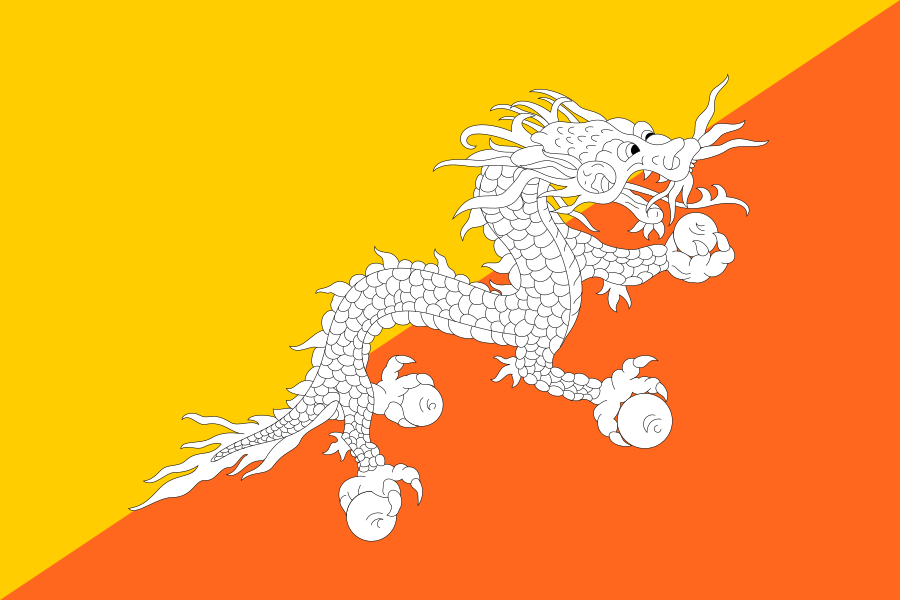
Identity
Name origin: name may derive from the Sanskrit words bhoṭa, the name for Tibet, and anta, meaning "end" -- a reference to Bhutan's location at the southernmost end of Ti…
CIA 2026
Loading TerraBrawl
Data as of May 28, 2026
Bhutan leads Asia in renewable energy. Discover what makes it the regional champion.
Bhutan leads Asia in renewable energy. With 82.5%, it sets the regional standard. Discover what makes it the regional champion.
Area
38K km²
Pop.
892.9K
Stats
115
Bhutan is a country in Asia with a population of 892.9K and an area of 38,394 km². Life expectancy is 73.0 years.
Short factual summary generated from the same country data used in game rounds.
Core numbers
Fast scan first, deep dive later.
Internet Users (%)
88%The percentage of people who have used the internet in the last 3 months.
GDP Per Capita
$14,645.27GDP per person adjusted for purchasing power in constant 2017 international dollars, from Our World in Data using the latest available country values in TerraBrawl.
Life Expectancy
73.0 yearsHow many years a newborn can expect to live, based on current mortality rates.
GDP Per Capita (PPP)
$16,215.15GDP per person, adjusted for purchasing power parity (PPP) so costs of living are comparable across countries.
Land Area
38.1K km²Total land area in square kilometers, excluding lakes, rivers, and territorial waters.
Country briefing
A quick real-world briefing before you dive deeper into rankings, surprises, and matchups.
Identity
Name origin: name may derive from the Sanskrit words bhoṭa, the name for Tibet, and anta, meaning "end" -- a reference to Bhutan's location at the southernmost end of Ti…
Geography
Size snapshot: slightly larger than Maryland.
Culture
Major languages include Sharchopkha 28%, Dzongkha (official) 24%, Lhotshamkha 22%, other 26% (includes foreign languages) (2005 est.).
Cities
Browse this country's cities before City Detective asks you to guess.
Top stats
The strongest source-backed stats before the deeper data table.
Protected Land (%)
51.6%The percentage of land area designated as protected natural reserves or parks.
Highest Elevation
7.6K mHighest point elevation from CIA World Factbook.
Renewable Energy (%)
82.5%The percentage of energy consumption that comes from renewable sources like solar, wind, and hydro.
Government Debt (% GDP)
111% of GDPCentral government debt as a share of GDP, from World Bank Open Data.
Education Spending (% GDP)
5.8% of GDPGovernment education spending as a share of GDP, from World Bank Open Data.
Reality checks
The stats that tend to surprise players in real rounds.
Only ranks #183 in spirits consumption
Liters of spirits consumed per person per year, from Our World in Data using the latest available country values in TerraBrawl.
Only ranks #163 in high-tech exports (%)
High-tech products (like computers, pharmaceuticals, and aerospace) as a percentage of total manufactured exports.
Only ranks #182 in women in parliament (%)
The percentage of parliament seats held by women.
Only ranks #125 in tourist arrivals
How many international tourists visit the country each year.
Only ranks #177 in beer consumption
Liters of beer consumed per person per year, from Our World in Data using the latest available country values in TerraBrawl.
Compared with the region
Country vs continent vs world averages
GDP per person, adjusted for purchasing power parity (PPP) so costs of living are comparable across countries.
How many years a newborn can expect to live, based on current mortality rates.
Composite 0-1 index of life expectancy, education, and income, from Our World in Data using the latest available country values in TerraBrawl.
The percentage of people who have used the internet in the last 3 months.
Think you can guess which countries rank higher?
Play this countryFactbook notes
Country briefing
After Britain’s victory in the 1865 Duar War, Britain and Bhutan signed the Treaty of Sinchulu, under which Bhutan would receive an annual subsidy in exchange for ceding land to British India.
After Britain’s victory in the 1865 Duar War, Britain and Bhutan signed the Treaty of Sinchulu, under which Bhutan would receive an annual subsidy in exchange for ceding land to British India. Ugyen WANGCHUCK -- who had served as the de facto ruler of an increasingly unified Bhutan and had improved relations with the British toward the end of the 19th century -- was named king in 1907. Three years later, a treaty was signed whereby the British agreed not to interfere in Bhutanese internal affairs, and Bhutan allowed Britain to direct its foreign affairs. Bhutan negotiated a similar arrangement with independent India in 1949. The Indo-Bhutanese Treaty of Friendship returned to Bhutan a small piece of the territory annexed by the British, formalized the annual subsidies the country received, and defined India's responsibilities in defense and foreign relations. Under a succession of modernizing monarchs beginning in the 1950s, Bhutan joined the UN in 1971 and slowly continued its engagement beyond its borders.
In 2005, King Jigme Singye WANGCHUCK unveiled the draft of Bhutan's first constitution -- which introduced major democratic reforms -- and held a national referendum for its approval. The King abdicated the throne in 2006 in favor of his son, Jigme Khesar Namgyel WANGCHUCK. In 2007, India and Bhutan renegotiated their treaty, eliminating the clause that stated that Bhutan would be "guided by" India in conducting its foreign policy, although Thimphu continues to coordinate closely with New Delhi. In 2008, Bhutan held its first parliamentary election in accordance with the constitution. Bhutan experienced a peaceful turnover of power following a parliamentary election in 2013, which resulted in the defeat of the incumbent party. In 2018, the incumbent party again lost the parliamentary election. In 2024, of the more than 100,000 ethnic Nepali -- predominantly Lhotshampa -- refugees who fled or were forced out of Bhutan in the 1990s, about 6,500 remain displaced in Nepal.
Data vault
Every tracked stat, grouped for fast scanning.
Keep exploring
Open the head-to-head pages people naturally search after reading this profile.
Jump straight to the rankings where this country has its strongest edge.
Turn Bhutan's strongest number into a challenge card.
The percentage of people who have used the internet in the last 3 months.
Bhutan has a population of 892.9K, ranking #163 globally by population.
Bhutan is located in Asia. It has an area of 38,394 km².
Life expectancy in Bhutan is 73.0 years, ranking #121 globally.
Bhutan's GDP per capita (PPP) is $16,215.15, ranking #114 globally.
Bhutan ranks particularly high in Internet Users (%) (#76), GDP Per Capita (#112), Life Expectancy (#121).
Bhutan has an HDI of 0.698, ranking #125 globally. The HDI combines life expectancy, education, and income indicators.
Bhutan has a population density of 20.6 people per km², ranking #183 globally.