Geography
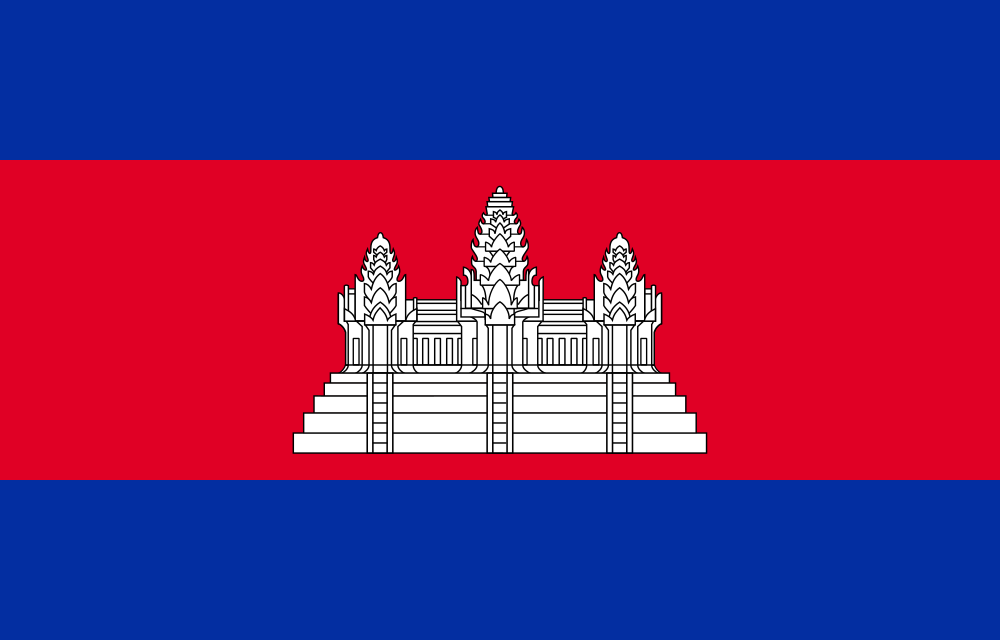
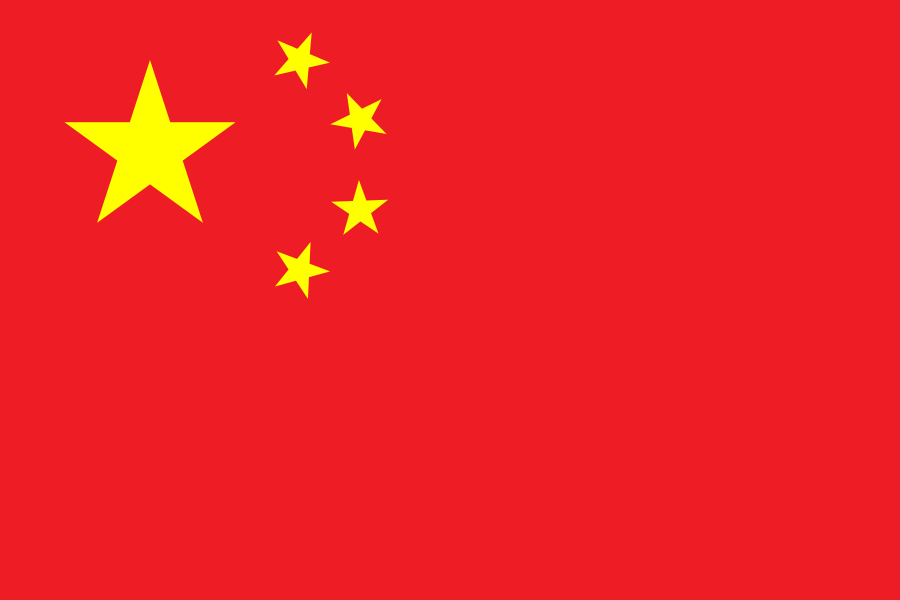
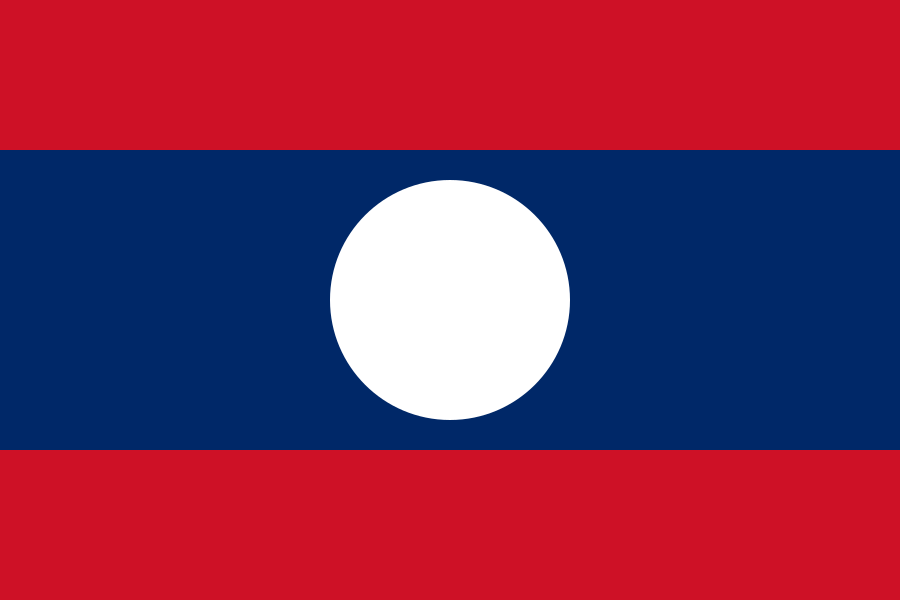
Location: Southeastern Asia, bordering the Gulf of Thailand, Gulf of Tonkin, and South China Sea, as well as China, Laos, and Cambodia.
CIA 2026
Loading TerraBrawl
Data as of May 28, 2026
Vietnam tops Asia for renewable energy. How does it compare to its neighbors?
Vietnam tops Asia for renewable energy. Neighbors look to it as a regional benchmark. How does it compare to its neighbors?
Area
331K km²
Pop.
106.69M
Stats
132
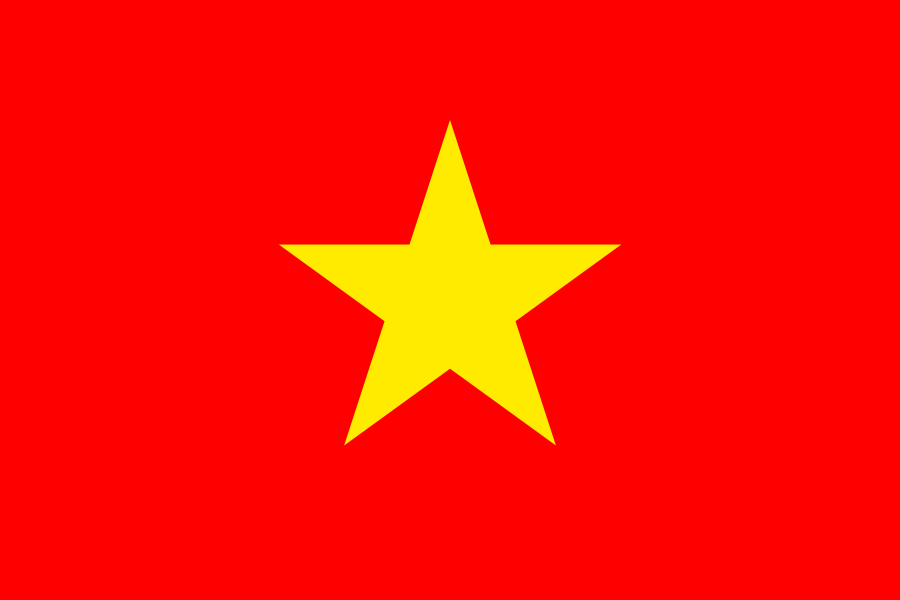
Vietnam is a country in Asia with a population of 106.69M and an area of 331,212 km². Life expectancy is 74.6 years.
Short factual summary generated from the same country data used in game rounds.
Core numbers
Fast scan first, deep dive later.
Population Density
320.18 /km²How many people live in each square kilometer of land.
Land Area
313.4K km²Total land area in square kilometers, excluding lakes, rivers, and territorial waters.
Internet Users (%)
84.15%The percentage of people who have used the internet in the last 3 months.
CO2 Per Capita
3.7 t/person/yrAnnual carbon dioxide emissions in tonnes per person, from Our World in Data using the latest available country values in TerraBrawl.
Human Development Index
0.77Composite 0-1 index of life expectancy, education, and income, from Our World in Data using the latest available country values in TerraBrawl.
Country briefing
A quick real-world briefing before you dive deeper into rankings, surprises, and matchups.
Geography
Location: Southeastern Asia, bordering the Gulf of Thailand, Gulf of Tonkin, and South China Sea, as well as China, Laos, and Cambodia.
Culture
Major languages include Vietnamese (official); English (often as a second language); some French, Chinese, and Khmer;.
Identity
Formal name: Socialist Republic of Vietnam.
Cities
Browse this country's cities before City Detective asks you to guess.
Ho Chi Minh City
Ho Chi Minh City (HCMC), Vietnam
Hanoi
Vietnam
Haiphong
Hai Phong, Vietnam
Da Nang
Da Nang City, Vietnam
Cần Thơ
Can Tho City, Vietnam
Biên Hòa
Dong Nai, Vietnam
Huế
Thua Thien Hue Province, Vietnam
Qui Nhon
Gia Lai, Vietnam
Top stats
The strongest source-backed stats before the deeper data table.
High-Tech Exports (%)
44.26%High-tech products (like computers, pharmaceuticals, and aerospace) as a percentage of total manufactured exports.
Irrigated Land
46.0K km²Irrigated land area from CIA World Factbook.
Merchant Fleet Size
2.0KNumber of merchant marine ships from the frozen public-domain CIA World Factbook snapshot.
Armed Forces Personnel
522.0KTotal armed forces personnel from the World Bank latest available country value.
Electric Generating Capacity
85.72M kWInstalled electricity generating capacity in kilowatts from the frozen public-domain CIA World Factbook snapshot.
Reality checks
The stats that tend to surprise players in real rounds.
Only ranks #199 in obesity rate
Share of adults with obesity, from Our World in Data using the latest available country values in TerraBrawl.
Keeps unemployment rate unusually low
The percentage of the workforce that is unemployed but actively looking for work.
Has one of the highest total co2 emissions figures
Total carbon dioxide emissions excluding LULUCF from the World Bank latest available country value.
Ranks #16 globally in foreign patents
How many patent applications are filed by non-residents each year.
Ranks #20 globally in air passengers
Total passengers carried by airlines registered in that country, regardless of where flights originated or ended.
Compared with the region
Country vs continent vs world averages
GDP per person, adjusted for purchasing power parity (PPP) so costs of living are comparable across countries.
How many years a newborn can expect to live, based on current mortality rates.
Composite 0-1 index of life expectancy, education, and income, from Our World in Data using the latest available country values in TerraBrawl.
The percentage of people who have used the internet in the last 3 months.
Think you can guess which countries rank higher?
Play this countryFactbook notes
Country briefing
Vietnam's early history included periods of occupation by outside forces and eventual power consolidation under Vietnamese dynastic families.
Vietnam's early history included periods of occupation by outside forces and eventual power consolidation under Vietnamese dynastic families. A succession of Han Chinese emperors ruled the area, which was centered on the Red River Valley, until approximately the 10th century. The Ly Dynasty (11th-13th century) created the first independent Vietnamese state, which was known as Dai Viet, and established their capital at Thang Long (Hanoi). Under the Tran Dynasty (13th-15th century), TRAN Hung Dao, one of Vietnam’s national heroes, led Dai Viet forces to fight off Mongol invaders in 1279. After a brief Chinese occupation in the early 1400s, Vietnamese resistance leader LE Thai To made himself emperor and established the Le Dynasty, which lasted until the late 18th century despite decades of political turmoil, civil war, and division. During this period, Dai Viet expanded southward to the Central Highlands and Mekong Delta, reaching the approximate boundaries of modern-day Vietnam by the 1750s. Dai Viet suffered additional civil war and division in the latter half of the 18th century, but it was reunited and renamed Vietnam under Emperor NGUYEN Phuc Anh (aka Gia Long) in 1802.
France began its conquest of Vietnam in 1858 and made Vietnam part of French Indochina in 1887. Vietnam declared independence after World War II, but the French continued to rule until communist forces under Ho Chi MINH defeated them in 1954. Under the Geneva Accords of 1954, Vietnam was divided into the communist North and anti-communist South. Fighting erupted between the two governments shortly afterwards with the North supporting communist rebels in the South and eventually committing thousands of combat troops. The US provided to the South significant economic and military assistance, including large numbers of US military forces, which reached a peak strength of over 500,000 troops in 1968. US combat forces were withdrawn following a cease-fire agreement in 1973. Two years later, North Vietnamese forces overran the South, reuniting the country under communist rule. The conflict, known as the Second Indochina War (1955-1975), devastated Vietnam, spilled over into the neighboring countries of Cambodia and Laos, and is estimated to have resulted in the deaths of up to 3 million Vietnamese civilians and soldiers. It also caused more than 58,000 US combat and non-combat deaths and created deep domestic divisions in the US.
Despite the return of peace, the country experienced little economic growth for over a decade because of its diplomatic isolation, leadership policies, and the persecution and mass exodus of citizens, many of them successful South Vietnamese merchants. However, since the enactment of Vietnam's "doi moi" (renovation) policy in 1986, the economy has seen strong growth, particularly in agricultural and industrial production, construction, exports, foreign investment, and tourism. Nevertheless, the Communist Party maintains tight political and social control of the country, and Vietnam faces many related challenges, such as rising income inequality and corruption.
Data vault
Every tracked stat, grouped for fast scanning.
Keep exploring
Open the head-to-head pages people naturally search after reading this profile.
Jump straight to the rankings where this country has its strongest edge.
Turn Vietnam's strongest number into a challenge card.
The total number of people living in the country.
Vietnam has a population of 106.69M, ranking #16 globally by population.
Vietnam is located in Asia. It has an area of 331,212 km².
Life expectancy in Vietnam is 74.6 years, ranking #106 globally.
Vietnam's GDP per capita (PPP) is $16,385.51, ranking #113 globally.
Vietnam ranks particularly high in Population (#16), Population Density (#37), Land Area (#68).
Vietnam has an HDI of 0.766, ranking #94 globally. The HDI combines life expectancy, education, and income indicators.
Vietnam has a population density of 320.2 people per km², ranking #37 globally.