Geography
Size snapshot: slightly smaller than the US.
CIA 2026
Loading TerraBrawl
Data as of May 28, 2026
With a global ranking of #2, China leads in population. Test your knowledge of this global leader.
With a global ranking of #2, China leads in population. Few places match this level of performance. Test your knowledge of this global leader.
Area
9.7M km²
Pop.
1.41B
Stats
130
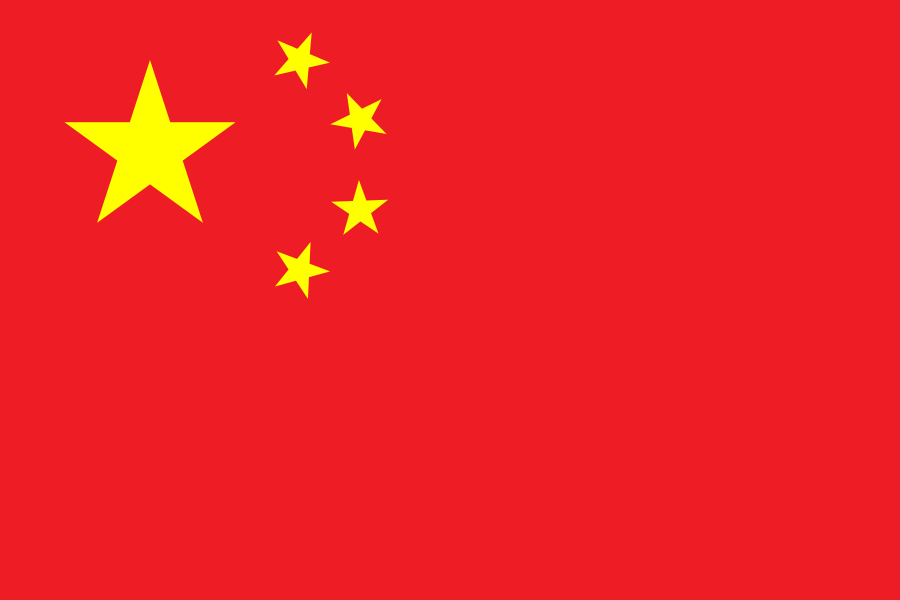
China is a country in Asia with a population of 1.41B and an area of 9,706,961 km². Life expectancy is 78.0 years.
Short factual summary generated from the same country data used in game rounds.
Core numbers
Fast scan first, deep dive later.
Land Area
9.39M km²Total land area in square kilometers, excluding lakes, rivers, and territorial waters.
CO2 Per Capita
8.7 t/person/yrAnnual carbon dioxide emissions in tonnes per person, from Our World in Data using the latest available country values in TerraBrawl.
Internet Users (%)
92%The percentage of people who have used the internet in the last 3 months.
University Enrollment Rate
76.88%Total university and college enrollment as a percentage of the typical college-age population.
Life Expectancy
78.0 yearsHow many years a newborn can expect to live, based on current mortality rates.
Country briefing
A quick real-world briefing before you dive deeper into rankings, surprises, and matchups.
Geography
Size snapshot: slightly smaller than the US.
Culture
Major languages include Standard Chinese or Mandarin (official; Putonghua, based on the Beijing dialect), Yue (Cantonese), Wu (Shanghainese), and more.
Identity
Formal name: People's Republic of China.
Cities
Browse this country's cities before City Detective asks you to guess.
Chongqing
China
Guangzhou
Guangdong, China
Wuhan
Hubei, China
Dongguan
Guangdong, China
Nanjing
Jiangsu, China
Beijing
China
Shanghai
China
Chengdu
Sichuan, China
Top stats
The strongest source-backed stats before the deeper data table.
Domestic Patents
1.43MHow many patent applications are filed by residents each year.
GDP (Nominal)
$18,743,803,170,827.2The country's total economic output in current US dollars.
Irrigated Land
690.1K km²Irrigated land area from CIA World Factbook.
Land Border Length
22.5K kmTotal length of land borders with neighboring countries from the frozen public-domain CIA World Factbook snapshot.
Electric Generating Capacity
2.95B kWInstalled electricity generating capacity in kilowatts from the frozen public-domain CIA World Factbook snapshot.
Reality checks
The stats that tend to surprise players in real rounds.
Ranks #1 globally in highest elevation
Highest point elevation from CIA World Factbook.
Has one of the highest total co2 emissions figures
Total carbon dioxide emissions excluding LULUCF from the World Bank latest available country value.
Ranks #2 globally in railway length
Total railway length from CIA World Factbook.
Ranks #2 globally in foreign patents
How many patent applications are filed by non-residents each year.
Ranks #2 globally in air passengers
Total passengers carried by airlines registered in that country, regardless of where flights originated or ended.
Compared with the region
Country vs continent vs world averages
GDP per person, adjusted for purchasing power parity (PPP) so costs of living are comparable across countries.
How many years a newborn can expect to live, based on current mortality rates.
Composite 0-1 index of life expectancy, education, and income, from Our World in Data using the latest available country values in TerraBrawl.
The percentage of people who have used the internet in the last 3 months.
Think you can guess which countries rank higher?
Play this countryFactbook notes
Country briefing
China's historical civilization dates to at least the 13th century B.C., first under the Shang (to 1046 B.C.) and then the Zhou (1046-221 B.C.) dynasties.
China's historical civilization dates to at least the 13th century B.C., first under the Shang (to 1046 B.C.) and then the Zhou (1046-221 B.C.) dynasties. The imperial era of China began in 221 B.C. under the Qin Dynasty and lasted until the fall of the Qing Dynasty in 1912. During this period, China alternated between periods of unity and disunity under a succession of imperial dynasties. In the 19th century, the Qing Dynasty suffered heavily from overextension by territorial conquest, insolvency, civil war, imperialism, military defeats, and foreign expropriation of ports and infrastructure. It collapsed following the Revolution of 1911, and China became a republic under SUN Yat-sen of the Kuomintang (KMT or Nationalist) Party. However, the republic was beset by division, warlordism, and continued foreign intervention. In the late 1920s, a civil war erupted between the ruling KMT-controlled government, led by CHIANG Kai-shek, and the Chinese Communist Party (CCP). Japan occupied much of northeastern China in the early 1930s, and then launched a full-scale invasion of the country in 1937. The resulting eight years of warfare devastated the country and cost up to 20 million Chinese lives by the time of Japan’s defeat in 1945. The Nationalist-Communist civil war continued with renewed intensity after the end of World War II and culminated with a CCP victory in 1949, under the leadership of MAO Zedong.
MAO and the CCP established an autocratic socialist system that, while ensuring the PRC's sovereignty, imposed strict controls over everyday life and launched agricultural, economic, political, and social policies -- such as the Great Leap Forward (1958-1962) and the Cultural Revolution (1966-1976) -- that cost the lives of millions of people. MAO died in 1976. Beginning in 1978, leaders DENG Xiaoping, JIANG Zemin, and HU Jintao focused on market-oriented economic development and opening up the country to foreign trade, while maintaining the rule of the CCP. Since the change, China has been among the world’s fastest growing economies, with real gross domestic product averaging over 9% growth annually through 2021, lifting an estimated 800 million people out of poverty and dramatically improving overall living standards. By 2011, the PRC’s economy was the second largest in the world. Current leader XI Jinping has continued these policies but has also maintained tight political controls. Over the past decade, China has increased its global outreach, including military deployments, participation in international organizations, and a global connectivity plan in 2013 called the "Belt and Road Initiative" (BRI). Many nations have signed on to BRI agreements to attract PRC investment, but others have expressed concerns about such issues as the opaque nature of the projects, financing, and potentially unsustainable debt obligations. XI Jinping assumed the positions of General Secretary of the Chinese Communist Party and Chairman of the Central Military Commission in 2012 and President in 2013. In 2018, the PRC’s National People’s Congress passed an amendment abolishing presidential term limits, which allowed XI to gain a third five-year term in 2023.
Data vault
Every tracked stat, grouped for fast scanning.
Keep exploring
Open the head-to-head pages people naturally search after reading this profile.
Jump straight to the rankings where this country has its strongest edge.
Turn China's strongest number into a challenge card.
The total number of people living in the country.
China has a population of 1.41B, ranking #2 globally by population.
China is located in Asia. It has an area of 9,706,961 km².
Life expectancy in China is 78.0 years, ranking #66 globally.
China's GDP per capita (PPP) is $27,104.87, ranking #83 globally.
China ranks particularly high in Population (#2), Land Area (#2), CO2 Per Capita (#30).
China has an HDI of 0.797, ranking #78 globally. The HDI combines life expectancy, education, and income indicators.
China has a population density of 150.3 people per km², ranking #73 globally.