Albania

EuropeLand of Contrasts

Albania ranks high and low in ways you wouldn't predict. A top performer in university enrollment (#20), it falls behind in fertility rate. Can you guess what else is surprising?

Albania is a country in Europe with a population of 2.55M and an area of 28,748 km². Life expectancy is 79.6 years.

At a Glance

The numbers that define this country

University Enrollment Rate

82.0%
#20globally

Total university and college enrollment as a percentage of the typical college-age population.

Life Expectancy

79.6 years
#53globally

How many years a newborn can expect to live, based on current mortality rates.

Life Expectancy

79.6 years
#60globally

How many years a newborn can expect to live, based on current mortality rates.

Human Development Index

0.81
#71globally

The Human Development Index (HDI), combining life expectancy, education, and income into a single score from 0 to 1.

GDP Per Capita (PPP)

26.7K
#84globally

GDP per person, adjusted for purchasing power parity (PPP) so costs of living are comparable across countries.

Internet Users (%)

83.0%
#100globally

The percentage of people who have used the internet in the last 3 months.

Where They Stand Out

Global rankings worth knowing

🌱Electricity Access (%)

100.0%
#4globallyTop performer

The percentage of the population with access to electricity.

🚀University Enrollment Rate

82.0%
#20globallyTop performer

Total university and college enrollment as a percentage of the typical college-age population.

💰FDI Inflows (% GDP)

6.3%
#31globallyTop performer

Foreign investment flowing into the country as a percentage of GDP.

🌍Lowest Elevation

0
#43globally

Lowest point elevation from CIA World Factbook.

🤝Women in Parliament (%)

35.7%
#45globally

The percentage of parliament seats held by women.

Did You Know?

Facts that catch players off guard

🌱

Ranks #4 globally in electricity access (%)

Electricity Access (%): 100.0%

The percentage of the population with access to electricity.

World Bank 2023
👥

Only ranks #225 in fertility rate

Fertility Rate: 1.09

The average number of children a woman would have over her lifetime based on current birth rates.

World Bank 2023
🚀

Only ranks #133 in foreign patents

Foreign Patents: 1.00

How many patent applications are filed by non-residents each year.

World Bank 2023
🚀

Ranks #20 globally in university enrollment rate

University Enrollment Rate: 82.0%

Total university and college enrollment as a percentage of the typical college-age population.

World Bank 2023
❤️

Has one of the highest rates of suicide rate

Suicide Rate: 2.75

The number of suicide deaths per 100,000 people each year.

World Bank 2023

Surprised? See how you stack up.

Play Now

How Albania Compares

Country vs continent vs world averages

Albania
Europe avg
World avg

GDP per Capita

GDP per person, adjusted for purchasing power parity (PPP) so costs of living are comparable across countries.

World Bank 2023
Albania26.7K
Europe57.5K
World31.8K

Life Expectancy

Above avg

How many years a newborn can expect to live, based on current mortality rates.

World Bank 2023
Albania79.6 years
Europe80.0 years
World73.7 years

Human Development Index

Above avg

The Human Development Index (HDI), combining life expectancy, education, and income into a single score from 0 to 1.

Our World in Data 2023
Albania0.81
Europe0.89
World0.74

Internet Users

Above avg

The percentage of people who have used the internet in the last 3 months.

World Bank 2023
Albania83.0%
Europe90.1%
World70.3%

Think you can guess which countries rank higher?

Test Your Intuition
Regional comparison for Albania across 4 key metrics, comparing with Europe and world averages.

About Albania

After declaring independence from the Ottoman Empire in 1912, Albania experienced a period of political upheaval that led to a short-lived monarchy, which ended in 1939 when Italy conquered the country. Germany then occupied Albania in 1943, and communist partisans took over the country in 1944. Albania allied itself first with the USSR (until 1960) and then with China (until 1978). In the early 1990s, Albania ended communist rule and established a multiparty democracy.

Government-endorsed pyramid schemes in 1997 led to economic collapse and civil disorder, which only ended when UN peacekeeping troops intervened. In 1999, some 450,000 ethnic Albanians fled from Kosovo to Albania to escape the war with the Serbs. Albania joined NATO in 2009 and became an official candidate for EU membership in 2014.

🌍Geography & Climate6 facts
Location
Southeastern Europe, bordering the Adriatic Sea and Ionian Sea, between Greece to the south and Montenegro and Kosovo to the north
Climate
mild temperate; cool, cloudy, wet winters; hot, clear, dry summers; interior is cooler and wetter
Terrain
mostly mountains and hills; small plains along coast
Natural Resources
petroleum, natural gas, coal, bauxite, chromite, copper, iron ore, nickel, salt, timber, hydropower, arable land
Natural Hazards
destructive earthquakes; tsunamis occur along southwestern coast; floods; drought
Size Comparison
slightly smaller than Maryland
👥People & Culture4 facts
Languages
Albanian 98.8% (official - derived from Tosk dialect), Greek 0.5%, other 0.6% (including Macedonian, Romani, Vlach, Turkish, Italian, and Serbo-Croatian), unspecified 0.1% (2011 est.)
Religions
Muslim 56.7%, Roman Catholic 10%, Orthodox 6.8%, atheist 2.5%, Bektashi (a Sufi order) 2.1%, other 5.7%, unspecified 16.2% (2011 est.)
Ethnic Groups
Albanian 82.6%, Greek 0.9%, other 1% (including Vlach, Romani, Macedonian, Montenegrin, and Egyptian), unspecified 15.5% (2011 est.)
Major Cities
520,000 TIRANA (capital) (2023)
🏛️Government & History10 facts
Government Type
parliamentary republic
Capital
Tirana (Tirane)
Capital Coordinates
41 19 N, 19 49 E
Capital Timezone
UTC+1 (6 hours ahead of Washington, DC, during Standard Time)
Official Name
Republic of Albania
Name Origin
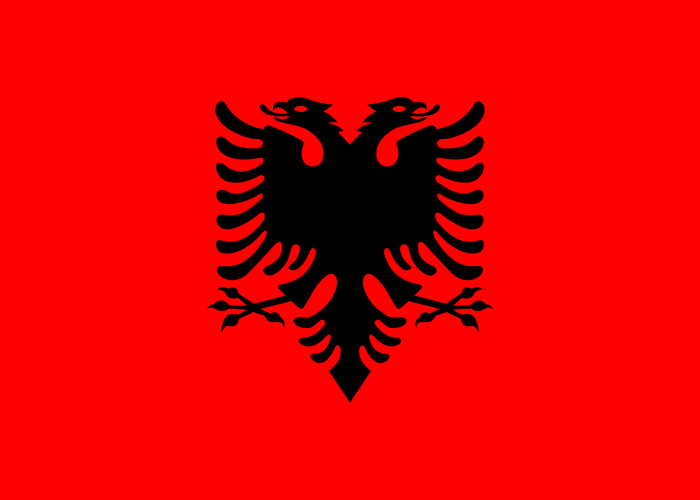
name may be derived from the pre-Celtic word alb, meaning "hill," or from the Indo-European root word albh, meaning "white;" the local name "Shqiperia" is derived from the Albanian word shqiponje ("eagle") and is popularly interpreted to mean "Land of the Eagles"
Independence
28 November 1912 (from the Ottoman Empire)
National Symbols
black double-headed eagle
National Anthem
"Hymni i Flamurit" (Hymn to the Flag)
UNESCO Heritage
4 (2 cultural, 1 natural, 1 mixed)
💼Economy & Trade7 facts
Overview
upper-middle-income Balkan economy; EU accession candidate; growth bolstered by tourism, agriculture, mining, construction, and private consumption; fiscal consolidation through revenue collection and tax compliance enhancements to address public debt; challenges include weak governance, corruption, and high emigration rates
Industries
food; footwear, apparel and clothing; lumber, oil, cement, chemicals, mining, basic metals, hydropower
Agricultural Products
milk, maize, tomatoes, watermelons, potatoes, wheat, grapes, onions, cucumbers/gherkins, olives (2023)
Export Partners
Italy 41%, Greece 10%, Germany 5%, Spain 5%, Serbia 4% (2023)
Export Commodities
garments, footwear, electricity, crude petroleum, iron alloys (2023)
Import Partners
Italy 22%, China 11%, Turkey 9%, Germany 7%, Greece 6% (2023)
Import Commodities
cars, refined petroleum, garments, packaged medicine, iron bars (2023)
🔧Infrastructure & Defense4 facts
Military Forces
Republic of Albania Armed Forces (Forcat e Armatosura të Republikës së Shqipërisë (FARSH); aka Albanian Armed Forces (AAF)): Land Forces, Naval Force (includes Coast Guard), Air Forces Ministry of Interior: Guard of the Republic, State Police (includes the Border and Migration Police) (2025)
Military Service
18-30 for voluntary military service for men and women; conscription abolished 2010 (2025)
Energy Mix
solar: 3.3% of total installed capacity (2023 est.); hydroelectricity: 96.7% of total installed capacity (2023 est.)
Broadcast Media
over 65 TV stations, including several that broadcast nationally and are sometimes available to neighboring countries; many viewers have access to Italian and Greek TV via terrestrial reception; TV stations have begun a government-mandated conversion from analog to digital broadcast; cable TV service is available; 2 public radio networks and roughly 78 private radio stations; several international broadcasters are available (2024)

Deep Dive

67 of 85 metrics

Every stat we track, organized by category

🌱Environment9 metricsBest: #4
Electricity Access (%)
100.0%#4WB
Renewable Energy (%)
41.9%#57WB
Protected Land (%)
23.6%#57WB
Irrigated Land
1.9K#75
Forest Coverage (%)
28.8%#112WB
Forest Area
7.9K#131WB
Air Pollution (PM2.5)
15.707#125WB
CO2 Per Capita
1.59#141OWID
Carbon Emissions (Total)
3.39M#144
🚀Education & Future5 metricsBest: #20
University Enrollment Rate
82.0%#20WB
Human Development Index
0.81#71OWID
Domestic Patents
23#92WB
Education Spending (% GDP)
3.1%#138WB
Foreign Patents
1.00#133WB
💰Wealth & Economy10 metricsBest: #31
FDI Inflows (% GDP)
6.3%#31WB
Government Debt (% GDP)
81.9%#36WB
Youth Unemployment Rate
25.1%#33
Unemployment Rate
10.3%#39WB
GDP Growth Rate
4.0%#71WB
GDP Per Capita (PPP)
26.7K#84WB
GDP Per Capita
$18.9K#95OWID
GDP (Nominal)
27.05B#113WB
Inflation Rate
2.2%#148WB
High-Tech Exports (%)
1.5%#141WB
🍻Lifestyle5 metricsBest: #37
Tourist Arrivals
2.66M#37WB
Spirits Consumption
1.16#80OWID
Alcohol Consumption
4.47#94OWID
Beer Consumption
1.53#95OWID
Air Passengers
374.8K#120WB
🌍Land & Sea5 metricsBest: #43
Lowest Elevation
0#43
Highest Elevation
2.8K#84
Border Countries Count
4.00#62
Coastline Length
362#124
Land Boundaries Length
691#130
🤝Society & Equality2 metricsBest: #45
Women in Parliament (%)
35.7%#45WB
Inequality (Gini)
29.4#87WB
❤️Health & Survival10 metricsBest: #53
Life Expectancy
79.6 years#53WB
Life Expectancy
79.6 years#60OWID
Hospital Beds (per 1,000)
2.90#62WB
Smoking Rate
21.9%#67WB
Obesity Rate
26.6%#90OWID
Doctors (per 1,000)
1.88#94WB
Health Spending (% GDP)
6.2%#103WB
Infant Mortality
8.30#125WB
Child Mortality
9.40#128WB
Suicide Rate
2.75#160WB
👥Demographics12 metricsBest: #53
Elderly Population (%)
16.9%#53WB
Median Age
37.9 years#84
Death Rate
7.90#89WB
Population Density
88.106#113WB
Population
2.55M#143WB
Urban Population (%)
58.5%#140WB
Land Area
27.4K#143WB
Dependency Ratio
50.974#146WB
Teen Birth Rate
12.789#148WB
Youth Population (%)
16.8%#158WB
Birth Rate
8.71#196WB
Fertility Rate
1.09#225WB
🛡️Military & Defense2 metricsBest: #67
Military Spend (% GDP)
2.0%#67
Active Military Personnel
7.5K#130
📡Technology3 metricsBest: #100
Internet Users (%)
83.0%#100WB
Broadband Access (%)
22#117WB
Mobile Subscriptions (%)
89#172WB
🔧Infrastructure3 metricsBest: #110
Merchant Ships
69#110
Airports
3.00#186
Railway Length
424#117
Energy1 metricsBest: #111
Electricity Capacity
2.86M#111

Share a Fact

Share something surprising about Albania!

Albania
#20 in University Enrollment Rate

Total university and college enrollment as a percentage of the typical college-age population.

Top 10% globally
82.0%

Frequently Asked Questions about Albania

What is the population of Albania?

Albania has a population of 2.55M, ranking #143 globally by population.

What continent is Albania in?

Albania is located in Europe. It has an area of 28,748 km².

What is the life expectancy in Albania?

Life expectancy in Albania is 79.6 years, ranking #53 globally.

What is the GDP per capita of Albania?

Albania's GDP per capita (PPP) is 26.7K, ranking #84 globally.

What is Albania known for in global statistics?

Albania ranks particularly high in University Enrollment Rate (#20), Life Expectancy (#53), Life Expectancy (#60).

What is Albania's Human Development Index?

Albania has an HDI of 0.810, ranking #71 globally. The HDI combines life expectancy, education, and income indicators.

How densely populated is Albania?

Albania has a population density of 88.1 people per km², ranking #113 globally.
Think you know Albania?

Compare countries, guess statistics, and prove you know your stuff.