Culture
Major languages include Serbian (official) 88.1%, Hungarian 3.4%, Bosnian 1.9%, Romani 1.4%, and more.
CIA 2026
Loading TerraBrawl
Data as of May 28, 2026
Serbia excels and struggles in equal measure. See what other surprises Serbia holds.
Serbia excels and struggles in equal measure. At #23 in hospital beds, you'd never guess its low mark in fertility rate. See what other surprises Serbia holds.
Area
78K km²
Pop.
6.65M
Stats
127
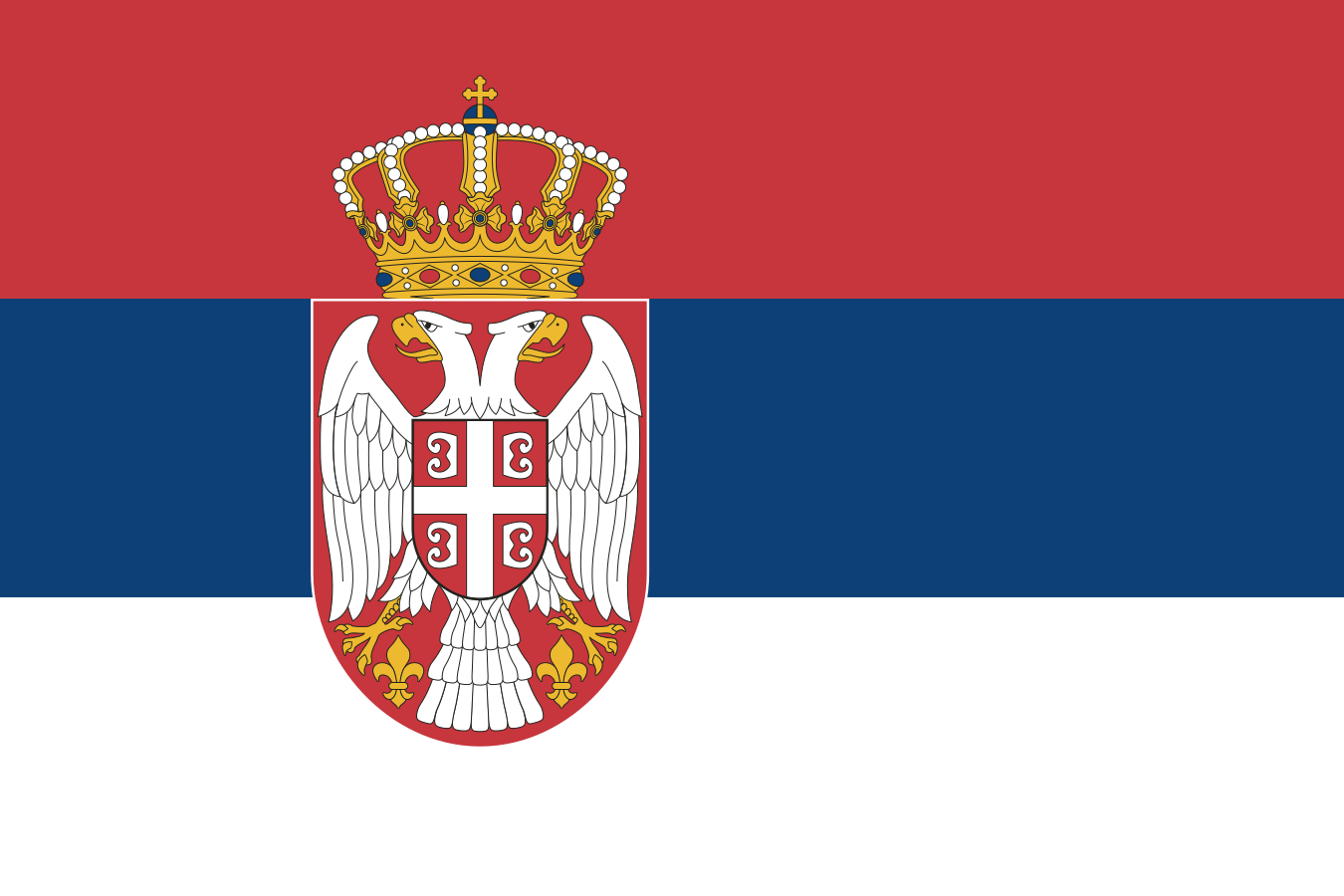
Serbia is a country in Europe with a population of 6.65M and an area of 77,589 km². Life expectancy is 76.2 years.
Short factual summary generated from the same country data used in game rounds.
Core numbers
Fast scan first, deep dive later.
CO2 Per Capita
6.2 t/person/yrAnnual carbon dioxide emissions in tonnes per person, from Our World in Data using the latest available country values in TerraBrawl.
University Enrollment Rate
73.21%Total university and college enrollment as a percentage of the typical college-age population.
Human Development Index
0.83Composite 0-1 index of life expectancy, education, and income, from Our World in Data using the latest available country values in TerraBrawl.
Internet Users (%)
87.69%The percentage of people who have used the internet in the last 3 months.
GDP Per Capita (PPP)
$32,233.76GDP per person, adjusted for purchasing power parity (PPP) so costs of living are comparable across countries.
GDP Per Capita
$26,884.46GDP per person adjusted for purchasing power in constant 2017 international dollars, from Our World in Data using the latest available country values in TerraBrawl.
Country briefing
A quick real-world briefing before you dive deeper into rankings, surprises, and matchups.
Culture
Major languages include Serbian (official) 88.1%, Hungarian 3.4%, Bosnian 1.9%, Romani 1.4%, and more.
Identity
Formal name: Republic of Serbia.
Geography
Size snapshot: slightly smaller than South Carolina.
Cities
Browse this country's cities before City Detective asks you to guess.
Top stats
The strongest source-backed stats before the deeper data table.
Smoking Rate
39.5%The percentage of people aged 15 and older who use tobacco products.
Elderly Population (%)
22.69%Share of the population ages 65 and older, from World Bank Open Data.
Lowest Elevation
35 mLowest point elevation from CIA World Factbook.
FDI Inflows (% GDP)
6.2% of GDPForeign direct investment net inflows as a share of GDP, from World Bank Open Data.
Reality checks
The stats that tend to surprise players in real rounds.
Only ranks #226 in coastline length
Total coastline length from CIA World Factbook.
Ranks #26 globally in median age
The age that splits the population in half: half are younger, half are older. UN WPP estimate as of 1 July 2023.
Ranks #23 globally in hospital beds (per 1,000)
The number of hospital beds available per 1,000 people.
Has one of the highest suicide rate figures
Suicide mortality rate per 100,000 people, from World Bank Open Data.
Only ranks #195 in birth rate
The number of babies born per 1,000 people each year.
Compared with the region
Country vs continent vs world averages
GDP per person, adjusted for purchasing power parity (PPP) so costs of living are comparable across countries.
How many years a newborn can expect to live, based on current mortality rates.
Composite 0-1 index of life expectancy, education, and income, from Our World in Data using the latest available country values in TerraBrawl.
The percentage of people who have used the internet in the last 3 months.
Think you can guess which countries rank higher?
Play this countryFactbook notes
Country briefing
In 1918, the Croats, Serbs, and Slovenes formed a kingdom known after 1929 as Yugoslavia.
In 1918, the Croats, Serbs, and Slovenes formed a kingdom known after 1929 as Yugoslavia. The monarchy remained in power until 1945, when the communist Partisans headed by Josip Broz (aka TITO) took control of the newly created Socialist Federal Republic of Yugoslavia (SFRY). After TITO died in 1980, communism in Yugoslavia gradually gave way to resurgent nationalism. In 1989, Slobodan MILOSEVIC became president of the Republic of Serbia, and his calls for Serbian domination led to the violent breakup of Yugoslavia along ethnic lines. In 1991, Croatia, Slovenia, and Macedonia declared independence, followed by Bosnia in 1992. The remaining republics of Serbia and Montenegro declared a new Federal Republic of Yugoslavia (FRY) in 1992, and MILOSEVIC led military campaigns to unite ethnic Serbs in neighboring republics into a "Greater Serbia." These actions ultimately failed, and international intervention led to the signing of the Dayton Accords in 1995.
In 1998, an ethnic Albanian insurgency in the formerly autonomous Serbian province of Kosovo resulted in a brutal Serbian counterinsurgency campaign. Serbia rejected a proposed international settlement, and NATO responded with a bombing campaign that forced Serbian forces to withdraw from Kosovo in June 1999. In 2003, the FRY became the State Union of Serbia and Montenegro, a loose federation of the two republics. In 2006, Montenegro seceded and declared itself an independent nation.
In 2008, Kosovo also declared independence -- an action Serbia still refuses to recognize. In 2013, Serbia and Kosovo signed the first agreement of principles governing the normalization of relations between the two countries. Additional agreements were reached in 2015 and 2023, but implementation remains incomplete. Serbia has been an official candidate for EU membership since 2012, and President Aleksandar VUCIC has promoted the ambitious goal of Serbia joining the EU by 2025.
Data vault
Every tracked stat, grouped for fast scanning.
Keep exploring
Open the head-to-head pages people naturally search after reading this profile.
Jump straight to the rankings where this country has its strongest edge.
Turn Serbia's strongest number into a challenge card.
Annual carbon dioxide emissions in tonnes per person, from Our World in Data using the latest available country values in TerraBrawl.
Serbia has a population of 6.65M, ranking #109 globally by population.
Serbia is located in Europe. It has an area of 77,589 km².
Life expectancy in Serbia is 76.2 years, ranking #92 globally.
Serbia's GDP per capita (PPP) is $32,233.76, ranking #76 globally.
Serbia ranks particularly high in CO2 Per Capita (#47), University Enrollment Rate (#46), Human Development Index (#63).
Serbia has an HDI of 0.833, ranking #63 globally. The HDI combines life expectancy, education, and income indicators.
Serbia has a population density of 78.8 people per km², ranking #123 globally.