Culture
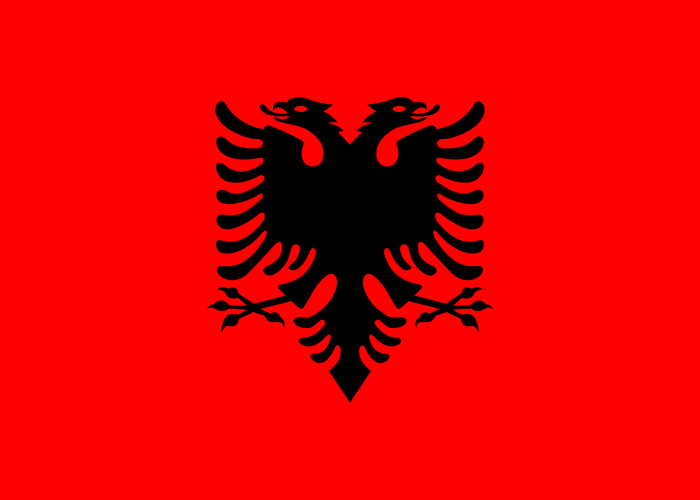
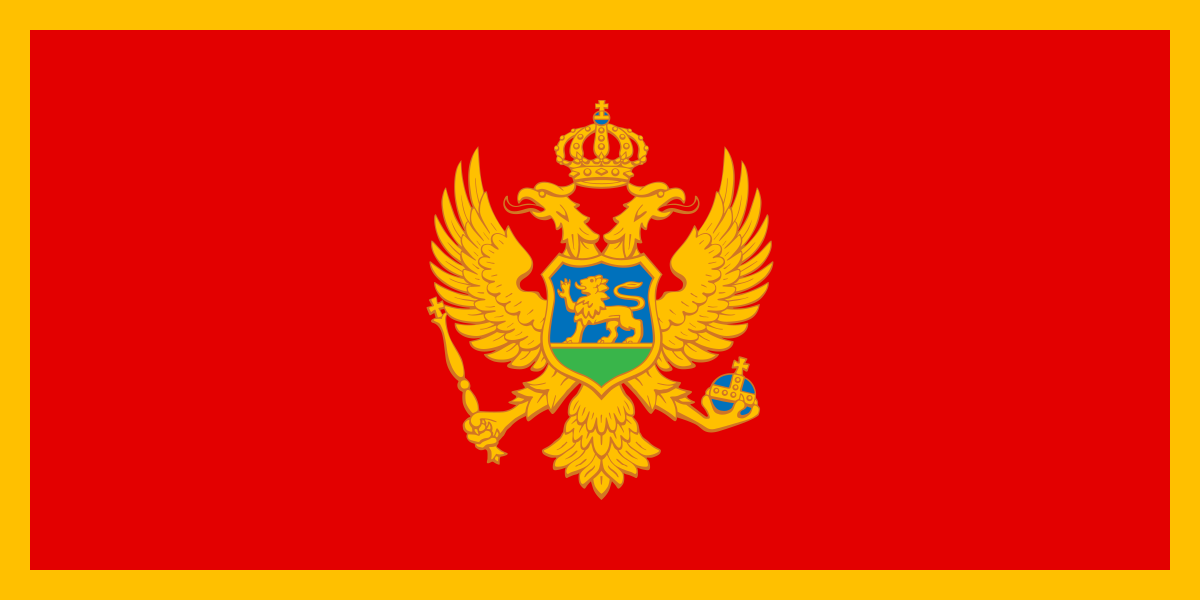
National symbols include double-headed eagle.
CIA 2026
Loading TerraBrawl
Data as of May 28, 2026
Montenegro proves that wealth isn't everything. See how this underdog defies expectations.
Montenegro proves that wealth isn't everything. Despite modest GDP, it achieves 0.862 in human development index, ranking #48 globally. See how this underdog defies expectations.
Area
14K km²
Pop.
599.8K
Stats
121
Montenegro is a country in Europe with a population of 599.8K and an area of 13,812 km². Life expectancy is 77.6 years.
Short factual summary generated from the same country data used in game rounds.
Core numbers
Fast scan first, deep dive later.
Human Development Index
0.86Composite 0-1 index of life expectancy, education, and income, from Our World in Data using the latest available country values in TerraBrawl.
Internet Users (%)
88.88%The percentage of people who have used the internet in the last 3 months.
Life Expectancy
77.6 yearsHow many years a newborn can expect to live, based on current mortality rates.
GDP Per Capita (PPP)
$34,225.87GDP per person, adjusted for purchasing power parity (PPP) so costs of living are comparable across countries.
GDP Per Capita
$27,852.04GDP per person adjusted for purchasing power in constant 2017 international dollars, from Our World in Data using the latest available country values in TerraBrawl.
Country briefing
A quick real-world briefing before you dive deeper into rankings, surprises, and matchups.
Culture
National symbols include double-headed eagle.
Economy
Key industries include steelmaking, aluminum, agricultural processing, consumer goods, and more.
Identity
Name origin: the name in Italian means "dark mountain" and is a translation of the Serbo-Croatian name Crna Gora.
Cities
Browse this country's cities before City Detective asks you to guess.
Top stats
The strongest source-backed stats before the deeper data table.
Mobile Subscriptions (%)
207.24 per 100 peopleMobile cellular subscriptions per 100 people, from World Bank Open Data.
Health Spending (% GDP)
10.92% of GDPCurrent health expenditure as a share of GDP, from World Bank Open Data.
Unemployment Rate
14.1%The percentage of the workforce that is unemployed but actively looking for work.
Spirits Consumption
3.2 L/person/yrLiters of spirits consumed per person per year, from Our World in Data using the latest available country values in TerraBrawl.
Forest Coverage (%)
61.49%The percentage of land covered by forests - natural or planted trees at least 5 meters tall (excludes orchards and urban parks).
Reality checks
The stats that tend to surprise players in real rounds.
Keeps child mortality unusually low
Deaths before age 5 per 1,000 live births, from World Bank Open Data.
Only ranks #125 in railway length
Total railway length from CIA World Factbook.
Ranks #24 globally in beer consumption
Liters of beer consumed per person per year, from Our World in Data using the latest available country values in TerraBrawl.
Only ranks #110 in domestic patents
How many patent applications are filed by residents each year.
Ranks #25 globally in fdi inflows (% gdp)
Foreign direct investment net inflows as a share of GDP, from World Bank Open Data.
Compared with the region
Country vs continent vs world averages
GDP per person, adjusted for purchasing power parity (PPP) so costs of living are comparable across countries.
How many years a newborn can expect to live, based on current mortality rates.
Composite 0-1 index of life expectancy, education, and income, from Our World in Data using the latest available country values in TerraBrawl.
The percentage of people who have used the internet in the last 3 months.
Think you can guess which countries rank higher?
Play this countryFactbook notes
Country briefing
The use of the name Crna Gora or Black Mountain (Montenegro) began in the 13th century in reference to a highland region in the Serbian province of Zeta.
The use of the name Crna Gora or Black Mountain (Montenegro) began in the 13th century in reference to a highland region in the Serbian province of Zeta. Under Ottoman control beginning in 1496, Montenegro was a semi-autonomous theocracy ruled by a series of bishop princes until 1852, when it became a secular principality. Montenegro fought a series of wars with the Ottomans and eventually won recognition as an independent sovereign principality at the Congress of Berlin in 1878. In 1918, the country was absorbed by the Kingdom of Serbs, Croats, and Slovenes, which became the Kingdom of Yugoslavia in 1929. At the end of World War II, Montenegro joined the Socialist Federal Republic of Yugoslavia (SFRY). When the SFRY dissolved in 1992, Montenegro and Serbia created the Federal Republic of Yugoslavia (FRY), which shifted in 2003 to a looser State Union of Serbia and Montenegro. Montenegro voted to restore its independence on 3 June 2006. Montenegro became an official EU candidate in 2010 and joined NATO in 2017.
Data vault
Every tracked stat, grouped for fast scanning.
Keep exploring
Open the head-to-head pages people naturally search after reading this profile.
Jump straight to the rankings where this country has its strongest edge.
Turn Montenegro's strongest number into a challenge card.
Composite 0-1 index of life expectancy, education, and income, from Our World in Data using the latest available country values in TerraBrawl.
Montenegro has a population of 599.8K, ranking #170 globally by population.
Montenegro is located in Europe. It has an area of 13,812 km².
Life expectancy in Montenegro is 77.6 years, ranking #74 globally.
Montenegro's GDP per capita (PPP) is $34,225.87, ranking #71 globally.
Montenegro ranks particularly high in Human Development Index (#48), Internet Users (%) (#70), Life Expectancy (#74).
Montenegro has an HDI of 0.862, ranking #48 globally. The HDI combines life expectancy, education, and income indicators.
Montenegro has a population density of 46.4 people per km², ranking #156 globally.