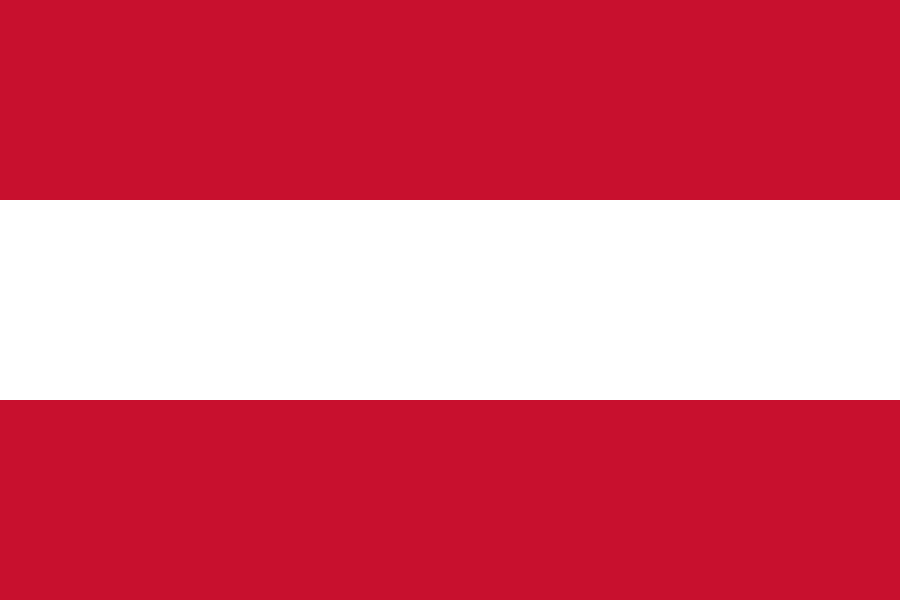
Austria

EuropeGlobal Leader

Few places match Austria's #5 ranking in renewable energy. With 43.3%, the numbers speak for themselves. See if you can spot its other strengths.

Austria is a country in Europe with a population of 9.17M and an area of 83,871 km². Life expectancy is 81.5 years.

At a Glance

The numbers that define this country

Life Satisfaction

7.62
#8globally

How satisfied people are with their lives, rated on a scale from 0 to 10.

University Enrollment Rate

91.7%
#14globally

Total university and college enrollment as a percentage of the typical college-age population.

GDP Per Capita

$63.3K
#22globally

GDP per person, adjusted for purchasing power parity (PPP) so costs of living are comparable across countries.

Human Development Index

0.93
#22globally

The Human Development Index (HDI), combining life expectancy, education, and income into a single score from 0 to 1.

GDP Per Capita (PPP)

71.6K
#24globally

GDP per person, adjusted for purchasing power parity (PPP) so costs of living are comparable across countries.

Internet Users (%)

95.0%
#32globally

The percentage of people who have used the internet in the last 3 months.

Where They Stand Out

Global rankings worth knowing

🍻Beer Consumption

5.88
#3globallyTop performer

How many liters of beer the average adult (15+) drinks per year.

🌱Electricity Access (%)

100.0%
#7globallyTop performer

The percentage of the population with access to electricity.

🌍Border Countries Count

8.00
#6globallyTop performer

Number of neighboring border countries from CIA World Factbook.

❤️Hospital Beds (per 1,000)

7.10
#8globallyTop performer

The number of hospital beds available per 1,000 people.

🚀R&D Spending (% GDP)

3.2%
#8globallyTop performer

Spending on research and development as a percentage of GDP.

Did You Know?

Facts that catch players off guard

🍻

Ranks #3 globally in beer consumption

Beer Consumption: 5.88

How many liters of beer the average adult (15+) drinks per year.

Our World in Data 2023
🌱

Ranks #7 globally in electricity access (%)

Electricity Access (%): 100.0%

The percentage of the population with access to electricity.

World Bank 2023
🌍

Ranks #6 globally in border countries count

Border Countries Count: 8.00

Number of neighboring border countries from CIA World Factbook.

🔧

Only ranks #181 in merchant ships

Merchant Ships: 1.00

Merchant marine fleet size from CIA World Factbook.

❤️

Ranks #8 globally in hospital beds (per 1,000)

Hospital Beds (per 1,000): 7.10

The number of hospital beds available per 1,000 people.

World Bank 2023

Surprised? See how you stack up.

Play Now

How Austria Compares

Country vs continent vs world averages

Austria
Europe avg
World avg

GDP per Capita

Above avg

GDP per person, adjusted for purchasing power parity (PPP) so costs of living are comparable across countries.

World Bank 2023
Austria71.6K
Europe57.5K
World31.8K

Life Expectancy

Above avg

How many years a newborn can expect to live, based on current mortality rates.

World Bank 2023
Austria81.5 years
Europe80.0 years
World73.7 years

Human Development Index

Above avg

The Human Development Index (HDI), combining life expectancy, education, and income into a single score from 0 to 1.

Our World in Data 2023
Austria0.93
Europe0.89
World0.74

Internet Users

Above avg

The percentage of people who have used the internet in the last 3 months.

World Bank 2023
Austria95.0%
Europe90.1%
World70.3%

Think you can guess which countries rank higher?

Test Your Intuition
Regional comparison for Austria across 4 key metrics, comparing with Europe and world averages.

About Austria

Once the center of power for the large Austro-Hungarian Empire, Austria was reduced to a small republic after its defeat in World War I. Nazi Germany annexed Austria in 1938, and the victorious Allies then occupied the country in 1945. As a result, Austria's status remained unclear for a decade after World War II, until a State Treaty signed in 1955 ended the occupation, recognized Austria's independence, and forbade unification with Germany. A constitutional law that same year declared the country's "perpetual neutrality" as a condition for Soviet military withdrawal. Austria joined the EU in 1995, but the obligation to remain neutral kept it from joining NATO, although the country became a member of NATO's Partnership for Peace program in 1995. Austria entered the EU Economic and Monetary Union in 1999.

🌍Geography & Climate6 facts
Location
Central Europe, north of Italy and Slovenia
Climate
temperate; continental, cloudy; cold winters with frequent rain and some snow in lowlands and snow in mountains; moderate summers with occasional showers
Terrain
mostly mountains (Alps) in the west and south; mostly flat or gently sloping along the eastern and northern margins
Natural Resources
oil, coal, lignite, timber, iron ore, copper, zinc, antimony, magnesite, tungsten, graphite, salt, hydropower
Natural Hazards
landslides; avalanches; earthquakes
Size Comparison
about the size of South Carolina; slightly more than two-thirds the size of Pennsylvania
👥People & Culture4 facts
Languages
German (official nationwide) 88.6%, Turkish 2.3%, Serbian 2.2%, Croatian (official in Burgenland) 1.6%, other (includes Slovene, official in southern Carinthia, and Hungarian, official in Burgenland) 5.3% (2001 est.)
Religions
Roman Catholic 55.2%, Muslim 8.3%, Orthodox 4.9%, Evangelical Christian 3.8%, Jewish 0.1%, other 5.4%, none 22.4% (2021 est.)
Ethnic Groups
Austrian 80.8%, German 2.6%, Bosnian and Herzegovinian 1.9%, Turkish 1.8%, Serbian 1.6%, Romanian 1.3%, other 10% (2018 est.)
Major Cities
1.975 million VIENNA (capital) (2023)
🏛️Government & History10 facts
Government Type
federal parliamentary republic
Capital
Vienna
Capital Coordinates
48 12 N, 16 22 E
Capital Timezone
UTC+1 (6 hours ahead of Washington, DC, during Standard Time)
Official Name
Republic of Austria
Name Origin
the name Oesterreich means "eastern realm" and dates to the 10th century; the designation refers to the fact that Austria was the easternmost extension of Bavaria and the German peoples; the word Austria is a Latinization of the German name
Independence
no official date of independence: 976 (Margravate of Austria established); 17 September 1156 (Duchy of Austria founded); 6 January 1453 (Archduchy of Austria acknowledged); 11 August 1804 (Austrian Empire proclaimed); 30 March 1867 (Austro-Hungarian dual monarchy established); 12 November 1918 (First Republic proclaimed); 27 April 1945 (Second Republic proclaimed)
National Symbols
eagle, edelweiss, Alpine gentian
National Anthem
"Bundeshymne" (Federal Hymn)
UNESCO Heritage
12 (11 cultural, 1 natural)
💼Economy & Trade7 facts
Overview
one of the strongest EU and euro economies; diversified trade portfolios and relations; enormous trade economy; Russian energy dependence, but investing in alternative energy; aging labor force but large refugee population; large government debt
Industries
construction, machinery, vehicles and parts, food, metals, chemicals, lumber and paper, electronics, tourism
Agricultural Products
milk, sugar beets, maize, wheat, barley, potatoes, pork, grapes, triticale, soybeans (2023)
Export Partners
Germany 25%, USA 9%, Italy 7%, Switzerland 5%, Hungary 4% (2023)
Export Commodities
cars, packaged medicine, vaccines, vehicle parts/accessories, nitrogen compounds (2023)
Import Partners
Germany 34%, China 7%, Italy 7%, Switzerland 5%, Czechia 4% (2023)
Import Commodities
cars, garments, vaccines, vehicle parts/accessories, refined petroleum (2023)
🔧Infrastructure & Defense5 facts
Military Forces
Austrian Armed Forces (Bundesheer): Land Forces, Air Force, Cyber Forces, Special Operations Forces, Militia (reserves) (2025)
Military Service
registration requirement at age 17, the legal minimum age for voluntary military service; men above the age of 18 are subject to compulsory military service; women may volunteer; compulsory service is for 6 months, or optionally, alternative civil/community service (Zivildienst) for 9 months (2025)
Energy Mix
fossil fuels: 14.9% of total installed capacity (2023 est.); solar: 9% of total installed capacity (2023 est.); wind: 11.9% of total installed capacity (2023 est.); hydroelectricity: 56.4% of total installed capacity (2023 est.); biomass and waste: 7.8% of total installed capacity (2023 est.)
Broadcast Media
public broadcaster, Oesterreichischer Rundfunk (ORF), is a major player in the TV and radio markets; private broadcasters, cable, and satellite TV are available in most homes are widely used; some German stations carry programs for Austrian viewers; national and regional newspapers compete fiercely for readers; the print media are owned by a handful of mostly Austrian and German media groups (2023)
Space Program
established a national space program in 2002; develops, builds, operates, and tracks satellites, including remote sensing and research/scientific satellites; member of the ESA; works closely with ESA and EU member states and the commercial sector to develop a range of space capabilities and technologies, including applications for satellite payloads, space flight, and space research; participates in a range of ESA/EU programs, including Space Surveillance and Tracking (SST), Copernicus Earth observation, and Galileo global navigation satellite system; also cooperates with other foreign space agencies and industries, including those of China, India, Russia, and the US (2025)

Deep Dive

78 of 156 metrics

Every stat we track, organized by category

🍻Lifestyle5 metricsBest: #3
Beer Consumption
5.88#3OWID
Alcohol Consumption
11.51#11OWID
Tourist Arrivals
15.09M#11WB
Air Passengers
46.04M#25WB
Spirits Consumption
1.65#65OWID
🌱Environment10 metricsBest: #5
Electricity Access (%)
100.0%#7WB
Renewable Energy (%)
43.3%#5OWID
Protected Land (%)
29.6%#38WB
CO2 Per Capita
6.18#49OWID
Carbon Emissions (Total)
56.96M#55
Forest Coverage (%)
47.2%#58WB
Renewable Energy (%)
36.0%#66WB
Forest Area
39.0K#79WB
Irrigated Land
382#114
Air Pollution (PM2.5)
10.934#160WB
🚀Education & Future8 metricsBest: #6
R&D Spending (% GDP)
3.2%#8WB
University Enrollment Rate
91.7%#14WB
Human Development Index
0.93#22OWID
Domestic Patents
1.9K#20WB
Leisure Time
15.52#6OECD
Education Spending (% GDP)
5.3%#49WB
Life Expectancy
81.9 years#18OECD
Foreign Patents
175#64WB
🌍Land & Sea5 metricsBest: #6
Border Countries Count
8.00#6
Lowest Elevation
115#22
Highest Elevation
3.8K#46
Land Boundaries Length
2.5K#77
Coastline Length
0#198
❤️Health & Survival10 metricsBest: #8
Hospital Beds (per 1,000)
7.10#8WB
Doctors (per 1,000)
5.52#10WB
Health Spending (% GDP)
10.9%#18WB
Life Expectancy
82.0 years#38OWID
Suicide Rate
14.51#33WB
Life Expectancy
81.5 years#39WB
Smoking Rate
24.9%#48WB
Obesity Rate
17.0%#134OWID
Infant Mortality
2.60#175WB
Child Mortality
3.10#176WB
🤝Society & Equality6 metricsBest: #8
Life Satisfaction
7.62#8OECD
Safety at Night
83.0%#9OECD
Women in Parliament (%)
36.1%#43WB
Road Deaths
4.40#18OECD
Homicide Rate
0.60#26OECD
Inequality (Gini)
31.2#77WB
💰Wealth & Economy13 metricsBest: #15
GDP Per Capita
$63.3K#22OWID
GDP Per Capita (PPP)
71.6K#24WB
GDP (Nominal)
534.79B#29WB
Government Debt (% GDP)
78.3%#42WB
High-Tech Exports (%)
18.5%#36WB
Gender Pay Gap (%)
12.0%#15OECD
Long-Term Unemployment
1.1%#17OECD
FDI Inflows (% GDP)
2.6%#92WB
Unemployment Rate
5.4%#89WB
Youth Unemployment Rate
11.7%#105
Inflation Rate
2.9%#119WB
Employment Rate (%)
78.2%#25OECD
GDP Growth Rate
-0.7%#191WB
👥Demographics12 metricsBest: #27
Median Age
44.5 years#27
Elderly Population (%)
20.6%#28WB
Death Rate
10.21#34WB
Population
9.17M#100WB
Urban Population (%)
69.5%#100WB
Population Density
110.661#96WB
Land Area
82.5K#114WB
Dependency Ratio
53.455#127WB
Birth Rate
8.81#192WB
Fertility Rate
1.35#203WB
Teen Birth Rate
3.84#192WB
Youth Population (%)
14.2%#195WB
🔧Infrastructure3 metricsBest: #32
Railway Length
6.1K#32
Airports
62#77
Merchant Ships
1.00#181
📡Technology3 metricsBest: #32
Internet Users (%)
95.0%#32WB
Mobile Subscriptions (%)
124#83WB
Broadband Access (%)
30#91WB
Energy1 metricsBest: #36
Electricity Capacity
33.37M#36
🛡️Military & Defense2 metricsBest: #90
Active Military Personnel
22.0K#90
Military Spend (% GDP)
1.0%#122

Neighboring Countries

Compare Austria with...

Share a Fact

Share something surprising about Austria!

Austria
#8 in Life Satisfaction

How satisfied people are with their lives, rated on a scale from 0 to 10.

Top 5% globally
7.62

Frequently Asked Questions about Austria

What is the population of Austria?

Austria has a population of 9.17M, ranking #100 globally by population.

What continent is Austria in?

Austria is located in Europe. It has an area of 83,871 km².

What is the life expectancy in Austria?

Life expectancy in Austria is 81.5 years, ranking #39 globally.

What is the GDP per capita of Austria?

Austria's GDP per capita (PPP) is 71.6K, ranking #24 globally.

What is Austria known for in global statistics?

Austria ranks particularly high in Life Satisfaction (#8), University Enrollment Rate (#14), GDP Per Capita (#22).

What is Austria's Human Development Index?

Austria has an HDI of 0.930, ranking #22 globally. The HDI combines life expectancy, education, and income indicators.

How densely populated is Austria?

Austria has a population density of 110.7 people per km², ranking #96 globally.
Think you know Austria?

Compare countries, guess statistics, and prove you know your stuff.