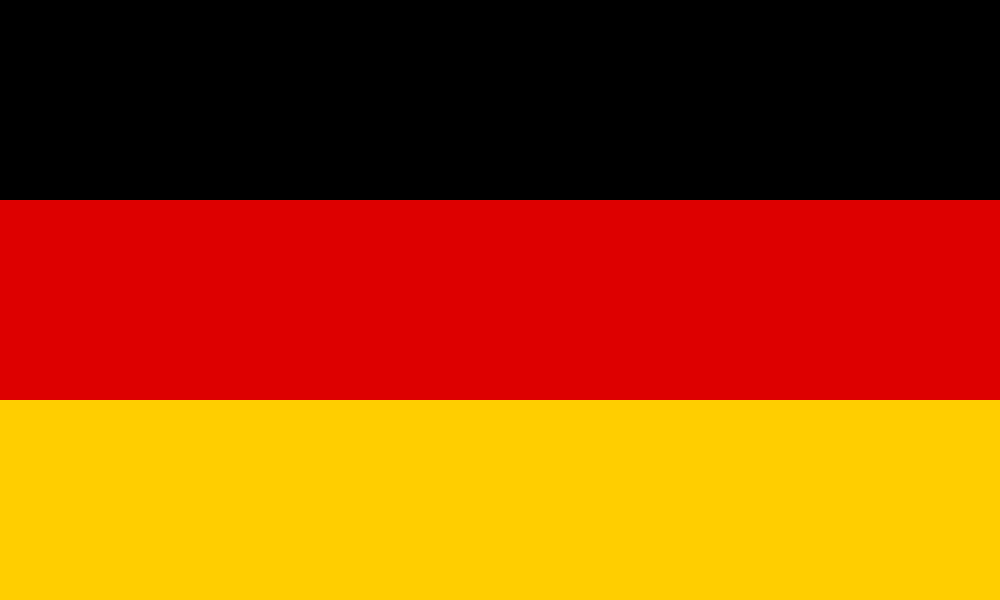
Germany

EuropeGlobal Leader

Germany claims the 3rd spot worldwide for economic output. That 4685.6 billion figure is hard to beat. How well do you really know Germany?

Germany is a country in Europe with a population of 84.01M and an area of 357,114 km². Life expectancy is 80.5 years.

At a Glance

The numbers that define this country

Human Development Index

0.96
#5globally

The Human Development Index (HDI), combining life expectancy, education, and income into a single score from 0 to 1.

Population

84.01M
#19globally

The total number of people living in the country.

GDP Per Capita (PPP)

72.3K
#22globally

GDP per person, adjusted for purchasing power parity (PPP) so costs of living are comparable across countries.

GDP Per Capita

$62.8K
#25globally

GDP per person, adjusted for purchasing power parity (PPP) so costs of living are comparable across countries.

Internet Users (%)

94.0%
#40globally

The percentage of people who have used the internet in the last 3 months.

Life Expectancy

81.4 years
#45globally

How many years a newborn can expect to live, based on current mortality rates.

Where They Stand Out

Global rankings worth knowing

💰GDP (Nominal)

4685.59B
#3globallyTop performer

The country's total economic output in current US dollars.

🚀Human Development Index

0.96
#5globallyTop performer

The Human Development Index (HDI), combining life expectancy, education, and income into a single score from 0 to 1.

🍻Beer Consumption

5.28
#5globallyTop performer

How many liters of beer the average adult (15+) drinks per year.

🌍Border Countries Count

9.00
#5globallyTop performer

Number of neighboring border countries from CIA World Factbook.

Electricity Capacity

275.66M
#6globallyTop performer

Installed generating capacity from CIA World Factbook.

Did You Know?

Facts that catch players off guard

💰

Ranks #3 globally in gdp (nominal)

GDP (Nominal): 4685.59B

The country's total economic output in current US dollars.

World Bank 2023
🚀

Ranks #5 globally in human development index

Human Development Index: 0.96

The Human Development Index (HDI), combining life expectancy, education, and income into a single score from 0 to 1.

Our World in Data 2023
🍻

Ranks #5 globally in beer consumption

Beer Consumption: 5.28

How many liters of beer the average adult (15+) drinks per year.

Our World in Data 2023
🌍

Ranks #5 globally in border countries count

Border Countries Count: 9.00

Number of neighboring border countries from CIA World Factbook.

Ranks #6 globally in electricity capacity

Electricity Capacity: 275.66M

Installed generating capacity from CIA World Factbook.

Surprised? See how you stack up.

Play Now

How Germany Compares

Country vs continent vs world averages

Germany
Europe avg
World avg

GDP per Capita

Above avg

GDP per person, adjusted for purchasing power parity (PPP) so costs of living are comparable across countries.

World Bank 2023
Germany72.3K
Europe57.5K
World31.8K

Life Expectancy

Above avg

How many years a newborn can expect to live, based on current mortality rates.

World Bank 2023
Germany80.5 years
Europe80.0 years
World73.7 years

Human Development Index

Above avg

The Human Development Index (HDI), combining life expectancy, education, and income into a single score from 0 to 1.

Our World in Data 2023
Germany0.96
Europe0.89
World0.74

Internet Users

Above avg

The percentage of people who have used the internet in the last 3 months.

World Bank 2023
Germany94.0%
Europe90.1%
World70.3%

Think you can guess which countries rank higher?

Test Your Intuition
Regional comparison for Germany across 4 key metrics, comparing with Europe and world averages.

About Germany

As Europe's largest economy and second most-populous nation (after Russia), Germany is a key member of the continent's economic, political, and defense organizations. European power struggles immersed Germany in two devastating world wars in the first half of the 20th century and left the country occupied by the victorious Allied powers of the US, UK, France, and the Soviet Union in 1945. With the advent of the Cold War, two German states were formed in 1949: the western Federal Republic of Germany (FRG) and the eastern German Democratic Republic (GDR). The democratic FRG embedded itself in key western economic and security organizations, including the EC (now the EU) and NATO, while the communist GDR was on the front line of the Soviet-led Warsaw Pact. The decline of the Soviet Union and the end of the Cold War allowed German reunification to occur in 1990. Since then, Germany has expended considerable funds to bring eastern productivity and wages up to western standards. In January 1999, Germany and 10 other EU countries introduced a common European exchange currency, the euro.

🌍Geography & Climate6 facts
Location
Central Europe, bordering the Baltic Sea and the North Sea, between the Netherlands and Poland, south of Denmark
Climate
temperate and marine; cool, cloudy, wet winters and summers; occasional warm mountain (foehn) wind
Terrain
lowlands in north, uplands in center, Bavarian Alps in south
Natural Resources
coal, lignite, natural gas, iron ore, copper, nickel, uranium, potash, salt, construction materials, timber, arable land
Natural Hazards
flooding
Size Comparison
three times the size of Pennsylvania; slightly smaller than Montana
👥People & Culture4 facts
Languages
German (official); note - Danish, Frisian, Sorbian, and Romani are official minority languages; Low German, Danish, North Frisian, Sater Frisian, Lower Sorbian, Upper Sorbian, and Romani are recognized as regional languages
Religions
Roman Catholic 24.8%, Protestant 22.6%, Muslim 3.7%, other 5.1%, none 43.8% (2022 est.)
Ethnic Groups
German 85.4%, Turkish 1.8%, Ukrainian 1.4%, Syrian 1.1%, Romanian 1%, Poland 1%, other/stateless/unspecified 8.3% (2022 est.)
Major Cities
3.574 million BERLIN (capital), 1.788 million Hamburg, 1.576 million Munich, 1.144 million Cologne, 796,000 Frankfurt (2023)
🏛️Government & History10 facts
Government Type
federal parliamentary republic
Capital
Berlin
Capital Coordinates
52 31 N, 13 24 E
Capital Timezone
UTC+1 (6 hours ahead of Washington, DC, during Standard Time)
Official Name
Federal Republic of Germany
Name Origin
the origin of the name is unclear; it may come from Celtic words meaning "neighboring people," or it may derive from Germanic words meaning either "spear man" or "head man;" the native designation "Deutsch" comes from the Old High German "diutisc" meaning "national"
Independence
18 January 1871 (establishment of the German Empire); divided into four zones of occupation (UK, US, USSR, and France) in 1945 after World War II; Federal Republic of Germany (FRG or West Germany) proclaimed on 23 May 1949 and included the former UK, US, and French zones; German Democratic Republic (GDR or East Germany) proclaimed on 7 October 1949 and included the former USSR zone; West Germany and East Germany unified on 3 October 1990, with all four powers formally relinquishing rights on 15 March 1991; notable earlier dates: 10 August 843 (Eastern Francia established from the division of the Carolingian Empire); 2 February 962 (crowning of OTTO I, recognized as the first Holy Roman Emperor)
National Symbols
eagle
National Anthem
"Lied der Deutschen"(Song of the Germans)
UNESCO Heritage
56 (54 cultural, 2 natural)
💼Economy & Trade7 facts
Overview
leading export-driven, core EU and eurozone economy; key automotive, chemical, engineering, finance, and green energy industries; growth stalled by energy crisis and declining exports; tight labor market with falling working-age population; fiscal rebalancing with phaseout of energy price supports
Industries
iron, steel, coal, cement, chemicals, machinery, vehicles, machine tools, electronics, automobiles, food and beverages, shipbuilding, textiles
Agricultural Products
milk, sugar beets, wheat, potatoes, barley, maize, rapeseed, pork, rye, triticale (2023)
Export Partners
USA 10%, France 8%, Netherlands 7%, China 7%, Italy 6% (2023)
Export Commodities
cars, vehicle parts/accessories, packaged medicine, plastic products, vaccines (2023)
Import Partners
China 12%, Netherlands 7%, USA 7%, Poland 6%, France 5% (2023)
Import Commodities
cars, vehicle parts/accessories, garments, natural gas, vaccines (2023)
🔧Infrastructure & Defense5 facts
Military Forces
Federal Armed Forces (Bundeswehr): German Army (Deutsche Heer), German Navy (Deutsche Marine, includes naval air arm), German Air Force (Deutsche Luftwaffe, includes air defense), Cyber and Information Space (Cyber und Informationsraum) (2025)
Military Service
17-23 years of age for voluntary military service for men and women (must have completed compulsory full-time education and have German citizenship); service obligation 7-23 months or 12 years (2025)
Energy Mix
fossil fuels: 49% of total installed capacity (2023 est.); nuclear: 1.3% of total installed capacity (2023 est.); solar: 11.1% of total installed capacity (2023 est.); wind: 25.9% of total installed capacity (2023 est.); hydroelectricity: 3.2% of total installed capacity (2023 est.); biomass and waste: 9.4% of total installed capacity (2023 est.)
Broadcast Media
a mix of publicly operated and privately owned TV and radio stations; 70 national and regional public broadcasters compete with nearly 400 privately owned national and regional TV stations; more than 90% of households have cable or satellite TV; hundreds of radio stations, including national and regional networks and a large number of local stations
Space Program
has one of Europe's largest space programs and is a top contributor to the ESA; builds and operates satellites, satellite/space launch vehicles (SLVs), probes, and unmanned orbiters; researches and develops a range of capabilities and technologies, including reusable space planes, satellite payloads, rockets, propulsion-assisted landing technologies, and aeronautics; participates in EU and ESA programs, including the Cassini-Huygens research mission to Saturn, Mars and Venus exploration missions, and the Galileo global navigation satellite system; participates in ESA's astronaut training program and human space flight operations; hosts the European Astronaut Center; participates in international programs such as the International Space Station (ISS) and the James Webb Space Telescope; hosts mission control centers for the ISS, the ESA, and the European Organization for the Exploitation of Meteorological Satellites (EUMETSAT); has ties to foreign space programs, including those of China, Japan, Russia, and the US; has a robust commercial space sector (2025)

Deep Dive

79 of 158 metrics

Every stat we track, organized by category

💰Wealth & Economy13 metricsBest: #3
GDP (Nominal)
4685.59B#3WB
GDP Per Capita (PPP)
72.3K#22WB
GDP Per Capita
$62.8K#25OWID
Gender Pay Gap (%)
14.2%#9OECD
High-Tech Exports (%)
18.0%#39WB
Employment Rate (%)
82.4%#10OECD
Government Debt (% GDP)
63.9%#68WB
Long-Term Unemployment
0.9%#19OECD
Inflation Rate
2.3%#146WB
Unemployment Rate
3.4%#131WB
FDI Inflows (% GDP)
1.0%#139WB
Youth Unemployment Rate
6.7%#149
GDP Growth Rate
-0.5%#189WB
🚀Education & Future8 metricsBest: #5
Human Development Index
0.96#5OWID
Domestic Patents
39.8K#5WB
Foreign Patents
18.7K#10WB
R&D Spending (% GDP)
3.1%#9WB
Leisure Time
15.623#5OECD
University Enrollment Rate
78.6%#30WB
Education Spending (% GDP)
5.2%#53WB
Life Expectancy
81.1 years#25OECD
🌍Land & Sea5 metricsBest: #5
Border Countries Count
9.00#5
Land Boundaries Length
3.7K#55
Coastline Length
2.4K#55
Highest Elevation
3.0K#69
Lowest Elevation
-3.5#211
🍻Lifestyle5 metricsBest: #5
Beer Consumption
5.28#5OWID
Alcohol Consumption
11.84#7OWID
Tourist Arrivals
12.45M#12WB
Air Passengers
80.20M#14WB
Spirits Consumption
2.12#48OWID
🔧Infrastructure3 metricsBest: #6
Airports
840#9
Railway Length
39.4K#6
Merchant Ships
595#38
Energy2 metricsBest: #6
Electricity Capacity
275.66M#6
Nuclear Electricity Share
1.4%#33
❤️Health & Survival10 metricsBest: #7
Hospital Beds (per 1,000)
7.80#7WB
Health Spending (% GDP)
11.8%#10WB
Doctors (per 1,000)
4.53#18WB
Life Expectancy
81.4 years#45OWID
Life Expectancy
80.5 years#47WB
Suicide Rate
12.9#44WB
Smoking Rate
21.3%#69WB
Obesity Rate
24.2%#101OWID
Child Mortality
3.70#167WB
Infant Mortality
3.10#168WB
👥Demographics12 metricsBest: #8
Elderly Population (%)
23.2%#8WB
Median Age
46.9 years#10
Death Rate
11.96#18WB
Population
84.01M#19WB
Urban Population (%)
82.0%#56WB
Population Density
238.352#56WB
Land Area
349.4K#64WB
Dependency Ratio
58.997#79WB
Fertility Rate
1.59#171WB
Teen Birth Rate
5.47#182WB
Birth Rate
8.87#191WB
Youth Population (%)
13.9%#198WB
🌱Environment10 metricsBest: #10
Carbon Emissions (Total)
600.19M#10
Protected Land (%)
39.3%#17WB
Electricity Access (%)
100.0%#30WB
CO2 Per Capita
6.77#43OWID
Forest Area
114.2K#51WB
Renewable Energy (%)
24.0%#21OWID
Irrigated Land
5.1K#54
Forest Coverage (%)
32.7%#101WB
Renewable Energy (%)
17.6%#115WB
Air Pollution (PM2.5)
10.288#165WB
🤝Society & Equality6 metricsBest: #17
Women in Parliament (%)
35.3%#48WB
Safety at Night
76.0%#17OECD
Inequality (Gini)
32.4#71WB
Road Deaths
3.36#27OECD
Life Satisfaction
6.98#30OECD
Homicide Rate
0.40#34OECD
🛡️Military & Defense2 metricsBest: #25
Active Military Personnel
185.0K#25
Military Spend (% GDP)
2.4%#52
📡Technology3 metricsBest: #40
Internet Users (%)
94.0%#40WB
Broadband Access (%)
45#44WB
Mobile Subscriptions (%)
129#62WB

Neighboring Countries

Compare Germany with...

Share a Fact

Share something surprising about Germany!

Germany
#5 in Human Development Index

The Human Development Index (HDI), combining life expectancy, education, and income into a single score from 0 to 1.

Top 5% globally
0.96

Frequently Asked Questions about Germany

What is the population of Germany?

Germany has a population of 84.01M, ranking #19 globally by population.

What continent is Germany in?

Germany is located in Europe. It has an area of 357,114 km².

What is the life expectancy in Germany?

Life expectancy in Germany is 80.5 years, ranking #47 globally.

What is the GDP per capita of Germany?

Germany's GDP per capita (PPP) is 72.3K, ranking #22 globally.

What is Germany known for in global statistics?

Germany ranks particularly high in Human Development Index (#5), Population (#19), GDP Per Capita (PPP) (#22).

What is Germany's Human Development Index?

Germany has an HDI of 0.959, ranking #5 globally. The HDI combines life expectancy, education, and income indicators.

How densely populated is Germany?

Germany has a population density of 238.4 people per km², ranking #56 globally.
Think you know Germany?

Compare countries, guess statistics, and prove you know your stuff.