Geography
Natural resources include petroleum, natural gas, iron ore, gold, and more.
CIA 2026
Loading TerraBrawl
Data as of May 28, 2026
With a global ranking of #8, Saudi Arabia leads in internet access. Test your knowledge of this global leader.
With a global ranking of #8, Saudi Arabia leads in internet access. Few places match this level of performance. Test your knowledge of this global leader.
Area
2.1M km²
Pop.
36.54M
Stats
126
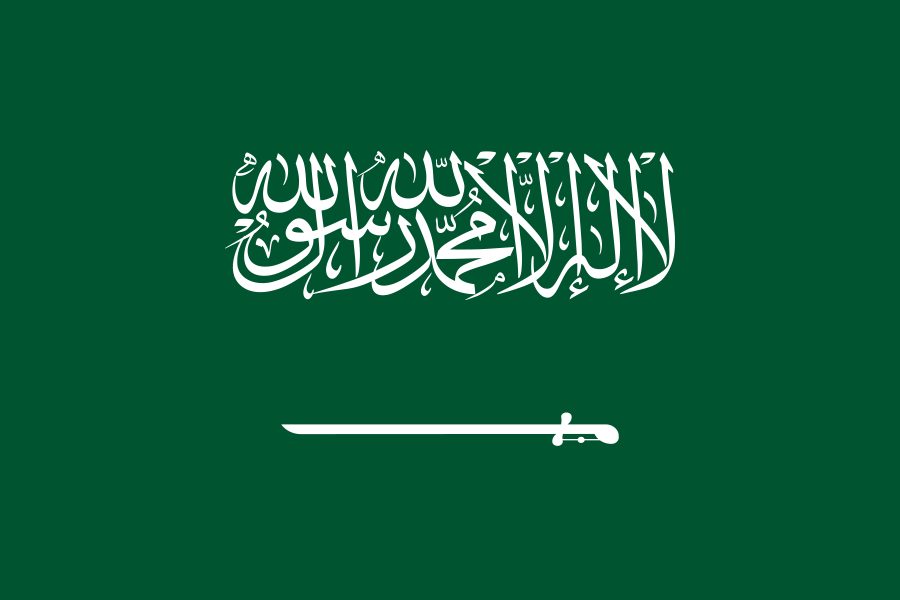
Saudi Arabia is a country in Asia with a population of 36.54M and an area of 2,149,690 km². Life expectancy is 78.7 years.
Short factual summary generated from the same country data used in game rounds.
Core numbers
Fast scan first, deep dive later.
CO2 Per Capita
20.38 t/person/yrAnnual carbon dioxide emissions in tonnes per person, from Our World in Data using the latest available country values in TerraBrawl.
Internet Users (%)
100%The percentage of people who have used the internet in the last 3 months.
Land Area
2.15M km²Total land area in square kilometers, excluding lakes, rivers, and territorial waters.
University Enrollment Rate
83.88%Total university and college enrollment as a percentage of the typical college-age population.
GDP Per Capita
$62,676.7GDP per person adjusted for purchasing power in constant 2017 international dollars, from Our World in Data using the latest available country values in TerraBrawl.
GDP Per Capita (PPP)
$71,375.37GDP per person, adjusted for purchasing power parity (PPP) so costs of living are comparable across countries.
Country briefing
A quick real-world briefing before you dive deeper into rankings, surprises, and matchups.
Geography
Natural resources include petroleum, natural gas, iron ore, gold, and more.
Culture
Major languages include Arabic (official).
Identity
Formal name: Kingdom of Saudi Arabia.
Cities
Browse this country's cities before City Detective asks you to guess.
Jeddah
Mecca Region, Saudi Arabia
Riyadh
Riyadh Region, Saudi Arabia
Makkah
Mecca Region, Saudi Arabia
Madinah
Medina Region, Saudi Arabia
Tabuk
Tabuk Region, Saudi Arabia
Dammam
Eastern Province, Saudi Arabia
Abha
'Asir Region, Saudi Arabia
Buraydah
Al-Qassim Region, Saudi Arabia
Top stats
The strongest source-backed stats before the deeper data table.
Military Spending
7.3% of GDPMilitary expenditure as a share of GDP, from World Bank Open Data.
Total CO2 Emissions
652.51 Mt CO2eTotal carbon dioxide emissions excluding LULUCF from the World Bank latest available country value.
Air Pollution (PM2.5)
53.15 µg/m³The average level of fine particle air pollution (PM2.5) that people are exposed to.
Electric Generating Capacity
119.62M kWInstalled electricity generating capacity in kilowatts from the frozen public-domain CIA World Factbook snapshot.
GDP (Nominal)
$1,239,804,533,333.33The country's total economic output in current US dollars.
Reality checks
The stats that tend to surprise players in real rounds.
Only ranks #188 in beer consumption
Liters of beer consumed per person per year, from Our World in Data using the latest available country values in TerraBrawl.
Only ranks #207 in dependency ratio
Dependents as a share of the working-age population, from World Bank Open Data.
Only ranks #205 in renewable energy (%)
The percentage of energy consumption that comes from renewable sources like solar, wind, and hydro.
Only ranks #220 in death rate
The number of deaths per 1,000 people each year.
Keeps suicide rate unusually low
Suicide mortality rate per 100,000 people, from World Bank Open Data.
Compared with the region
Country vs continent vs world averages
GDP per person, adjusted for purchasing power parity (PPP) so costs of living are comparable across countries.
How many years a newborn can expect to live, based on current mortality rates.
Composite 0-1 index of life expectancy, education, and income, from Our World in Data using the latest available country values in TerraBrawl.
The percentage of people who have used the internet in the last 3 months.
Think you can guess which countries rank higher?
Play this countryFactbook notes
Country briefing
Saudi Arabia is the birthplace of Islam and home to Islam's two holiest shrines in Mecca and Medina.
Saudi Arabia is the birthplace of Islam and home to Islam's two holiest shrines in Mecca and Medina. The king's official title is the Custodian of the Two Holy Mosques. ABD AL-AZIZ bin Abd al-Rahman AL SAUD (Ibn Saud) founded the modern Saudi state in 1932 after a 30-year campaign to unify most of the Arabian Peninsula. One of his male descendants rules the country today, as required by the country's 1992 Basic Law. After Iraq invaded Kuwait in 1990, Saudi Arabia took in the Kuwaiti royal family and 400,000 refugees, while allowing Western and Arab troops to deploy on its soil and liberate Kuwait the following year. Major terrorist attacks in 2003 spurred a strong ongoing campaign against domestic terrorism and extremism. US troops returned to the Kingdom in 2019 after attacks on Saudi oil infrastructure.
From 2005 to 2015, King ABDALLAH bin Abd al-Aziz Al Saud incrementally modernized the Kingdom through a series of social and economic initiatives that included expanding employment and social opportunities for women, attracting foreign investment, increasing the private sector's role in the economy, and discouraging the hiring of foreign workers. Saudi Arabia saw some protests during the 2011 Arab Spring but not the level of bloodshed seen in protests elsewhere in the region; Riyadh took a cautious but firm approach, arresting and quickly releasing some protesters and using its state-sponsored clerics to counter political and Islamist activism. The government held its first-ever elections in 2005 and 2011, when Saudis voted for municipal councilors. King ABDALLAH's reforms accelerated under King SALMAN bin Abd al-Aziz, who ascended to the throne in 2015 and lifted the Kingdom's ban on women driving, implemented education reforms, funded green initiatives, and allowed cinemas to operate for the first time in decades. In 2015, women were allowed to vote and stand as candidates for the first time in municipal elections, with 19 women winning seats. King SALMAN initially named his nephew, MUHAMMAD BIN NAYIF bin Abd al-Aziz Al Saud, as the Crown Prince, but a palace coup in 2017 resulted in King SALMAN's son, Deputy Crown Prince MUHAMMAD BIN SALMAN bin Abd al-Aziz Al Saud, taking over as Crown Prince. King SALMAN appointed MUHAMMAD BIN SALMAN as prime minister in 2022.
In 2015, Saudi Arabia led a coalition of 10 countries in a military campaign to restore Yemen's legitimate government, which had been ousted by Houthi forces. The war in Yemen has drawn international criticism for civilian casualties and its effect on the country’s dire humanitarian situation. The same year, MUHAMMAD BIN SALMAN announced that Saudi Arabia would lead a multi-nation Islamic Coalition to fight terrorism, and in 2017, Saudi Arabia inaugurated the Global Center for Combatting Extremist Ideology (also known as "Etidal").
The country remains a leading producer of oil and natural gas and holds about 17% of the world's proven oil reserves as of 2020. The government continues to pursue economic reform and diversification -- particularly since Saudi Arabia's accession to the WTO in 2005 -- and promotes foreign investment in the Kingdom. In 2016, the Saudi Government announced broad socio-economic reforms known as Vision 2030. Low global oil prices in 2015 and 2016 significantly lowered Saudi Arabia’s governmental revenue, prompting cuts to subsidies on water, electricity, and gasoline; reduced government-employee compensation; and new land taxes. In coordination with OPEC and some key non-OPEC countries, Saudi Arabia agreed to cut oil output in 2017 to regulate supply and help boost global prices. In 2020, this agreement collapsed, and Saudi Arabia launched a price war by flooding the market with low-priced oil before returning to the negotiating table to agree to a major output cut that helped buoy prices.
Data vault
Every tracked stat, grouped for fast scanning.
Keep exploring
Open the head-to-head pages people naturally search after reading this profile.
Jump straight to the rankings where this country has its strongest edge.
Turn Saudi Arabia's strongest number into a challenge card.
Annual carbon dioxide emissions in tonnes per person, from Our World in Data using the latest available country values in TerraBrawl.
Saudi Arabia has a population of 36.54M, ranking #42 globally by population.
Saudi Arabia is located in Asia. It has an area of 2,149,690 km².
Life expectancy in Saudi Arabia is 78.7 years, ranking #57 globally.
Saudi Arabia's GDP per capita (PPP) is $71,375.37, ranking #26 globally.
Saudi Arabia ranks particularly high in CO2 Per Capita (#6), Internet Users (%) (#8), Land Area (#12).
Saudi Arabia has an HDI of 0.900, ranking #37 globally. The HDI combines life expectancy, education, and income indicators.
Saudi Arabia has a population density of 15.7 people per km², ranking #196 globally.