Geography
Climate: mostly desert.
CIA 2026
Loading TerraBrawl
Data as of May 28, 2026
Iraq ranks high and low in ways you wouldn't predict. Can you guess what else is surprising?
Iraq ranks high and low in ways you wouldn't predict. It leads on obesity rate (#27) while trailing on renewable energy. Can you guess what else is surprising?
Area
438K km²
Pop.
42.92M
Stats
124
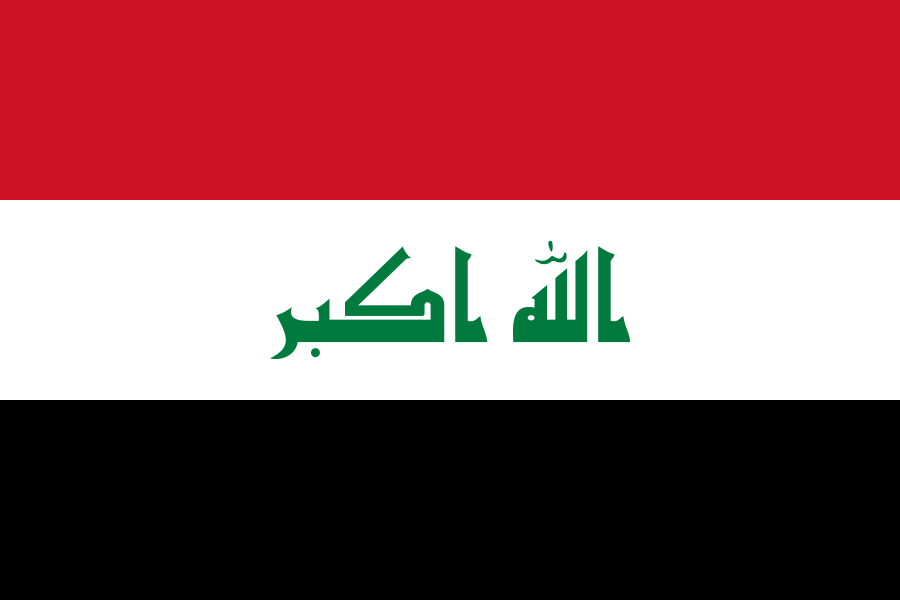
Iraq is a country in Asia with a population of 42.92M and an area of 438,317 km². Life expectancy is 72.3 years.
Short factual summary generated from the same country data used in game rounds.
Core numbers
Fast scan first, deep dive later.
Land Area
434.1K km²Total land area in square kilometers, excluding lakes, rivers, and territorial waters.
CO2 Per Capita
5.1 t/person/yrAnnual carbon dioxide emissions in tonnes per person, from Our World in Data using the latest available country values in TerraBrawl.
Internet Users (%)
82%The percentage of people who have used the internet in the last 3 months.
Population Density
103.83 /km²How many people live in each square kilometer of land.
GDP Per Capita
$12,725.04GDP per person adjusted for purchasing power in constant 2017 international dollars, from Our World in Data using the latest available country values in TerraBrawl.
Country briefing
A quick real-world briefing before you dive deeper into rankings, surprises, and matchups.
Geography
Climate: mostly desert.
Culture
Major languages include Arabic (official), Kurdish (official); Turkmen (a Turkish dialect) and Syriac (Neo-Aramaic) are recognized as official languages where native spe…
Identity
Formal name: Republic of Iraq.
Cities
Browse this country's cities before City Detective asks you to guess.
Baghdad
Iraq
Mosul
Nineveh, Iraq
Kirkuk
Iraq
Erbil
Iraq
Najaf
Iraq
Al Başrah al Qadīmah
Basra, Iraq
Karbala
Iraq
Sulaymaniyah
Iraq
Top stats
The strongest source-backed stats before the deeper data table.
Irrigated Land
35.3K km²Irrigated land area from CIA World Factbook.
Armed Forces Personnel
459.0KTotal armed forces personnel from the World Bank latest available country value.
Unemployment Rate
15.52%The percentage of the workforce that is unemployed but actively looking for work.
Obesity Rate
37.36%Share of adults with obesity, from Our World in Data using the latest available country values in TerraBrawl.
Electric Generating Capacity
31.34M kWInstalled electricity generating capacity in kilowatts from the frozen public-domain CIA World Factbook snapshot.
Reality checks
The stats that tend to surprise players in real rounds.
Keeps inflation rate unusually low
How much prices increased over the year, based on the cost of everyday goods and services.
Only ranks #99 in r&d spending (% gdp)
Research and development spending as a share of GDP, from World Bank Open Data.
Only ranks #203 in protected land (%)
The percentage of land area designated as protected natural reserves or parks.
Only ranks #217 in death rate
The number of deaths per 1,000 people each year.
Only ranks #199 in gdp growth rate
The annual percentage change in the country's GDP.
Compared with the region
Country vs continent vs world averages
GDP per person, adjusted for purchasing power parity (PPP) so costs of living are comparable across countries.
How many years a newborn can expect to live, based on current mortality rates.
Composite 0-1 index of life expectancy, education, and income, from Our World in Data using the latest available country values in TerraBrawl.
The percentage of people who have used the internet in the last 3 months.
Think you can guess which countries rank higher?
Play this countryFactbook notes
Country briefing
Formerly part of the Ottoman Empire, Iraq was occupied by the United Kingdom during World War I and was declared a League of Nations mandate under UK administration in 1920.
Formerly part of the Ottoman Empire, Iraq was occupied by the United Kingdom during World War I and was declared a League of Nations mandate under UK administration in 1920. Iraq attained its independence as a kingdom in 1932. It was proclaimed a republic in 1958 after a coup overthrew the monarchy, but in actuality, a series of strongmen ruled the country until 2003. The last was SADDAM Hussein, from 1979 to 2003. Territorial disputes with Iran led to an inconclusive and costly war from 1980 to 1988. In 1990, Iraq seized Kuwait but was expelled by US-led UN coalition forces during the two-month-long Gulf War of 1991. After Iraq's expulsion, the UN Security Council (UNSC) required Iraq to scrap all weapons of mass destruction and long-range missiles and to allow UN verification inspections. Continued Iraqi noncompliance with UNSC resolutions led to the Second Gulf War in 2003, when US-led forces ousted the SADDAM regime.
In 2005, Iraqis approved a constitution in a national referendum and elected a 275-member Council of Representatives (COR). The COR approved most of the cabinet ministers, marking the transition to Iraq's first constitutional government in nearly a half-century. Iraq's constitution also established the Kurdistan Regional Government (KRG), a semi-autonomous region that administers the governorates of Erbil, Dahuk, and As Sulaymaniyah. Iraq has held four national legislative elections since 2006, most recently in 2021. The COR approved Mohammad Shia' al-SUDANI as prime minister in 2022. Iraq has repeatedly postponed elections for provincial councils -- last held in 2013 -- and since 2019, the prime minister has had the authority to appoint governors rather than provincial councils.
Between 2014 and 2017, Iraq fought a military campaign against the Islamic State of Iraq and ash-Sham (ISIS) to recapture territory the group seized in 2014. In 2017, then-Prime Minister Haydar al-ABADI publicly declared victory against ISIS, although military operations against the group continue in rural areas. Also in 2017, Baghdad forcefully seized disputed territories across central and northern Iraq from the KRG, after a non-binding Kurdish independence referendum.
Data vault
Every tracked stat, grouped for fast scanning.
Keep exploring
Open the head-to-head pages people naturally search after reading this profile.
Jump straight to the rankings where this country has its strongest edge.
Turn Iraq's strongest number into a challenge card.
The total number of people living in the country.
Iraq has a population of 42.92M, ranking #36 globally by population.
Iraq is located in Asia. It has an area of 438,317 km².
Life expectancy in Iraq is 72.3 years, ranking #129 globally.
Iraq's GDP per capita (PPP) is $14,464.32, ranking #120 globally.
Iraq ranks particularly high in Population (#36), Land Area (#57), CO2 Per Capita (#67).
Iraq has an HDI of 0.695, ranking #126 globally. The HDI combines life expectancy, education, and income indicators.
Iraq has a population density of 103.8 people per km², ranking #102 globally.