Geography
Size snapshot: about 0.1 times the size of Washington, D.C.
CIA 2026
Loading TerraBrawl
Data as of May 28, 2026
Strong in one area, surprising in another — that's Nauru. How well do you know Nauru's stats?
Strong in one area, surprising in another — that's Nauru. It leads on obesity rate (#3) while trailing on life expectancy. How well do you know Nauru's stats?
Area
21 km²
Pop.
9.9K
Stats
86
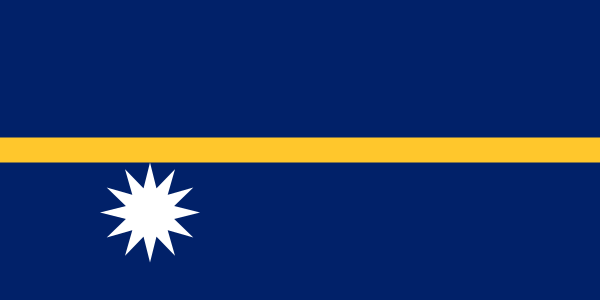
Nauru is a country in Oceania with a population of 9.9K and an area of 21 km². Life expectancy is 62.1 years.
Short factual summary generated from the same country data used in game rounds.
Core numbers
Fast scan first, deep dive later.
Population Density
593.75 /km²How many people live in each square kilometer of land.
CO2 Per Capita
5.1 t/person/yrAnnual carbon dioxide emissions in tonnes per person, from Our World in Data using the latest available country values in TerraBrawl.
Internet Users (%)
82%The percentage of people who have used the internet in the last 3 months.
GDP Per Capita
$12,604.06GDP per person adjusted for purchasing power in constant 2017 international dollars, from Our World in Data using the latest available country values in TerraBrawl.
GDP Per Capita (PPP)
$14,173.01GDP per person, adjusted for purchasing power parity (PPP) so costs of living are comparable across countries.
Human Development Index
0.70Composite 0-1 index of life expectancy, education, and income, from Our World in Data using the latest available country values in TerraBrawl.
Country briefing
A quick real-world briefing before you dive deeper into rankings, surprises, and matchups.
Geography
Size snapshot: about 0.1 times the size of Washington, D.C.
Culture
Major languages include Nauruan 93% (official, a distinct Pacific Island language), English 2% (widely understood, spoken, and more.
Identity
Formal name: Republic of Nauru.
Top stats
The strongest source-backed stats before the deeper data table.
Smoking Rate
48.3%The percentage of people aged 15 and older who use tobacco products.
Obesity Rate
70.18%Share of adults with obesity, from Our World in Data using the latest available country values in TerraBrawl.
Health Spending (% GDP)
18.17% of GDPCurrent health expenditure as a share of GDP, from World Bank Open Data.
Urban Population (%)
100%The percentage of people living in cities and urban areas.
Education Spending (% GDP)
5.7% of GDPGovernment education spending as a share of GDP, from World Bank Open Data.
Reality checks
The stats that tend to surprise players in real rounds.
Only ranks #212 in forest area
Total forest area in square kilometers, including natural and planted trees at least 5 meters tall.
Only ranks #213 in land area
Total land area in square kilometers, excluding lakes, rivers, and territorial waters.
Only ranks #208 in gdp (nominal)
The country's total economic output in current US dollars.
Keeps total co2 emissions unusually low
Total carbon dioxide emissions excluding LULUCF from the World Bank latest available country value.
Only ranks #232 in airports
Large, medium, and small airport records by country from the open OurAirports dataset.
Compared with the region
Country vs continent vs world averages
GDP per person, adjusted for purchasing power parity (PPP) so costs of living are comparable across countries.
How many years a newborn can expect to live, based on current mortality rates.
Composite 0-1 index of life expectancy, education, and income, from Our World in Data using the latest available country values in TerraBrawl.
The percentage of people who have used the internet in the last 3 months.
Think you can guess which countries rank higher?
Play this countryFactbook notes
Country briefing
By 1000 B.C., Micronesian and Polynesian settlers inhabited Nauru, and the island was divided among 12 clans.
By 1000 B.C., Micronesian and Polynesian settlers inhabited Nauru, and the island was divided among 12 clans. Nauru developed in relative isolation because ocean currents made landfall on the island difficult. As a result, the Nauruan language does not clearly resemble any other in the Pacific region. In 1798, a British mariner was the first European to spot the island and by 1830, European whalers used Nauru as a supply stop, trading firearms for food. A civil war in 1878 reduced the population by more than a third. Germany forcibly annexed Nauru in 1888 by holding the 12 chiefs under house arrest until they consented to the annexation. Phosphate was discovered in 1900 and was heavily mined, although Nauru and Nauruans earned about one tenth of one percent of the profits from the phosphate deposits.
Australian forces captured Nauru from Germany during World War I, and in 1919, it was placed under a joint Australian-British-New Zealand mandate with Australian administration. Japan occupied Nauru during World War II and used its residents as forced labor elsewhere in the Pacific while destroying much of the infrastructure on the island. After the war, Nauru became a UN trust territory under Australian administration. In 1962, recognizing the phosphate stocks would eventually be depleted, Australian Prime Minister Robert MENZIES offered to resettle all Nauruans on Curtis Island in Queensland, but Nauruans rejected that plan and opted for independence, which was achieved in 1968. In 1970, Nauru purchased the phosphate mining assets, and income from the mines made Nauruans among the richest people in the world. However, a series of unwise investments led to near bankruptcy by 2000. Widespread phosphate mining officially ceased in 2006.
As its economy faltered, Nauru briefly tried to rebrand itself as an offshore banking haven, an initiative that ended in 2005, and the country made a successful bid for Russian humanitarian aid in 2008. In 2001, Australia set up the Nauru Regional Processing Center (NRPC), an offshore refugee detention facility, paying Nauru per person at the center. The NRPC closed in 2008 but reopened in 2012. The number of refugees steadily declined after 2014, and in 2020, the remaining people were moved to Brisbane, Australia, effectively shuttering the NRPC. However, in 2023, Australia agreed to continue funding NRPC for two years and restarted settling asylees in the center in mid-2023. The center remains the Government of Nauru’s largest source of income.
Data vault
Every tracked stat, grouped for fast scanning.
Keep exploring
Open the head-to-head pages people naturally search after reading this profile.
Jump straight to the rankings where this country has its strongest edge.
Turn Nauru's strongest number into a challenge card.
How many people live in each square kilometer of land.
Nauru has a population of 9.9K, ranking #220 globally by population.
Nauru is located in Oceania. It has an area of 21 km².
Life expectancy in Nauru is 62.1 years, ranking #201 globally.
Nauru's GDP per capita (PPP) is $14,173.01, ranking #124 globally.
Nauru ranks particularly high in Population Density (#16), CO2 Per Capita (#65), Internet Users (%) (#108).
Nauru has an HDI of 0.703, ranking #124 globally. The HDI combines life expectancy, education, and income indicators.
Nauru has a population density of 593.8 people per km², ranking #16 globally.