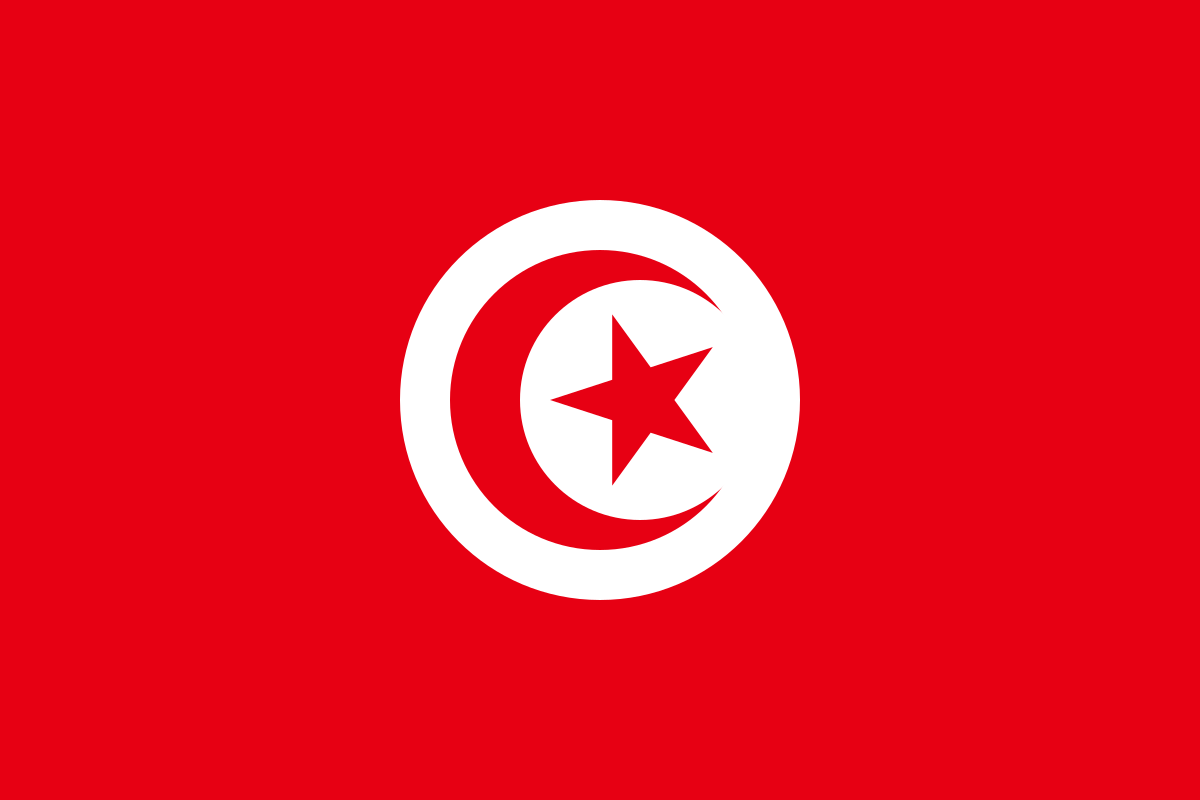
Geography
Natural resources include petroleum, phosphates, iron ore, lead, and more.
CIA 2026
Loading TerraBrawl
Data as of May 28, 2026
Across Africa, Tunisia stands first in life expectancy. Explore what drives its regional success.
Across Africa, Tunisia stands first in life expectancy. Few in the region come close to matching it. Explore what drives its regional success.
Area
164K km²
Pop.
11.96M
Stats
128
Tunisia is a country in Africa with a population of 11.96M and an area of 163,610 km². Life expectancy is 76.5 years.
Short factual summary generated from the same country data used in game rounds.
Core numbers
Fast scan first, deep dive later.
Life Expectancy
76.5 yearsHow many years a newborn can expect to live, based on current mortality rates.
Land Area
155.4K km²Total land area in square kilometers, excluding lakes, rivers, and territorial waters.
Human Development Index
0.75Composite 0-1 index of life expectancy, education, and income, from Our World in Data using the latest available country values in TerraBrawl.
CO2 Per Capita
2.7 t/person/yrAnnual carbon dioxide emissions in tonnes per person, from Our World in Data using the latest available country values in TerraBrawl.
Country briefing
A quick real-world briefing before you dive deeper into rankings, surprises, and matchups.
Geography
Natural resources include petroleum, phosphates, iron ore, lead, and more.
Culture
Major languages include Arabic (official, one of the languages of commerce), French (commerce), Tamazight.
Identity
Formal name: Republic of Tunisia.
Cities
Browse this country's cities before City Detective asks you to guess.
Top stats
The strongest source-backed stats before the deeper data table.
Youth Unemployment Rate
38.08% of youth labor forceShare of the labor force ages 15-24 that is unemployed from the World Bank latest available country value.
Unemployment Rate
16.2%The percentage of the workforce that is unemployed but actively looking for work.
Education Spending (% GDP)
6.7% of GDPGovernment education spending as a share of GDP, from World Bank Open Data.
Military Spending
2.5% of GDPMilitary expenditure as a share of GDP, from World Bank Open Data.
Irrigated Land
3.9K km²Irrigated land area from CIA World Factbook.
Reality checks
The stats that tend to surprise players in real rounds.
Keeps suicide rate unusually low
Suicide mortality rate per 100,000 people, from World Bank Open Data.
Only ranks #220 in lowest elevation
Lowest point elevation from CIA World Factbook.
Only ranks #189 in teen birth rate
The number of births per 1,000 women aged 15-19.
Compared with the region
Country vs continent vs world averages
GDP per person, adjusted for purchasing power parity (PPP) so costs of living are comparable across countries.
How many years a newborn can expect to live, based on current mortality rates.
Composite 0-1 index of life expectancy, education, and income, from Our World in Data using the latest available country values in TerraBrawl.
The percentage of people who have used the internet in the last 3 months.
Think you can guess which countries rank higher?
Play this countryFactbook notes
Country briefing
Many empires have controlled Tunisia, including the Phoenicians (as early as the 12 century B.C.), Carthaginians, Romans, Vandals, Byzantines, various Arab and Berber kingdoms, and Ottomans (16th to late-19th centuries).
Many empires have controlled Tunisia, including the Phoenicians (as early as the 12 century B.C.), Carthaginians, Romans, Vandals, Byzantines, various Arab and Berber kingdoms, and Ottomans (16th to late-19th centuries). Rivalry between French and Italian interests in Tunisia culminated in a French invasion in 1881 and the creation of a protectorate. Agitation for independence in the decades after World War I finally convinced the French to recognize Tunisia as an independent state in 1956. The country's first president, Habib BOURGUIBA, established a strict one-party state. He dominated the country for 31 years, repressing Islamic fundamentalism and establishing rights for women. In 1987, Zine el Abidine BEN ALI replaced BOURGUIBA in a bloodless coup.
Street protests that began in Tunis in 2010 over high unemployment, corruption, widespread poverty, and high food prices escalated in 2011, culminating in rioting that led to hundreds of deaths and later became known as the start of the regional Arab Spring uprising. BEN ALI dismissed the government and fled the country, and a "national unity government" was formed. Elections for the new Constituent Assembly were held later that year, and human rights activist Moncef MARZOUKI was elected as interim president. The Assembly began drafting a new constitution in 2012 and, after several iterations and a months-long political crisis that stalled the transition, ratified the document in 2014. Parliamentary and presidential elections for a permanent government were held at the end of 2014. Beji CAID ESSEBSI was elected as the first president under the country's new constitution. After ESSEBSI’s death in office in 2019, Kais SAIED was elected. SAIED's term, as well as that of Tunisia's 217-member parliament, was set to expire in 2024. However, in 2021, SAIED used the exceptional powers allowed under Tunisia's constitution to dismiss the prime minister and suspend the legislature. Tunisians approved a new constitution through public referendum in 2022, expanding presidential powers and creating a new bicameral legislature.
Data vault
Every tracked stat, grouped for fast scanning.
Keep exploring
Open the head-to-head pages people naturally search after reading this profile.
Jump straight to the rankings where this country has its strongest edge.
Turn Tunisia's strongest number into a challenge card.
The total number of people living in the country.
Tunisia has a population of 11.96M, ranking #81 globally by population.
Tunisia is located in Africa. It has an area of 163,610 km².
Life expectancy in Tunisia is 76.5 years, ranking #87 globally.
Tunisia's GDP per capita (PPP) is $14,521.01, ranking #119 globally.
Tunisia ranks particularly high in Population (#81), Life Expectancy (#87), Life Expectancy (#101).
Tunisia has an HDI of 0.746, ranking #105 globally. The HDI combines life expectancy, education, and income indicators.
Tunisia has a population density of 78.5 people per km², ranking #124 globally.