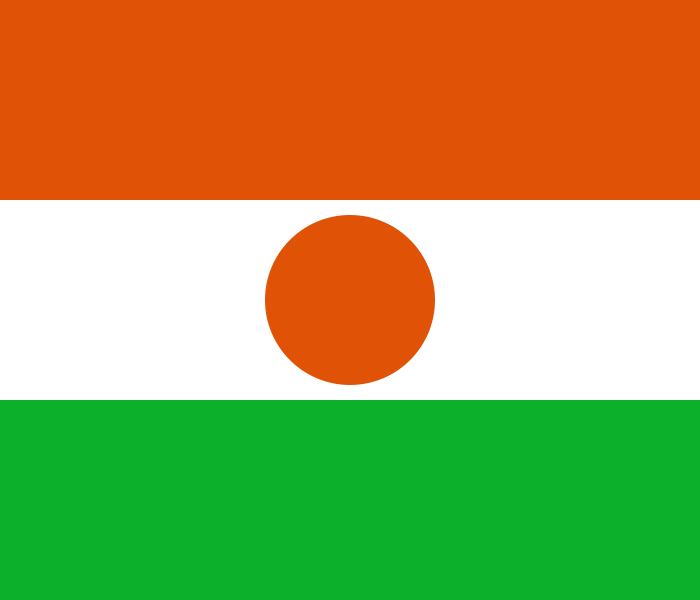
Geography
Climate: desert.
CIA 2026
Loading TerraBrawl
Data as of May 28, 2026
The numbers tell two very different stories about Niger. Think you can explain the gap?
The numbers tell two very different stories about Niger. #1 in fertility rate but near the bottom in life expectancy. Think you can explain the gap?
Area
1.3M km²
Pop.
27.32M
Stats
120
Niger is a country in Africa with a population of 27.32M and an area of 1,267,000 km². Life expectancy is 61.2 years.
Short factual summary generated from the same country data used in game rounds.
Core numbers
Fast scan first, deep dive later.
Land Area
1.27M km²Total land area in square kilometers, excluding lakes, rivers, and territorial waters.
Population Density
20.65 /km²How many people live in each square kilometer of land.
Internet Users (%)
23%The percentage of people who have used the internet in the last 3 months.
GDP Per Capita
$1,772.72GDP per person adjusted for purchasing power in constant 2017 international dollars, from Our World in Data using the latest available country values in TerraBrawl.
Life Expectancy
61.2 yearsAverage number of years a newborn would be expected to live if current mortality patterns stayed the same, from Our World in Data.
Country briefing
A quick real-world briefing before you dive deeper into rankings, surprises, and matchups.
Geography
Climate: desert.
Culture
Major languages include Hausa, Zarma, French (official), Fufulde, and more.
Identity
Formal name: Republic of Niger.
Cities
Browse this country's cities before City Detective asks you to guess.
Top stats
The strongest source-backed stats before the deeper data table.
Child Mortality
114.8 per 1k birthsDeaths before age 5 per 1,000 live births, from World Bank Open Data.
Birth Rate
46.29 per 1kThe number of babies born per 1,000 people each year.
Fertility Rate
6.5 children/womanThe average number of children a woman would have over her lifetime based on current birth rates.
Air Pollution (PM2.5)
85.12 µg/m³The average level of fine particle air pollution (PM2.5) that people are exposed to.
Reality checks
The stats that tend to surprise players in real rounds.
Ranks #2 globally in youth population (%)
The percentage of the population aged 0 to 14.
Only ranks #214 in broadband access (%)
Fixed broadband subscriptions per 100 people, from World Bank Open Data.
Only ranks #201 in doctors (per 1,000)
The number of doctors per 1,000 people.
Keeps youth unemployment rate unusually low
Share of the labor force ages 15-24 that is unemployed from the World Bank latest available country value.
Has one of the highest infant mortality figures
Infant deaths before age 1 per 1,000 live births, from World Bank Open Data.
Compared with the region
Country vs continent vs world averages
GDP per person, adjusted for purchasing power parity (PPP) so costs of living are comparable across countries.
How many years a newborn can expect to live, based on current mortality rates.
Composite 0-1 index of life expectancy, education, and income, from Our World in Data using the latest available country values in TerraBrawl.
The percentage of people who have used the internet in the last 3 months.
Think you can guess which countries rank higher?
Play this countryFactbook notes
Country briefing
Nomadic peoples from the Saharan north and agriculturalists from the south settled present-day Niger.
Nomadic peoples from the Saharan north and agriculturalists from the south settled present-day Niger. The Taureg kingdom of Takedda was one of the largest kingdoms in the north and played a prominent role in regional trade in the 14th century. In the south, the primary ethnic groups were the Songhai-Zarma in the west, the Hausa in the center, and the Kanuri in the east. When European colonizers arrived in the 19th century, the region was an assemblage of disparate local kingdoms.
In the late 19th century, the British and French agreed to partition the middle regions of the Niger River, and France began its conquest of what would become the colony of Niger. France experienced determined local resistance -- particularly during the Tuareg uprising (1916-1917) -- but established a colonial administration in 1922.
After achieving independence from France in 1960, Niger experienced single-party or military rule until 1991, when political pressure forced General Ali SAIBOU to allow multiparty elections. Political infighting and democratic backsliding led to coups in 1996 and 1999. In 1999, military officers restored democratic rule and held elections that brought Mamadou TANDJA to power. TANDJA was reelected in 2004 and spearheaded a 2009 constitutional amendment allowing him to extend his presidential term. In 2010, military officers led another coup that deposed TANDJA. ISSOUFOU Mahamadou was elected in 2011 and reelected in 2016. In 2021, BAZOUM Mohamed won the presidential election, marking Niger’s first transition from one democratically elected president to another. Nonetheless, a military junta led by General Abdourahamane TIANI once again seized power in July 2023, detaining President BAZOUM and announcing the creation of a National Council for the Safeguarding of the Homeland (CNSP).
Niger is one of the poorest countries in the world with minimal government services and insufficient funds to develop its resource base. It is ranked fourth to last in the world on the UN Development Program's Human Development Index of 2023/2024. The largely agrarian and subsistence-based economy is frequently disrupted by extended droughts common to the Sahel region of Africa. The Nigerien Government continues its attempts to diversify the economy through increased oil production and mining projects. In addition, Niger is facing increased security concerns on its borders from various external threats including insecurity in Libya, spillover from the conflict and terrorism in Mali, and violent extremism in northeastern Nigeria.
Data vault
Every tracked stat, grouped for fast scanning.
Keep exploring
Open the head-to-head pages people naturally search after reading this profile.
Jump straight to the rankings where this country has its strongest edge.
Turn Niger's strongest number into a challenge card.
Total land area in square kilometers, excluding lakes, rivers, and territorial waters.
Niger has a population of 27.32M, ranking #55 globally by population.
Niger is located in Africa. It has an area of 1,267,000 km².
Life expectancy in Niger is 61.2 years, ranking #205 globally.
Niger's GDP per capita (PPP) is $2,049.93, ranking #190 globally.
Niger ranks particularly high in Land Area (#20), Population (#55), Population Density (#182).
Niger has an HDI of 0.419, ranking #189 globally. The HDI combines life expectancy, education, and income indicators.
Niger has a population density of 20.7 people per km², ranking #182 globally.