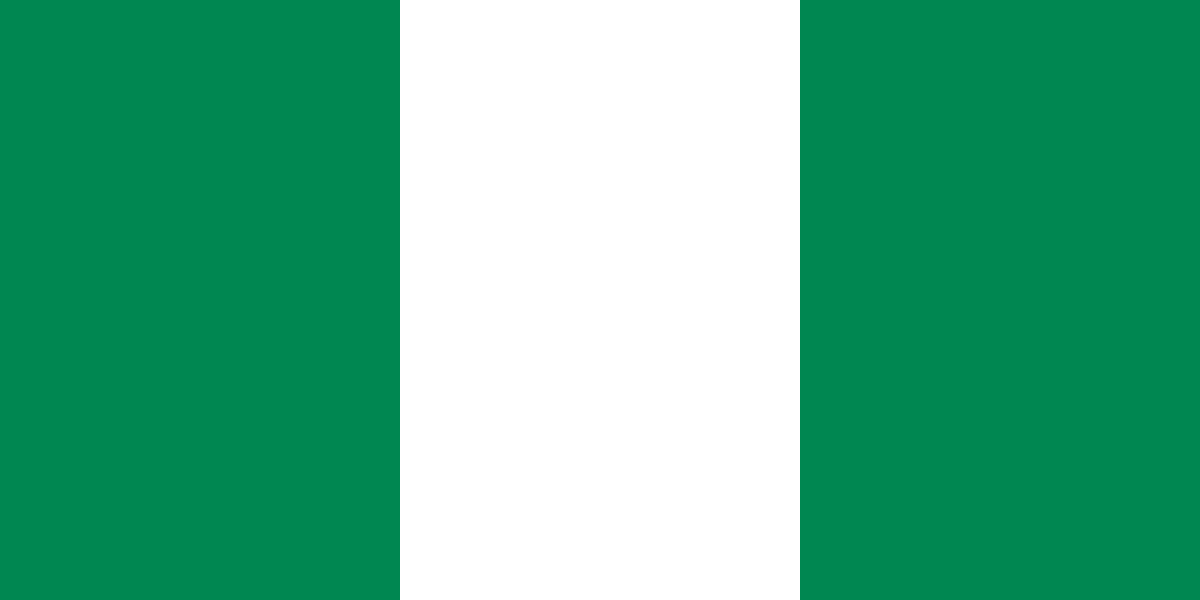
Culture
Major languages include English (official), Hausa, Yoruba, Igbo (Ibo), and more.
CIA 2026
Loading TerraBrawl
Data as of May 28, 2026
Nigeria ranks #6 globally in population. Think you know what else Nigeria excels at?
Nigeria ranks #6 globally in population. At 244.3 million, it outperforms most of the world. Think you know what else Nigeria excels at?
Area
924K km²
Pop.
244.34M
Stats
124
Nigeria is a country in Africa with a population of 244.34M and an area of 923,768 km². Life expectancy is 54.5 years.
Short factual summary generated from the same country data used in game rounds.
Core numbers
Fast scan first, deep dive later.
Land Area
910.8K km²Total land area in square kilometers, excluding lakes, rivers, and territorial waters.
Population Density
250.21 /km²How many people live in each square kilometer of land.
GDP Per Capita (PPP)
$9,086.88GDP per person, adjusted for purchasing power parity (PPP) so costs of living are comparable across countries.
GDP Per Capita
$5,665.45GDP per person adjusted for purchasing power in constant 2017 international dollars, from Our World in Data using the latest available country values in TerraBrawl.
CO2 Per Capita
0.58 t/person/yrAnnual carbon dioxide emissions in tonnes per person, from Our World in Data using the latest available country values in TerraBrawl.
Country briefing
A quick real-world briefing before you dive deeper into rankings, surprises, and matchups.
Culture
Major languages include English (official), Hausa, Yoruba, Igbo (Ibo), and more.
Identity
Formal name: Federal Republic of Nigeria.
Curated stat
Nigeria is projected to overtake the U.S. in population around 2050.
Cities
Browse this country's cities before City Detective asks you to guess.
Port Harcourt
Rivers State, Nigeria
Lagos
Nigeria
Kano
Kano State, Nigeria
Suleja
Niger State, Nigeria
Ibadan
Oyo State, Nigeria
Kaduna
Kaduna State, Nigeria
Benin City
Edo State, Nigeria
Maiduguri
Borno State, Nigeria
Top stats
The strongest source-backed stats before the deeper data table.
Child Mortality
104.9 per 1k birthsDeaths before age 5 per 1,000 live births, from World Bank Open Data.
Infant Mortality
60.1 per 1k birthsInfant deaths before age 1 per 1,000 live births, from World Bank Open Data.
Air Pollution (PM2.5)
56.53 µg/m³The average level of fine particle air pollution (PM2.5) that people are exposed to.
Inflation Rate
33.2%How much prices increased over the year, based on the cost of everyday goods and services.
Fertility Rate
4.6 children/womanThe average number of children a woman would have over her lifetime based on current birth rates.
Reality checks
The stats that tend to surprise players in real rounds.
Only ranks #215 in life expectancy
How many years a newborn can expect to live, based on current mortality rates.
Only ranks #183 in education spending (% gdp)
Government education spending as a share of GDP, from World Bank Open Data.
Only ranks #183 in women in parliament (%)
The percentage of parliament seats held by women.
Ranks #16 globally in renewable energy (%)
The percentage of energy consumption that comes from renewable sources like solar, wind, and hydro.
Ranks #16 globally in birth rate
The number of babies born per 1,000 people each year.
Compared with the region
Country vs continent vs world averages
GDP per person, adjusted for purchasing power parity (PPP) so costs of living are comparable across countries.
How many years a newborn can expect to live, based on current mortality rates.
Composite 0-1 index of life expectancy, education, and income, from Our World in Data using the latest available country values in TerraBrawl.
The percentage of people who have used the internet in the last 3 months.
Think you can guess which countries rank higher?
Play this countryFactbook notes
Country briefing
In ancient and pre-colonial times, the area of present-day Nigeria was occupied by a variety of ethnic groups with different languages and traditions.
In ancient and pre-colonial times, the area of present-day Nigeria was occupied by a variety of ethnic groups with different languages and traditions. These included large Islamic kingdoms such as Borno, Kano, and the Sokoto Caliphate dominating the north, the Benin and Oyo Empires that controlled much of modern western Nigeria, and more decentralized political entities and city states in the south and southeast. In 1914, the British amalgamated their separately administered northern and southern territories into a Colony and Protectorate of Nigeria.
Nigeria achieved independence from Britain in 1960 and transitioned to a federal republic with three constituent states in 1963 under President Nnamdi AZIKIWE. This structure served to enflame regional and ethnic tension, contributing to a bloody coup led by predominately southeastern military officers in 1966 and a countercoup later that year masterminded by northern officers. In the aftermath of this tension, the governor of Nigeria’s Eastern Region, centered on the southeast, declared the region independent as the Republic of Biafra. The ensuring civil war (1967-1970), resulted in more than a million deaths, many from starvation. While the war forged a stronger Nigerian state and national identity, it contributed to long-lasting mistrust of the southeast’s predominantly Igbo population. Wartime military leader Yakubu GOWON ruled until a bloodless coup by frustrated junior officers in 1975. This generation of officers, including Olusegun OBASANJO, Ibrahim BABANGIDA, and Muhammadu BUHARI, who would all later serve as president, continue to exert significant influence in Nigeria to the present day.
Military rule predominated until the first durable transition to civilian government and adoption of a new constitution in 1999. The elections of 2007 marked the first civilian-to-civilian transfer of power in the country's history. National and state elections in 2011 and 2015 were generally regarded as credible. The 2015 election was also heralded for the fact that the then-umbrella opposition party, the All Progressives Congress, defeated the long-ruling (since 1999) People's Democratic Party and assumed the presidency, marking the first peaceful transfer of power from one party to another. Presidential and legislative elections in 2019 and 2023 were deemed broadly free and fair despite voting irregularities, intimidation, and violence. The government of Africa's most populous nation continues to face the daunting task of institutionalizing democracy and reforming a petroleum-based economy whose revenues have been squandered through decades of corruption and mismanagement. In addition, Nigeria faces increasing violence from Islamic terrorism, largely in the northeast, large scale criminal banditry, secessionist violence in the southeast, and competition over land and resources nationwide.
Data vault
Every tracked stat, grouped for fast scanning.
Keep exploring
Open the head-to-head pages people naturally search after reading this profile.
Jump straight to the rankings where this country has its strongest edge.
Turn Nigeria's strongest number into a challenge card.
The total number of people living in the country.
Nigeria has a population of 244.34M, ranking #6 globally by population.
Nigeria is located in Africa. It has an area of 923,768 km².
Life expectancy in Nigeria is 54.5 years, ranking #215 globally.
Nigeria's GDP per capita (PPP) is $9,086.88, ranking #140 globally.
Nigeria ranks particularly high in Population (#6), Land Area (#30), Population Density (#52).
Nigeria has an HDI of 0.560, ranking #164 globally. The HDI combines life expectancy, education, and income indicators.
Nigeria has a population density of 250.2 people per km², ranking #52 globally.