Geography
Size snapshot: slightly larger than Pennsylvania.
CIA 2026
Loading TerraBrawl
Data as of May 28, 2026
Across North America, Nicaragua stands first in renewable energy. Explore what drives its regional success.
Across North America, Nicaragua stands first in renewable energy. Few in the region come close to matching it. Explore what drives its regional success.
Area
130K km²
Pop.
6.74M
Stats
115
Nicaragua is a country in North America with a population of 6.74M and an area of 130,373 km². Life expectancy is 74.9 years.
Short factual summary generated from the same country data used in game rounds.
Core numbers
Fast scan first, deep dive later.
Land Area
120.3K km²Total land area in square kilometers, excluding lakes, rivers, and territorial waters.
Life Expectancy
74.9 yearsHow many years a newborn can expect to live, based on current mortality rates.
Human Development Index
0.71Composite 0-1 index of life expectancy, education, and income, from Our World in Data using the latest available country values in TerraBrawl.
University Enrollment Rate
30.36%Total university and college enrollment as a percentage of the typical college-age population.
Country briefing
A quick real-world briefing before you dive deeper into rankings, surprises, and matchups.
Geography
Size snapshot: slightly larger than Pennsylvania.
Culture
Major languages include Spanish (official) 99.5%, Indigenous 0.3%, Portuguese 0.1%, other 0.1% (2020 est.).
Identity
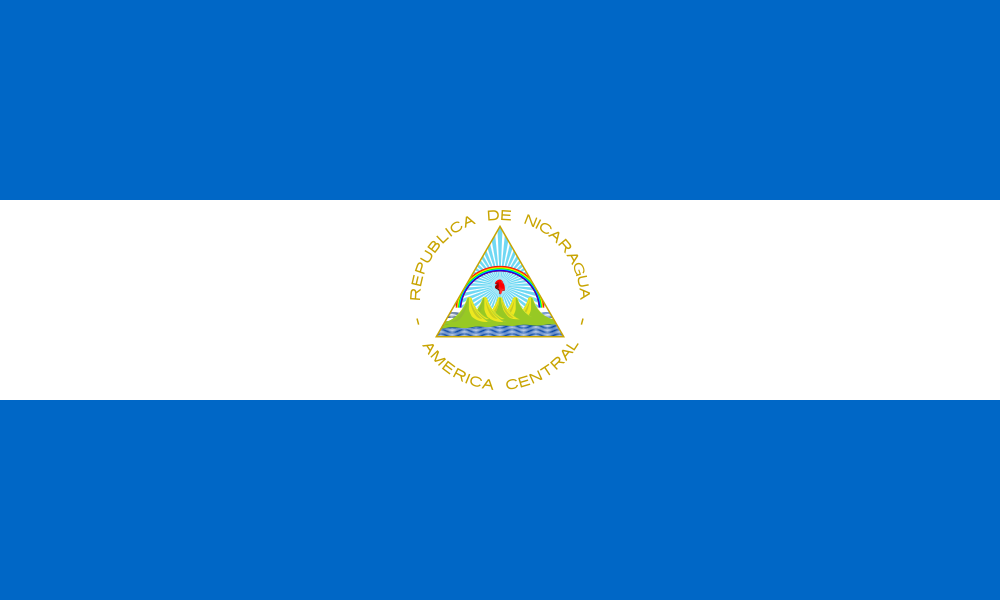
Formal name: Republic of Nicaragua.
Cities
Browse this country's cities before City Detective asks you to guess.
Managua
Managua Department, Nicaragua
León
Leon Department, Nicaragua
Chinandega
Chinandega Department, Nicaragua
Granada
Granada Department, Nicaragua
Matagalpa
Matagalpa Department, Nicaragua
Masaya
Masaya Department, Nicaragua
Top stats
The strongest source-backed stats before the deeper data table.
Women in Parliament (%)
53.85%The percentage of parliament seats held by women.
Teen Birth Rate
93.45 per 1kThe number of births per 1,000 women aged 15-19.
FDI Inflows (% GDP)
6.9% of GDPForeign direct investment net inflows as a share of GDP, from World Bank Open Data.
Renewable Energy (%)
50.4%The percentage of energy consumption that comes from renewable sources like solar, wind, and hydro.
Health Spending (% GDP)
9.0% of GDPCurrent health expenditure as a share of GDP, from World Bank Open Data.
Reality checks
The stats that tend to surprise players in real rounds.
Only ranks #146 in military spending
Military expenditure as a share of GDP, from World Bank Open Data.
Only ranks #152 in high-tech exports (%)
High-tech products (like computers, pharmaceuticals, and aerospace) as a percentage of total manufactured exports.
Only ranks #168 in merchant fleet size
Number of merchant marine ships from the frozen public-domain CIA World Factbook snapshot.
Only ranks #134 in hospital beds (per 1,000)
The number of hospital beds available per 1,000 people.
Compared with the region
Country vs continent vs world averages
GDP per person, adjusted for purchasing power parity (PPP) so costs of living are comparable across countries.
How many years a newborn can expect to live, based on current mortality rates.
Composite 0-1 index of life expectancy, education, and income, from Our World in Data using the latest available country values in TerraBrawl.
The percentage of people who have used the internet in the last 3 months.
Think you can guess which countries rank higher?
Play this countryFactbook notes
Country briefing
The Pacific coast of Nicaragua was settled as a Spanish colony in the early 16th century.
The Pacific coast of Nicaragua was settled as a Spanish colony in the early 16th century. Independence from Spain was declared in 1821, and the country became an independent republic in 1838. Britain occupied the Caribbean Coast in the first half of the 19th century, but gradually ceded control of the region in subsequent decades. By 1978, violent opposition to governmental manipulation and corruption resulted in a short-lived civil war that brought a civil-military coalition to power in 1979, spearheaded by Marxist Sandinista guerrillas led by Daniel ORTEGA Saavedra. Nicaraguan aid to leftist rebels in El Salvador prompted the US to sponsor anti-Sandinista Contra guerrillas through much of the 1980s.
After losing free and fair elections in 1990, 1996, and 2001, ORTEGA was elected president in 2006, 2011, 2016, and most recently in 2021. Municipal, regional, and national-level elections since 2008 have been marred by widespread irregularities. Democratic institutions have lost their independence under the ORTEGA regime as the president has assumed full control over all branches of government, as well as cracking down on a nationwide pro-democracy protest movement in 2018 and shuttering over 3,300 civil society organizations between 2018 and 2024. In the lead-up to the 2021 presidential election, authorities arrested over 40 individuals linked to the opposition, including presidential candidates, private sector leaders, NGO workers, human rights defenders, and journalists. Only five lesser-known presidential candidates from mostly small parties allied to ORTEGA's Sandinistas were allowed to run against ORTEGA. He then awarded the Sandinistas control of all 153 of Nicaraguan municipalities in the 2022 municipal elections, consolidating one-party rule.
Data vault
Every tracked stat, grouped for fast scanning.
Keep exploring
Open the head-to-head pages people naturally search after reading this profile.
Jump straight to the rankings where this country has its strongest edge.
Turn Nicaragua's strongest number into a challenge card.
The total number of people living in the country.
Nicaragua has a population of 6.74M, ranking #107 globally by population.
Nicaragua is located in North America. It has an area of 130,373 km².
Life expectancy in Nicaragua is 74.9 years, ranking #104 globally.
Nicaragua's GDP per capita (PPP) is $8,708.8, ranking #142 globally.
Nicaragua ranks particularly high in Population (#107), Land Area (#99), Life Expectancy (#104).
Nicaragua has an HDI of 0.706, ranking #123 globally. The HDI combines life expectancy, education, and income indicators.
Nicaragua has a population density of 56.7 people per km², ranking #147 globally.