Culture
Major languages include Asante 16%, Ewe 14%, Fante 11.6%, Boron (Brong) 4.9%, and more.
CIA 2026
Loading TerraBrawl
Data as of May 28, 2026
Ghana is an unsung leader in findex mobile money. Think you know this overlooked gem?
Ghana is an unsung leader in findex mobile money. Ranking #2 with 78.3, it's an overlooked achiever. Think you know this overlooked gem?
Area
239K km²
Pop.
35.34M
Stats
127
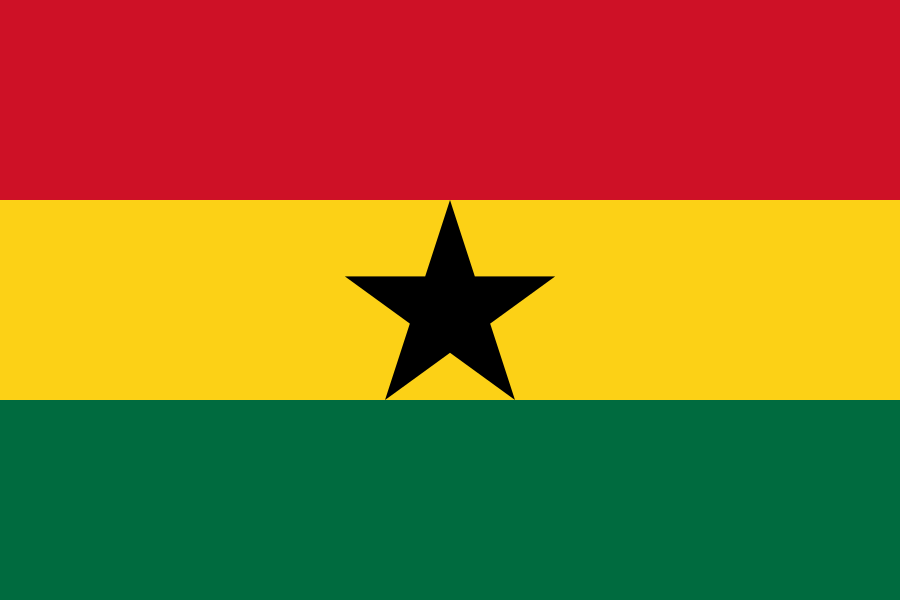
Ghana is a country in Africa with a population of 35.34M and an area of 238,533 km². Life expectancy is 65.5 years.
Short factual summary generated from the same country data used in game rounds.
Core numbers
Fast scan first, deep dive later.
Population Density
148.5 /km²How many people live in each square kilometer of land.
Land Area
227.5K km²Total land area in square kilometers, excluding lakes, rivers, and territorial waters.
Internet Users (%)
70%The percentage of people who have used the internet in the last 3 months.
GDP Per Capita
$7,061.93GDP per person adjusted for purchasing power in constant 2017 international dollars, from Our World in Data using the latest available country values in TerraBrawl.
GDP Per Capita (PPP)
$8,020GDP per person, adjusted for purchasing power parity (PPP) so costs of living are comparable across countries.
Country briefing
A quick real-world briefing before you dive deeper into rankings, surprises, and matchups.
Culture
Major languages include Asante 16%, Ewe 14%, Fante 11.6%, Boron (Brong) 4.9%, and more.
Identity
Formal name: Republic of Ghana.
Curated stat
Ghana is one of the African countries crossed by the historic Greenwich Meridian.
Cities
Browse this country's cities before City Detective asks you to guess.
Accra
Greater Accra, Ghana
Kumasi
Ashanti, Ghana
Sekondi-Takoradi
Western, Ghana
Tamale
Northern, Ghana
Cape Coast
Central, Ghana
Wa
Upper West, Ghana
Top stats
The strongest source-backed stats before the deeper data table.
Air Pollution (PM2.5)
54.24 µg/m³The average level of fine particle air pollution (PM2.5) that people are exposed to.
Inflation Rate
22.8%How much prices increased over the year, based on the cost of everyday goods and services.
Fertility Rate
3.5 children/womanThe average number of children a woman would have over her lifetime based on current birth rates.
Child Mortality
37.1 per 1k birthsDeaths before age 5 per 1,000 live births, from World Bank Open Data.
Reality checks
The stats that tend to surprise players in real rounds.
Only ranks #163 in smoking rate
The percentage of people aged 15 and older who use tobacco products.
Only ranks #151 in military spending
Military expenditure as a share of GDP, from World Bank Open Data.
Only ranks #205 in broadband access (%)
Fixed broadband subscriptions per 100 people, from World Bank Open Data.
Only ranks #137 in hospital beds (per 1,000)
The number of hospital beds available per 1,000 people.
Only ranks #207 in life expectancy
Average number of years a newborn would be expected to live if current mortality patterns stayed the same, from Our World in Data.
Compared with the region
Country vs continent vs world averages
GDP per person, adjusted for purchasing power parity (PPP) so costs of living are comparable across countries.
How many years a newborn can expect to live, based on current mortality rates.
Composite 0-1 index of life expectancy, education, and income, from Our World in Data using the latest available country values in TerraBrawl.
The percentage of people who have used the internet in the last 3 months.
Think you can guess which countries rank higher?
Play this countryFactbook notes
Country briefing
Ghana is a multiethnic country rich in natural resources and is one of the most stable and democratic countries in West Africa.
Ghana is a multiethnic country rich in natural resources and is one of the most stable and democratic countries in West Africa. Ghana has been inhabited for at least several thousand years, but little is known about its early inhabitants. By the 12th century, the gold trade started to boom in Bono (Bonoman) state in what is today southern Ghana, and it became the genesis of the Akan people's power and wealth in the region. Beginning in the 15th century, the Portuguese, followed by other European powers, arrived and competed for trading rights. Numerous kingdoms and empires emerged in the area, among the most powerful were the Kingdom of Dagbon in the north and the Asante (Ashanti) Empire in the south. By the mid-18th century, Asante was a highly organized state with immense wealth; it provided enslaved people for the Atlantic slave trade, and in return received firearms that facilitated its territorial expansion. The Asante resisted increasing British influence in the coastal areas, engaging in a series of wars during the 19th century before ultimately falling under British control. Formed from the merger of the British colony of the Gold Coast and the Togoland trust territory, Ghana in 1957 became the first Sub-Saharan country in colonial Africa to gain its independence, with Kwame NKRUMAH as its first leader.
Ghana endured a series of coups before Lt. Jerry RAWLINGS took power in 1981 and banned political parties. After approving a new constitution and restoring multiparty politics in 1992, RAWLINGS won presidential elections in 1992 and 1996 but was constitutionally prevented from running for a third term in 2000. John KUFUOR of the opposition New Patriotic Party (NPP) succeeded him and was reelected in 2004. John Atta MILLS of the National Democratic Congress won the 2008 presidential election and took over as head of state. MILLS died in 2012 and was constitutionally succeeded by his vice president, John Dramani MAHAMA, who subsequently won the 2012 presidential election. In 2016, Nana Addo Dankwa AKUFO-ADDO of the NPP defeated MAHAMA, marking the third time that Ghana’s presidency had changed parties since the return to democracy. AKUFO-ADDO was reelected in 2020. In recent years, Ghana has taken an active role in promoting regional stability and is highly integrated in international affairs.
Data vault
Every tracked stat, grouped for fast scanning.
Keep exploring
Open the head-to-head pages people naturally search after reading this profile.
Jump straight to the rankings where this country has its strongest edge.
Turn Ghana's strongest number into a challenge card.
The total number of people living in the country.
Ghana has a population of 35.34M, ranking #44 globally by population.
Ghana is located in Africa. It has an area of 238,533 km².
Life expectancy in Ghana is 65.5 years, ranking #186 globally.
Ghana's GDP per capita (PPP) is $8,020, ranking #144 globally.
Ghana ranks particularly high in Population (#44), Population Density (#76), Land Area (#82).
Ghana has an HDI of 0.628, ranking #143 globally. The HDI combines life expectancy, education, and income indicators.
Ghana has a population density of 148.5 people per km², ranking #76 globally.