Geography
Size snapshot: slightly smaller than New Jersey.
CIA 2026
Loading TerraBrawl
Data as of May 28, 2026
Under the radar, Djibouti shines in sl uem 1524 zs. What else is Djibouti quietly winning at?
Under the radar, Djibouti shines in sl uem 1524 zs. Ranking #1 with 76.8%, it's an overlooked achiever. What else is Djibouti quietly winning at?
Area
23K km²
Pop.
1.01M
Stats
106
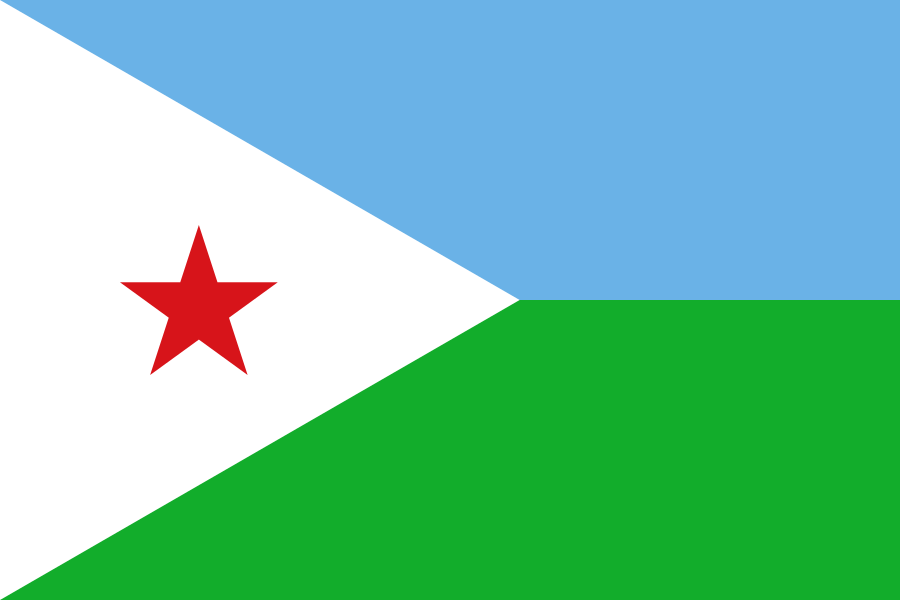
Djibouti is a country in Africa with a population of 1.01M and an area of 23,200 km². Life expectancy is 66.0 years.
Short factual summary generated from the same country data used in game rounds.
Core numbers
Fast scan first, deep dive later.
Internet Users (%)
65%The percentage of people who have used the internet in the last 3 months.
Land Area
23.2K km²Total land area in square kilometers, excluding lakes, rivers, and territorial waters.
Population Density
49.74 /km²How many people live in each square kilometer of land.
GDP Per Capita
$6,841.17GDP per person adjusted for purchasing power in constant 2017 international dollars, from Our World in Data using the latest available country values in TerraBrawl.
GDP Per Capita (PPP)
$7,810.28GDP per person, adjusted for purchasing power parity (PPP) so costs of living are comparable across countries.
Country briefing
A quick real-world briefing before you dive deeper into rankings, surprises, and matchups.
Geography
Size snapshot: slightly smaller than New Jersey.
Culture
Major languages include French (official), Arabic (official), Somali, Afar.
Identity
Formal name: Republic of Djibouti.
Cities
Browse this country's cities before City Detective asks you to guess.
Top stats
The strongest source-backed stats before the deeper data table.
Youth Unemployment Rate
76.77% of youth labor forceShare of the labor force ages 15-24 that is unemployed from the World Bank latest available country value.
Unemployment Rate
25.88%The percentage of the workforce that is unemployed but actively looking for work.
Infant Mortality
44.4 per 1k birthsInfant deaths before age 1 per 1,000 live births, from World Bank Open Data.
Air Pollution (PM2.5)
35.92 µg/m³The average level of fine particle air pollution (PM2.5) that people are exposed to.
Reality checks
The stats that tend to surprise players in real rounds.
Only ranks #238 in lowest elevation
Lowest point elevation from CIA World Factbook.
Only ranks #187 in health spending (% gdp)
Current health expenditure as a share of GDP, from World Bank Open Data.
Only ranks #214 in mobile subscriptions (%)
Mobile cellular subscriptions per 100 people, from World Bank Open Data.
Only ranks #203 in forest coverage (%)
The percentage of land covered by forests - natural or planted trees at least 5 meters tall (excludes orchards and urban parks).
Only ranks #202 in protected land (%)
The percentage of land area designated as protected natural reserves or parks.
Compared with the region
Country vs continent vs world averages
GDP per person, adjusted for purchasing power parity (PPP) so costs of living are comparable across countries.
How many years a newborn can expect to live, based on current mortality rates.
Composite 0-1 index of life expectancy, education, and income, from Our World in Data using the latest available country values in TerraBrawl.
The percentage of people who have used the internet in the last 3 months.
Think you can guess which countries rank higher?
Play this countryFactbook notes
Country briefing
Present-day Djibouti was the site of the medieval Ifat and Adal Sultanates.
Present-day Djibouti was the site of the medieval Ifat and Adal Sultanates. In the late 19th century, the Afar sultans signed treaties with the French that allowed the latter to establish the colony of French Somaliland in 1862. The French signed additional treaties with the ethnic Somali in 1885.
Tension between the ethnic Afar and Somali populations increased over time, as the ethnic Somalis perceived that the French unfairly favored the Afar and gave them disproportionate influence in local governance. In 1958, the French held a referendum that provided residents of French Somaliland the option to either continue their association with France or to join neighboring Somalia as it established its independence. Ethnic Somali protested the vote, because French colonial leaders did not recognize many Somali as residents, which gave the Afar outsized influence in the decision to uphold ties with France. After a second referendum in 1967, the French changed the territory’s name to the French Territory of the Afars and the Issas, in part to underscore their relationship with the ethnic Afar and downplay the significance of the ethnic Somalis. A final referendum in 1977 established Djibouti as an independent nation and granted ethnic Somalis Djiboutian nationality, formally resetting the balance of power between the majority ethnic Somalis and minority ethnic Afar residents. Upon independence, the country was named after its capital city of Djibouti. Hassan Gouled APTIDON, an ethnic Somali leader, installed an authoritarian one-party state and served as president until 1999. Unrest between the Afar minority and Somali majority culminated in a civil war during the 1990s that ended in 2001 with a peace accord between Afar rebels and the Somali Issa-dominated government. In 1999, Djibouti's first multiparty presidential election resulted in the election of Ismail Omar GUELLEH as president; he was reelected to a second term in 2005 and extended his tenure in office via a constitutional amendment, which allowed him to serve his third and fourth terms, and to begin a fifth term in 2021.
Djibouti occupies a strategic geographic location at the intersection of the Red Sea and the Gulf of Aden. Its ports handle 95% of Ethiopia’s trade. Djibouti’s ports also service transshipments between Europe, the Middle East, and Asia. The government has longstanding ties to France, which maintains a military presence in the country, as do the US, Japan, Italy, Germany, Spain, and China.
Data vault
Every tracked stat, grouped for fast scanning.
Keep exploring
Open the head-to-head pages people naturally search after reading this profile.
Jump straight to the rankings where this country has its strongest edge.
Turn Djibouti's strongest number into a challenge card.
The percentage of people who have used the internet in the last 3 months.
Djibouti has a population of 1.01M, ranking #160 globally by population.
Djibouti is located in Africa. It has an area of 23,200 km².
Life expectancy in Djibouti is 66.0 years, ranking #183 globally.
Djibouti's GDP per capita (PPP) is $7,810.28, ranking #147 globally.
Djibouti ranks particularly high in Internet Users (%) (#153), Population (#160), Land Area (#147).
Djibouti has an HDI of 0.513, ranking #175 globally. The HDI combines life expectancy, education, and income indicators.
Djibouti has a population density of 49.7 people per km², ranking #152 globally.