Culture
Major languages include Somali (official), Arabic (official), Italian, English.
CIA 2026
Loading TerraBrawl
Data as of May 28, 2026
With a global ranking of #2, Somalia leads in renewable energy. Test your knowledge of this global leader.
With a global ranking of #2, Somalia leads in renewable energy. Few places match this level of performance. Test your knowledge of this global leader.
Area
638K km²
Pop.
20.32M
Stats
106
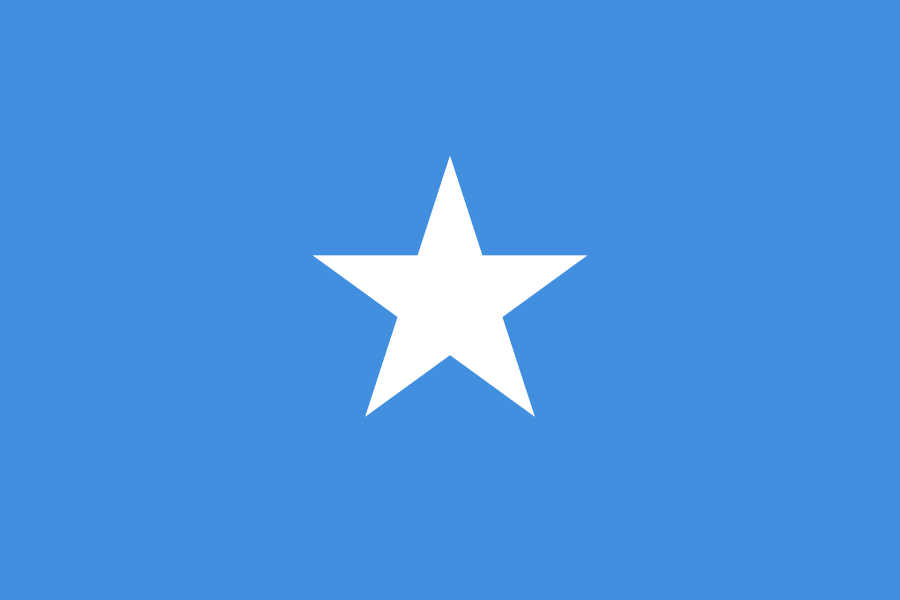
Somalia is a country in Africa with a population of 20.32M and an area of 637,657 km². Life expectancy is 58.8 years.
Short factual summary generated from the same country data used in game rounds.
Core numbers
Fast scan first, deep dive later.
Land Area
627.3K km²Total land area in square kilometers, excluding lakes, rivers, and territorial waters.
Population Density
29.26 /km²How many people live in each square kilometer of land.
Internet Users (%)
28%The percentage of people who have used the internet in the last 3 months.
Life Expectancy
58.8 yearsAverage number of years a newborn would be expected to live if current mortality patterns stayed the same, from Our World in Data.
Country briefing
A quick real-world briefing before you dive deeper into rankings, surprises, and matchups.
Culture
Major languages include Somali (official), Arabic (official), Italian, English.
Identity
Formal name: Federal Republic of Somalia.
Geography
Size snapshot: almost five times the size of Alabama.
Cities
Browse this country's cities before City Detective asks you to guess.
Mogadishu
Banaadir, Somalia
Kismayo
Lower Juba, Somalia
Baidoa
Bay, Somalia
Beledweyne
Hiiraan, Somalia
Marka
Lower Shabeelle, Somalia
Bosaso
Bari, Somalia
Top stats
The strongest source-backed stats before the deeper data table.
Renewable Energy (%)
95.4%The percentage of energy consumption that comes from renewable sources like solar, wind, and hydro.
Birth Rate
46.36 per 1kThe number of babies born per 1,000 people each year.
Fertility Rate
6.4 children/womanThe average number of children a woman would have over her lifetime based on current birth rates.
Child Mortality
104 per 1k birthsDeaths before age 5 per 1,000 live births, from World Bank Open Data.
Unemployment Rate
18.86%The percentage of the workforce that is unemployed but actively looking for work.
Reality checks
The stats that tend to surprise players in real rounds.
Only ranks #213 in protected land (%)
The percentage of land area designated as protected natural reserves or parks.
Only ranks #192 in human development index
Composite 0-1 index of life expectancy, education, and income, from Our World in Data using the latest available country values in TerraBrawl.
Only ranks #189 in beer consumption
Liters of beer consumed per person per year, from Our World in Data using the latest available country values in TerraBrawl.
Only ranks #188 in spirits consumption
Liters of spirits consumed per person per year, from Our World in Data using the latest available country values in TerraBrawl.
Ranks #4 globally in dependency ratio
Dependents as a share of the working-age population, from World Bank Open Data.
Compared with the region
Country vs continent vs world averages
GDP per person, adjusted for purchasing power parity (PPP) so costs of living are comparable across countries.
How many years a newborn can expect to live, based on current mortality rates.
Composite 0-1 index of life expectancy, education, and income, from Our World in Data using the latest available country values in TerraBrawl.
The percentage of people who have used the internet in the last 3 months.
Think you can guess which countries rank higher?
Play this countryFactbook notes
Country briefing
Between A.D.
Between A.D. 800 and 1100, immigrant Muslim Arabs and Persians set up coastal trading posts along the Gulf of Aden and the Indian Ocean, solidifying present-day Somalia’s close trading relationship with the Arab Peninsula. In the late 19th century, Britain, France, and Italy established colonies in the Somali Peninsula that lasted until 1960, when British Somaliland gained independence and joined with Italian Somaliland to form the Republic of Somalia.
The country functioned as a parliamentary democracy until 1969, when General Mohamed SIAD Barre took control in a coup, beginning a 22-year socialist dictatorship. In an effort to centralize power, SIAD called for the eradication of the clan, the key cultural and social organizing principle in Somali society. Resistance to SIAD’s socialist leadership, which was causing a rapid deterioration of the country, prompted allied clan militias to overthrow SIAD in 1991, resulting in state collapse. Subsequent fighting between rival clans for resources and territory overwhelmed the country, causing a manmade famine and prompting international intervention. Beginning in 1993, the UN spearheaded an international humanitarian mission, but the international community largely withdrew by 1995 after an incident that became known as Black Hawk Down, in which two US military helicopters were shot down in Mogadishu. The fighting and subsequent siege and rescue resulted in 21 deaths and 82 wounded among the international forces.
International peace conferences in the 2000s resulted in a number of transitional governments that operated outside Somalia. Left largely to themselves, Somalis in the country established alternative governance structures; some areas formed their own administrations, such as Somaliland and Puntland, while others developed localized institutions. Many local populations turned to sharia courts, an Islamic judicial system that implements religious law. Several of these courts came together in 2006 to form the Islamic Courts Union (ICU). The ICU established order in many areas of central and southern Somalia, including Mogadishu, but was forced out when Ethiopia intervened militarily in 2006 on behalf of the Somali Transitional Federal Government (TFG). As the TFG settled in the capital, the ICU fled to rural areas or left Somalia altogether, but the organization reemerged less than a year later as the Islamic insurgent and terrorist movement al-Shabaab, which is still active today.
In 2007, the African Union (AU) established a peacekeeping force, took over security responsibility for the country, and gave the TFG space to develop Somalia’s new government. By 2012, Somali powerbrokers agreed on a provisional constitution with a loose federal structure and established a central government in Mogadishu called the Somali Federal Government (SFG). Since then, the country has seen several interim regional administrations and three presidential elections, but significant governance and security problems remain because al-Shabaab still controls large portions of the country.
Data vault
Every tracked stat, grouped for fast scanning.
Keep exploring
Open the head-to-head pages people naturally search after reading this profile.
Jump straight to the rankings where this country has its strongest edge.
Turn Somalia's strongest number into a challenge card.
Total land area in square kilometers, excluding lakes, rivers, and territorial waters.
Somalia has a population of 20.32M, ranking #65 globally by population.
Somalia is located in Africa. It has an area of 637,657 km².
Life expectancy in Somalia is 58.8 years, ranking #210 globally.
Somalia's GDP per capita (PPP) is $1,601.96, ranking #196 globally.
Somalia ranks particularly high in Land Area (#42), Population (#65), Population Density (#171).
Somalia has an HDI of 0.404, ranking #192 globally. The HDI combines life expectancy, education, and income indicators.
Somalia has a population density of 29.3 people per km², ranking #171 globally.